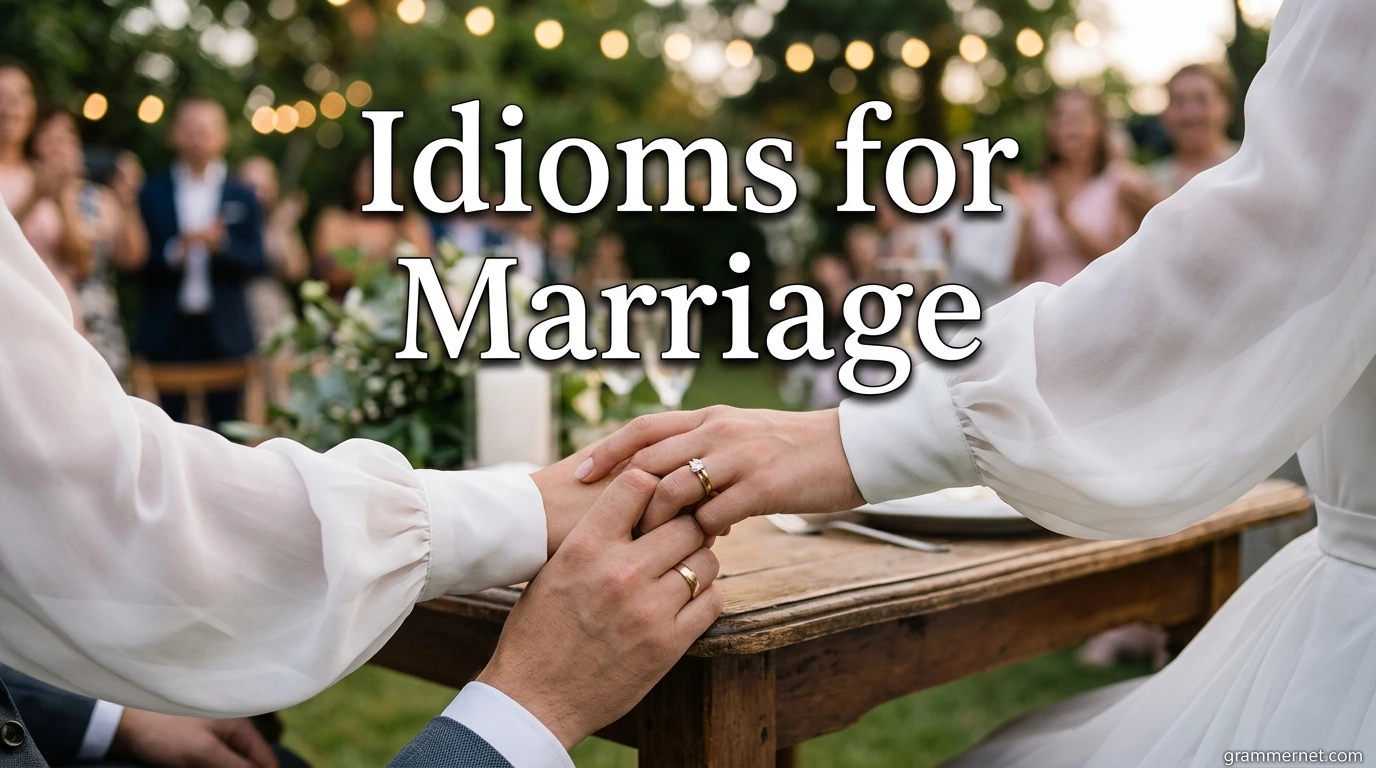
Marriage is one of the most important topics in everyday English, literature, movies, and conversations. People do not always speak about it in a direct way; instead, they often use colorful idioms for marriage to express love, commitment, celebration, and sometimes even challenges in married life.
Learning these idioms helps English learners understand native speakers more naturally, enjoy romantic stories more deeply, and talk about relationships with greater confidence.
It also gives students and professionals a richer vocabulary for speeches, essays, interviews, and real-life conversations. Whether you are discussing weddings, relationships, or married life, these expressions can make your English feel more fluent, natural, and emotionally expressive.
What Are Idioms for Marriage?
Idioms for marriage are figurative expressions connected to getting married, wedding ceremonies, relationships, and married life. These phrases often sound more natural than plain vocabulary and can carry humor, warmth, tradition, or even criticism.
For example, instead of saying “They got married,” native speakers might say “They tied the knot.” That small change makes the sentence feel more idiomatic and native-like.
Marriage idioms are especially useful because they appear in:
- daily conversation
- wedding speeches
- romantic movies
- books and novels
- newspapers and magazines
- casual social media posts
Why Learn Idioms for Marriage?
Learning idioms for marriage can help you:
- understand native English more easily
- speak more naturally in social situations
- describe weddings and relationships with style
- recognize humor, tradition, or emotional tone
- improve both speaking and writing skills
Marriage idioms are also culturally rich. Some are old-fashioned and poetic, while others are modern and casual. Knowing the difference helps you use them well and avoid awkward misunderstandings.
Common Idioms for Marriage
1. Tie the Knot
Meaning: To get married.
Example: “They tied the knot last summer in a beautiful beach wedding.”
Alternative expressions:
- get married
- become husband and wife
- say ‘I do’
Typical use cases: Wedding announcements, celebrations, casual conversation
Fun fact / origin: This idiom may come from ancient wedding rituals in which a knot symbolized the union of two people.
2. Get Hitched
Meaning: To get married.
Example: “My cousin is getting hitched in October.”
Alternative expressions:
- tie the knot
- marry
- wed
Typical use cases: Casual speech, friendly conversation, informal writing
Note: This is very informal and often used playfully.
3. Pop the Question
Meaning: To ask someone to marry you.
Example: “He popped the question during their vacation in Paris.”
Alternative expressions:
- propose
- ask for someone’s hand in marriage
Typical use cases: Engagement stories, romantic conversations, wedding news
Fun fact: The “question” refers to the marriage proposal.
4. Say “I Do”
Meaning: To officially agree to marry someone during a wedding ceremony.
Example: “They said ‘I do’ in front of all their friends and family.”
Alternative expressions:
- get married
- exchange vows
- marry each other
Typical use cases: Wedding ceremonies, romantic stories, speeches
5. Walk Down the Aisle
Meaning: To get married; also refers to the bride’s walk toward the altar.
Example: “She will walk down the aisle next Saturday.”
Alternative expressions:
- get married
- have a wedding ceremony
Typical use cases: Wedding planning, romantic descriptions, event announcements
Fun fact: The “aisle” is the walkway in a church or wedding venue.
6. Take the Plunge
Meaning: To make a major life decision, often marriage.
Example: “After dating for five years, they finally took the plunge.”
Alternative expressions:
- make a commitment
- go for it
- decide to marry
Typical use cases: Marriage decisions, career changes, life choices
Fun fact: This idiom originally means jumping into water, but figuratively it means taking a brave step.
7. Honeymoon Period
Meaning: A very happy and exciting early stage of marriage or a new relationship.
Example: “The first year of their marriage was the honeymoon period.”
Alternative expressions:
- early bliss
- happy beginning
- first stage of romance
Typical use cases: Marriage, relationships, business or friendship beginnings
Note: This idiom is also used outside marriage to describe the beginning of anything positive.
8. Wedded Bliss
Meaning: A very happy married life.
Example: “They enjoyed many years of wedded bliss.”
Alternative expressions:
- happy marriage
- marital happiness
- joyful married life
Typical use cases: Storytelling, compliments, romantic writing
Fun fact: “Wedded” is an old-fashioned word for “married,” which gives the phrase a romantic tone.
9. Ball and Chain
Meaning: A humorous or critical way to refer to a spouse, often implying that marriage feels restrictive.
Example: “He jokingly called his wife his ball and chain.”
Alternative expressions:
- spouse
- partner
- significant other
Typical use cases: Informal humor, joking conversation
Important note: This idiom can sound rude or outdated if used seriously.
10. Old Ball and Chain
Meaning: A humorous or sometimes negative term for one’s spouse, usually jokingly.
Example: “He said he had to go home to his old ball and chain.”
Alternative expressions:
- my spouse
- my wife/husband
- my partner
Warning: Use carefully. It can sound disrespectful or old-fashioned.
11. Make an Honest Woman/Man of Someone
Meaning: To marry someone, especially after a romantic or sexual relationship.
Example: “Back then, people would say he should make an honest woman of her.”
Alternative expressions:
- marry someone
- formalize the relationship
Fun fact: This is a very old-fashioned expression and is less common in modern polite speech.
Note: It may carry outdated cultural values, so use with caution.
12. Marry into a Family
Meaning: To become part of a family by marrying someone from that family.
Example: “She married into a well-known political family.”
Alternative expressions:
- become part of the family through marriage
- join the family by marriage
Typical use cases: Family background, social status, news stories
13. For Better or Worse
Meaning: In all situations, good or bad; often used in wedding vows.
Example: “They promised to stay together for better or worse.”
Alternative expressions:
- through good times and bad
- no matter what happens
- in all circumstances
Typical use cases: Wedding vows, relationship commitments, emotional writing
14. Put a Ring on It
Meaning: To make a relationship official by proposing marriage.
Example: “After years of dating, he finally put a ring on it.”
Alternative expressions:
- propose
- make it official
- get engaged
Fun fact: This phrase became widely popular in modern culture through music and pop culture references.
Typical use cases: Casual conversation, entertainment, social media
Idioms for Marriage by Context
Getting Married
- tie the knot
- get hitched
- say “I do”
- walk down the aisle
- take the plunge
Proposals and Engagement
- pop the question
- put a ring on it
Married Life
- honeymoon period
- wedded bliss
- for better or worse
Humor or Criticism
- ball and chain
- old ball and chain
Family and Social Status
- marry into a family
- make an honest woman/man of someone
How to Use Marriage Idioms Naturally
Marriage idioms are often emotional and context-sensitive. Some are sweet and romantic, while others are humorous, old-fashioned, or even rude. The key is choosing the right one for the right situation.
Helpful tips:
- Use tie the knot and say “I do” in neutral or positive situations.
- Use get hitched in casual, friendly conversation.
- Use ball and chain only if you are sure it will be understood as a joke.
- Use for better or worse in formal or emotional writing.
- Use honeymoon period when describing the beginning of a marriage or relationship.
Think about the tone before you speak. If the idiom sounds playful, keep it informal. If it sounds poetic, it may fit speeches or writing, If it sounds rude or old-fashioned, be extra careful.
Common Mistakes to Avoid
1. Using idioms literally
“Tie the knot” does not mean physically tying a rope.
2. Using outdated or offensive idioms carelessly
Expressions like ball and chain or make an honest woman of someone can sound rude or old-fashioned.
3. Mixing up proposal and marriage idioms
Pop the question means propose. Tie the knot means get married.
4. Overusing idioms
Too many idioms in one sentence can make your speech sound unnatural.
5. Ignoring region and culture
Some idioms are more common in British English, while others are more common in American English or older speech.
Fun Origins Behind Marriage Idioms
Tie the knot
Likely inspired by old wedding traditions involving knots or bindings symbolizing union.
Take the plunge
Came from the image of taking a brave leap into water, now used for big life decisions.
Honeymoon
Originally related to the first sweet month after marriage, with “honey” symbolizing sweetness and “moon” suggesting a cycle of time.
Ball and chain
This comes from the image of a prisoner’s heavy chain, later used jokingly for marriage. Because of this, it can be offensive if not used carefully.
Interactive Practice Section
Fill in the blanks (Easy)
- They will ______ the knot next spring.
- He finally ______ the question during dinner.
- Their first year was a lovely honeymoon ______.
Answers:
- tie
- popped
- period
Match the idiom to the meaning (Medium)
IdiomMeaningTie the knotA. To propose marriagePop the questionB, To get marriedPut a ring on itC, To make the relationship official
Answers:
- Tie the knot → B
- Pop the question → A
- Put a ring on it → C
Choose the best idiom (Advanced)
- “They officially agreed to marry each other during the ceremony.”
- “Their relationship was very happy and exciting at first.”
- “He proposed to her on the beach at sunset.”
Answers:
- Say “I do”
- Honeymoon period
- Pop the question
Quick Quiz
Question 1
Which idiom means “to get married”?
A. Pop the question B. Tie the knot C. Honeymoon period
Answer: B
Question 2
Which idiom means “to propose marriage”?
A. Pop the question B. Get hitched C. Say “I do”
Answer: A
Question 3
Which idiom means “happy early stage of marriage”?
A. Old ball and chain B. Wedded bliss C. Honeymoon period
Answer: C
Visual and Infographic Ideas
If you are creating a blog post, lesson plan, or study notes, these visuals can help:
- A tied ribbon or knot for tie the knot
- A ring box for pop the question and put a ring on it
- Wedding aisle illustration for walk down the aisle
- A calendar moon icon for honeymoon period
- A heart and lock for wedded bliss
A comparison chart could also show:
- romantic idioms
- humorous idioms
- formal idioms
- old-fashioned idioms
This helps learners understand tone and context quickly.
Why Idioms for Marriage Matter
Idioms for marriage appear in movies, songs, books, speeches, and everyday conversation. They help people talk about love, commitment, family, and married life in a way that feels natural and culturally rich. Knowing these idioms can improve your speaking, listening, and writing skills while also helping you understand English more deeply.
They are especially useful when describing:
- weddings
- proposals
- married life
- relationship stages
- family connections
FAQs
What are idioms for marriage?
They are expressions connected to weddings, proposals, married life, and relationships that have figurative meanings.
Why should English learners study marriage idioms?
They help you understand native speech, stories, and media more naturally and sound more fluent.
Which marriage idiom is most common?
Tie the knot and pop the question are among the most common.
Is “ball and chain” rude?
It can be rude or jokingly negative, so use it very carefully.
What does “honeymoon period” mean?
It means the early, very happy stage of a marriage or relationship.
Can I use these idioms in formal writing?
Some can be used in formal writing, but others are informal or old-fashioned. Choose carefully.
What is the difference between “pop the question” and “tie the knot”?
“Pop the question” means to propose marriage; “tie the knot” means to get married.
Conclusion
Idioms for marriage add warmth, emotion, humor, and cultural richness to English. From tie the knot and pop the question to honeymoon period and wedded bliss, these expressions help you describe relationships and weddings in a more natural and engaging way.
By learning the meanings, origins, and proper contexts of these idioms, you can speak more confidently and understand native speakers more easily. Practice them in conversation, writing, and listening exercises, and soon they will become a natural part of your English vocabulary.
