
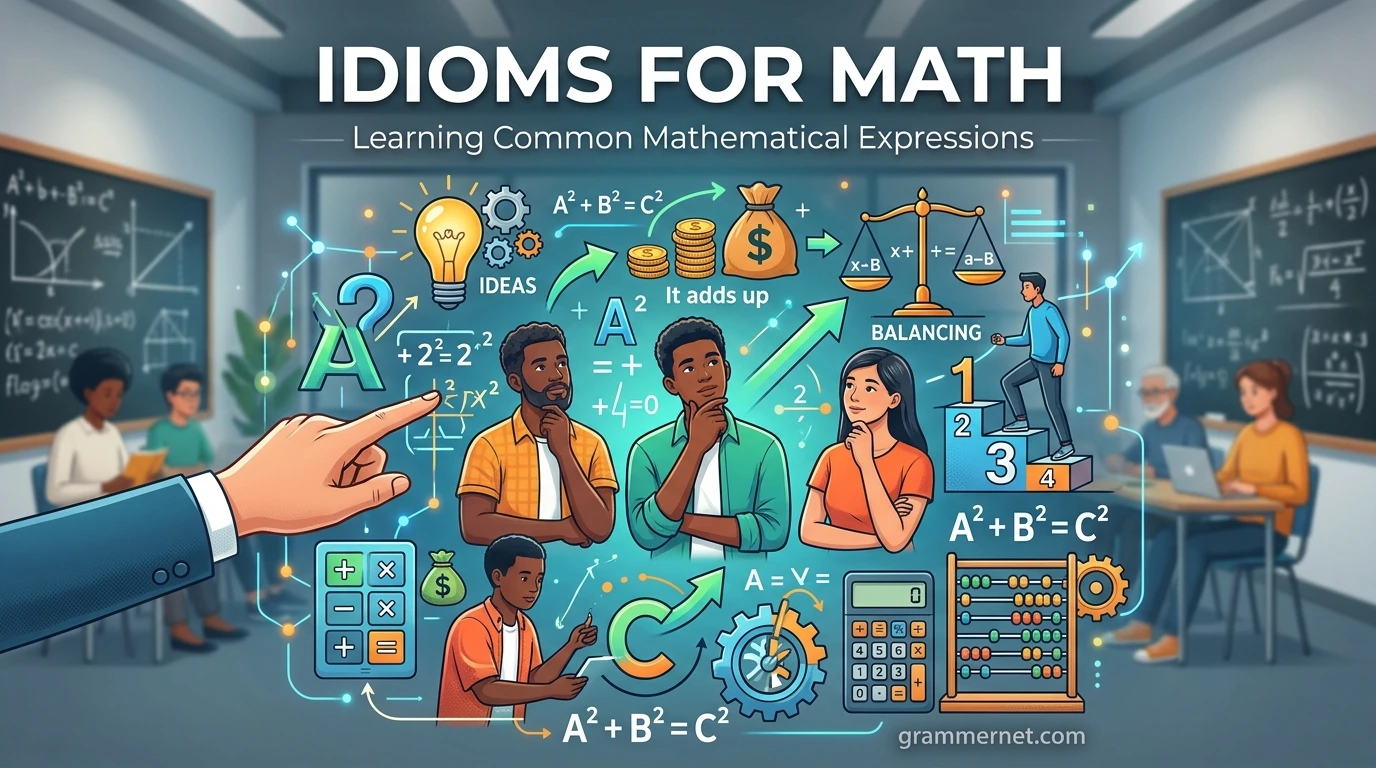
Idioms for math help English learners talk about numbers, logic, decisions, and problem-solving in a more natural way. These expressions are useful in school, work, finance, and daily life because people often use math-inspired language even when they are not talking about actual equations.
Learning idioms for math can improve your listening skills, make your speaking sound more fluent, and help you understand books, movies, and conversations better. They also give you a smart way to describe planning, balance, accuracy, and reasoning in real-life situations.
What Are Idioms for Math?
Idioms for math are expressions inspired by numbers, calculation, counting, balance, and logic. They are not always literal, so you should understand them through context instead of word-for-word translation.
For example, when someone says “do the math,” they do not always mean solving numbers on paper. They often mean thinking carefully before making a decision.
Math idioms are common in:
- school and academic English
- business and finance
- problem-solving conversations
- casual speech and writing
Common Idioms for Math (With Meaning, Examples, and Usage)
1. Do the Math
Meaning: Think carefully and calculate the facts before making a decision.
Example: “If you spend that much every day, do the math—you’ll be broke by the end of the month.”
Alternative Expressions:
- think it through
- calculate the facts
- figure it out logically
Typical Use Cases:
- financial decisions
- planning
- problem-solving
Fun Fact: This idiom often appears in advice, warnings, and discussions where logic matters.
2. Add Up
Meaning: To make sense, seem reasonable, or total correctly.
Example: “His story doesn’t add up.”
Alternative Expressions:
- make sense
- be logical
- seem correct
Typical Use Cases:
- checking facts
- investigating
- everyday conversation
Fun Fact: This comes directly from arithmetic, where numbers add to a correct total.
3. Put Two and Two Together
Meaning: To figure something out from the facts.
Example: “When I saw the empty room, I put two and two together and realized they had moved.”
Alternative Expressions:
- infer
- deduce
- understand the situation
Typical Use Cases:
- solving mysteries
- understanding clues
- casual reasoning
4. By the Numbers
Meaning: In a very controlled, exact, or structured way.
Example: “The project was handled by the numbers.”
Alternative Expressions:
- by a strict plan
- exactly
- methodically
Typical Use Cases:
- business
- sports
- organized work
Fun Fact: This idiom suggests doing something in a precise, step-by-step manner.
5. Six of One, Half a Dozen of the Other
Meaning: Two choices are essentially the same.
Example: “Whether we take the train or bus, it’s six of one, half a dozen of the other.”
Alternative Expressions:
- both are the same
- no real difference
- equally good or bad
Typical Use Cases:
- comparisons
- decision-making
- casual discussion
Fun Fact: A half dozen is six, so this idiom cleverly uses number repetition.
6. Zero In On
Meaning: To focus closely on one thing.
Example: “The teacher zeroed in on the main grammar mistake.”
Alternative Expressions:
- focus on
- concentrate on
- target
Typical Use Cases:
- learning
- analysis
- business strategy
Fun Fact: This phrase comes from aiming at a target and narrowing attention to one point.
7. In the Black
Meaning: Making money; financially successful.
Example: “The company is finally in the black this year.”
Alternative Expressions:
- profitable
- financially healthy
- earning money
Typical Use Cases:
- business
- finance
- accounting
Fun Fact: In accounting, black ink traditionally represented profit.
8. In the Red
Meaning: Losing money or in debt.
Example: “The store has been in the red for months.”
Alternative Expressions:
- losing money
- in debt
- financially struggling
Typical Use Cases:
- business reports
- budgeting
- financial discussions
Fun Fact: Red ink was used in bookkeeping to show losses.
9. Balance the Books
Meaning: To make income and spending equal, or to sort out finances.
Example: “At the end of the month, the accountant balances the books.”
Alternative Expressions:
- settle accounts
- reconcile finances
- review spending
Typical Use Cases:
- accounting
- budgeting
- company finance
10. Break Even
Meaning: To have no profit and no loss.
Example: “The business is not making money yet, but it can break even soon.”
Alternative Expressions:
- recover costs
- no profit, no loss
- come out equal
Typical Use Cases:
- business
- events
- investments
11. Count On Someone
Meaning: To depend on someone.
Example: “You can count on me to help.”
Alternative Expressions:
- rely on
- trust
- depend on
Typical Use Cases:
- friendship
- teamwork
- family support
Note: Even though this is not purely a math idiom, it uses counting language and is common in everyday English.
12. Count the Cost
Meaning: To consider the negative results or consequences before doing something.
Example: “Before moving abroad, you should count the cost.”
Alternative Expressions:
- think about the consequences
- weigh the risks
- consider the outcome
Typical Use Cases:
- planning
- decision-making
- serious discussions
13. A Numbers Game
Meaning: A situation where success depends mostly on quantity or statistics rather than quality.
Example: “In sales, it’s often a numbers game.”
Alternative Expressions:
- quantity matters
- statistical advantage
- volume-based success
Typical Use Cases:
- business
- marketing
- sports
- job hunting
Fun Fact: This phrase is often used when repeated effort increases the chance of success.
14. Back to Square One
Meaning: To start again from the beginning after failure.
Example: “Our plan failed, so we’re back to square one.”
Alternative Expressions:
- start over
- begin again
- return to the start
Typical Use Cases:
- projects
- problem-solving
- school assignments
Fun Fact: The phrase may come from early board games or radio sports commentaries where starting positions were marked by numbers.
15. Off by a Mile
Meaning: Completely wrong or far from correct.
Example: “Your guess was off by a mile.”
Alternative Expressions:
- way off
- very wrong
- far from accurate
Typical Use Cases:
- tests
- guesses
- decisions
Note: This is a vivid way to show a big mistake in judgment or calculation.
16. At Sixes and Sevens
Meaning: In a state of confusion or disorder.
Example: “After the move, the office was at sixes and sevens.”
Alternative Expressions:
- confused
- disorganized
- all mixed up
Fun Fact / Origin: The phrase likely comes from old games and trade terms involving numbers.
Idioms for Math by Context
Problem-Solving and Logic
- Do the math
- Add up
- Put two and two together
- Off by a mile
Money and Business
- In the black
- In the red
- Break even
- Balance the books
- A numbers game
Focus and Strategy
- Zero in on
- By the numbers
- Count the cost
Start Again or Compare
- Back to square one
- Six of one, half a dozen of the other
Tips for Using Idioms for Math Naturally
1. Match the setting
Use “in the black” in business contexts, but “do the math” in everyday conversation.
2. Learn the meaning behind the image
Math idioms are easier to remember when you picture the numbers or calculation behind them.
3. Use them in full sentences
It is easier to remember idioms when you use them in real examples, not just as a list.
4. Avoid overusing them
One or two idioms in a conversation sound natural. Too many can feel forced.
5. Practice with topics you know
Try writing examples about school, budgeting, sports, or work.
Common Mistakes to Avoid
1. Taking idioms literally
“Back to square one” does not mean drawing a square. It means starting over.
2. Using them in the wrong context
“In the black” is for financial profit, not for general happiness.
3. Confusing similar expressions
- Add up = make sense
- Do the math = think carefully and calculate They are related, but not identical.
4. Using idioms too formally
Some math idioms are better in speech than in academic writing.
5. Mixing idioms incorrectly
Avoid creating unnatural combinations like “do the books” when you mean “do the math.”
Fun Origins and Images Behind Math Idioms
Many math idioms come from real-life practices in business, accounting, and problem-solving.
- In the black / in the red comes from bookkeeping colors.
- Back to square one may come from game boards or radio sports maps.
- Put two and two together reflects logical reasoning from basic arithmetic.
- A numbers game comes from situations where statistics and volume matter.
These origins make the idioms easier to understand and remember.
Interactive Practice Section
Exercise 1: Fill in the Blanks (Easy)
- The story doesn’t ______ up.
- The company is finally in the ______ this year.
- We’re back to ______ one after the mistake.
Answers:
- add
- black
- square
Exercise 2: Match the Idiom to the Meaning (Medium)
IdiomMeaningZero in onA. Start againIn the redB. Focus closelyBack to square oneC. Losing money
Answers: Zero in on → B In the red → C Back to square one → A
Exercise 3: Choose the Best Idiom (Advanced)
- “The business is making a profit.”
- “We need to focus closely on the main problem.”
- “The plan failed, so we must begin again.”
Answers:
- In the black
- Zero in on
- Back to square one
Quick Quiz
Question 1
Which idiom means “to think carefully and calculate”?
A. Break even B. Do the math C. In the black
Answer: B
Question 2
Which idiom means “no profit and no loss”?
A. Break even B. Add up C. At sixes and sevens
Answer: A
Question 3
Which idiom means “things are disorganized or confused”?
A. By the numbers B. At sixes and sevens C. Count on
Answer: B
Suggested Visuals and Infographics
If you are creating study notes or classroom materials, visuals can make math idioms easier to remember:
- A calculator for do the math
- A balance scale for balance the books
- A red arrow downward for in the red
- A black arrow upward for in the black
- A target for zero in on
- A start line for back to square one
You can also make a simple chart grouping idioms into:
- money
- logic
- confusion
- focus
- recovery
Why Idioms for Math Matter
Idioms for math are useful because they appear in daily speech, education, business, and financial English. They help you express logic, balance, profit, and decision-making in a more natural and memorable way. Even if you are not discussing actual mathematics, these idioms often appear in conversations about problems, choices, and numbers.
Understanding them improves both fluency and comprehension, especially when English speakers use math as a metaphor for life, work, or money.
FAQs
What are idioms for math?
They are expressions inspired by numbers, calculations, balance, and logic that have figurative meanings.
Why should English learners study math idioms?
They help learners understand natural English and speak more fluently in everyday and business situations.
What does “do the math” mean?
It means to think carefully and calculate the facts before deciding something.
What does “in the red” mean?
It means a person or business is losing money or is in debt.
What does “back to square one” mean?
It means starting over again after failure or a setback.
Is “by the numbers” a formal idiom?
It can be used in both casual and professional contexts, depending on the sentence.
How can I remember math idioms more easily?
Use examples from real life, group them by context, and practice them in conversation or writing.
Conclusion
Idioms for math make English more logical, expressive, and useful in everyday life. From “do the math” and “in the red” to “back to square one” and “zero in on,” these phrases help you talk about numbers, problems, money, and decision-making in a natural way.
By learning them in context, practicing with examples, and avoiding common mistakes, you can build stronger English skills and use math idioms confidently in speaking and writing. Keep practicing these expressions, and your understanding of English will add up beautifully.
