
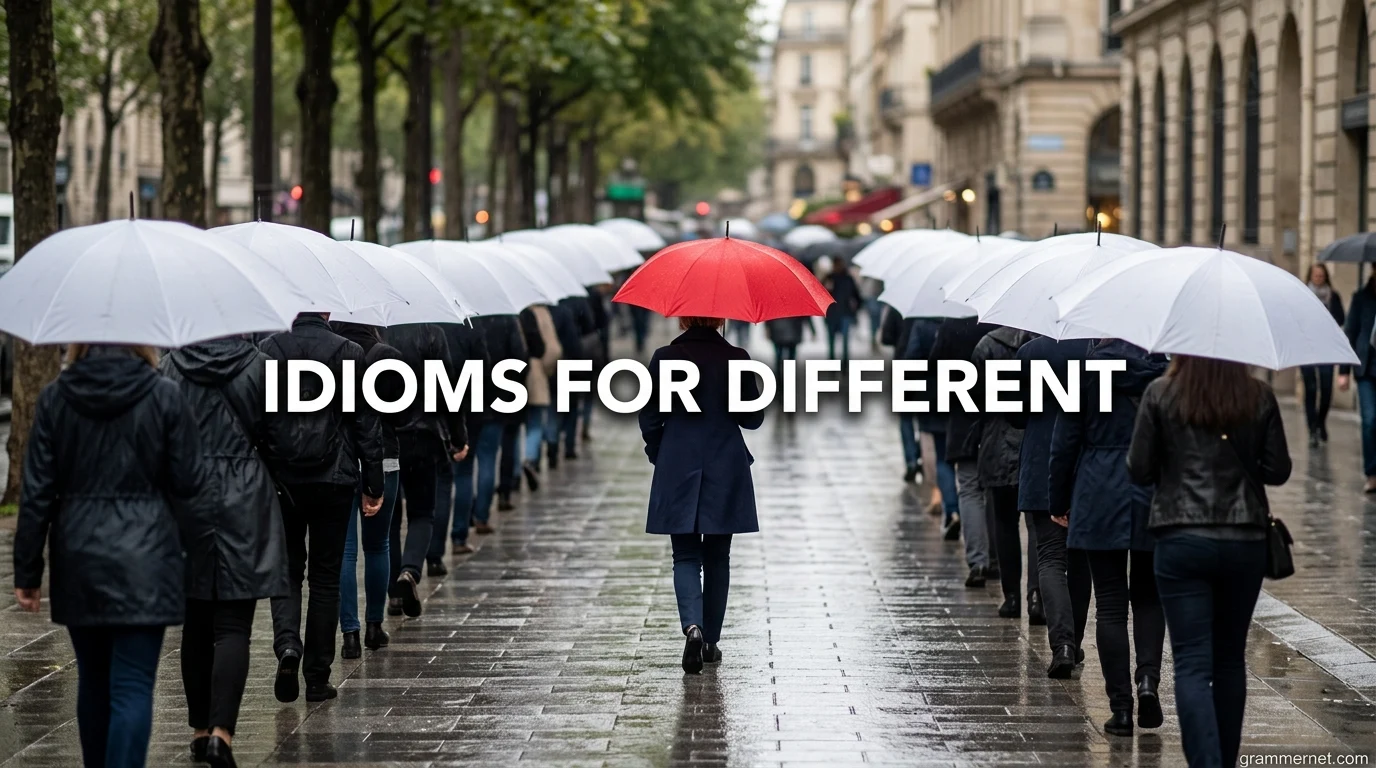
Being able to talk about differences clearly is an important part of natural English. We often need to compare people, things, ideas, and situations in everyday life, school, and work. Learning idioms for different helps English learners sound more fluent, express contrast more vividly, and understand native speakers better. It also makes your English more flexible, especially when you want to describe something unusual, unique, or unlike anything else. In real life, these idioms can help you speak more naturally in conversations, essays, presentations, and even casual messages.
What Does “Different” Mean in Idiomatic English?
The word different usually means “not the same.” But in idioms, it often goes beyond simple comparison. It can express:
- uniqueness
- contrast
- incompatibility
- personal style
- unexpected change
For example, when someone says something is a different kettle of fish, they do not mean a fish container. They mean the situation is completely different from another one.
Idioms for different are useful because English speakers love colorful ways to talk about contrast and individuality.
Common Idioms for Different
A Different Kettle of Fish
Meaning: A completely different matter or situation.
Example: “Fixing the computer is easy, but installing the whole system is a different kettle of fish.”
Alternative Expressions:
- a totally different matter
- a whole other issue
- something completely separate
Typical Use Cases:
- comparing two situations
- discussing problems
- changing topics
Fun Fact / Origin: This phrase comes from old British usage where a “kettle” could mean a container for cooking fish. Over time, it came to mean “a different thing altogether.”
Chalk and Cheese
Meaning: Two people or things that are very different from each other.
Example: “My brother and I are like chalk and cheese.”
Alternative Expressions:
- complete opposites
- very unlike each other
- worlds apart
Typical Use Cases:
- comparing personalities
- discussing siblings or friends
- describing opposite styles
Fun Fact / Origin: Chalk and cheese are both white, but they are completely different in texture, taste, and use, which makes the contrast memorable.
Cut from a Different Cloth
Meaning: A person who is very different in character, style, or behavior.
Example: “She’s cut from a different cloth; she always thinks creatively.”
Alternative Expressions:
- one of a kind
- unique person
- unlike others
Typical Use Cases:
- personality praise
- leadership qualities
- creative or unusual people
Fun Fact / Origin: This idiom comes from tailoring and suggests that someone was made from a different material, so they are naturally distinct.
March to the Beat of Your Own Drum
Meaning: To do things in your own way, not following the crowd.
Example: “He marches to the beat of his own drum and never copies others.”
Alternative Expressions:
- be independent
- follow your own path
- think differently
Typical Use Cases:
- individuality
- creative expression
- nonconformity
Fun Fact / Origin: This idiom likely comes from the idea of a person following their own rhythm rather than the group’s rhythm.
One of a Kind
Meaning: Unique; unlike anyone or anything else.
Example: “That teacher is truly one of a kind.”
Alternative Expressions:
- unique
- special
- exceptional
Typical Use Cases:
- compliments
- descriptions of people or items
- marketing and branding
Apples and Oranges
Meaning: Two things that are too different to be compared fairly.
Example: “You can’t compare a car and a bicycle—they’re apples and oranges.”
Alternative Expressions:
- not comparable
- completely different
- unlike things
Typical Use Cases:
- debates
- business comparisons
- academic discussions
Fun Fact / Origin: This idiom uses two very different fruits to show that some comparisons are not fair or logical.
World Apart
Meaning: Very different; separated by a large difference.
Example: “Their lifestyles are worlds apart.”
Alternative Expressions:
- very different
- completely unlike
- far removed from each other
Typical Use Cases:
- comparing lifestyles
- cultures
- opinions
A Far Cry from
Meaning: Very different from something else, often in a negative or surprising way.
Example: “This result is a far cry from what we expected.”
Alternative Expressions:
- very different from
- not at all like
- completely unlike
Typical Use Cases:
- expectations
- quality comparisons
- changes over time
Fun Fact / Origin: The phrase “far cry” originally referred to a loud distant call, and later came to mean something very far away in quality or nature.
Different Strokes for Different Folks
Meaning: Different people like different things.
Example: “I love horror movies, but my sister prefers comedies—different strokes for different folks.”
Alternative Expressions:
- everyone has their own taste
- people like different things
- personal preferences vary
Typical Use Cases:
- opinions
- lifestyle choices
- taste in food, music, or fashion
Fun Fact / Origin: This idiom became popular in modern American English and reflects the idea of respecting individual preferences.
Out of the Ordinary
Meaning: Unusual or different from what is normal.
Example: “Nothing out of the ordinary happened today.”
Alternative Expressions:
- unusual
- special
- not typical
Typical Use Cases:
- daily life
- news reports
- observations
Stand Out from the Crowd
Meaning: To be noticeably different, often in a positive way.
Example: “Her ideas always stand out from the crowd.”
Alternative Expressions:
- be distinctive
- attract attention
- be unique
Typical Use Cases:
- fashion
- career
- creative work
Not the Same as
Meaning: A simple but useful expression showing difference.
Example: “Your opinion is not the same as mine.”
Alternative Expressions:
- different from
- unlike
- distinct from
Typical Use Cases:
- everyday conversation
- academic writing
- polite disagreement
Idioms for Different by Context
Personality and Behavior
- cut from a different cloth
- march to the beat of your own drum
- one of a kind
Comparison and Contrast
- apples and oranges
- world apart
- a far cry from
Uniqueness and Standing Out
- stand out from the crowd
- out of the ordinary
- one of a kind
Simple Difference in Conversation
- different strokes for different folks
- not the same as
- chalk and cheese
Grouping idioms by context helps learners remember them faster and use them more naturally.
How to Use Idioms for Different Naturally
Choose the Right Level of Formality
Some idioms are casual and conversational, while others fit essays or presentations better.
- Casual: chalk and cheese
- Slightly formal: a far cry from
- Neutral: not the same as
Understand the Tone
Some idioms are positive, while others simply describe contrast.
- Positive: one of a kind
- Neutral: apples and oranges
- Positive/individualistic: march to the beat of your own drum
Practice with Real Comparisons
Try using idioms when comparing:
- people
- hobbies
- cultures
- jobs
- products
- ideas
Learn Them in Full Sentences
Idioms are easier to remember when you see them in context, not as isolated phrases.
Common Mistakes to Avoid
Using the Wrong Comparison Structure
Incorrect:
- “He is different with me.”
Correct:
- “He is different from me.”
Using Idioms Literally
“Chalk and cheese” does not mean actual chalk and cheese.
Overusing Idioms
Too many idioms in one paragraph can sound unnatural.
Mixing Similar Idioms
- world apart = very different
- a far cry from = very different, often compared to expectation
- apples and oranges = not fairly comparable
Forgetting the Audience
Some idioms are very casual and may not suit formal writing.
Tips for Remembering Idioms for Different
Use Visual Contrast
Imagine chalk vs. cheese, apples vs. oranges, or two people walking in different directions.
Group Similar Idioms
Study idioms for:
- uniqueness
- contrast
- personality
- comparison
Create Example Sentences
Make your own examples from your life:
- school
- work
- family
- hobbies
- relationships
Use Them in Conversations
Try one new idiom when talking about differences every day.
Fun Origins Behind Different Idioms
Chalk and Cheese
The phrase works because chalk and cheese are both pale but completely different in texture and use.
Apples and Oranges
These are both fruits, but they are too different to compare fairly.
March to the Beat of Your Own Drum
This image suggests someone follows their own rhythm instead of the group’s rhythm.
A Different Kettle of Fish
This came from older British English and means a completely different situation.
Understanding origins often makes idioms more memorable and easier to use.
Practice Exercises
Exercise 1: Fill in the Blanks (Easy)
- Her ideas are ______ from everyone else’s.
- We can’t compare those two things—they’re apples and ______.
- He marches to the beat of his own ______.
Answers
- different
- oranges
- drum
Exercise 2: Match the Idiom to the Meaning (Medium)
IdiomMeaningChalk and cheeseA. Completely differentOne of a kindB. UniqueA far cry fromC. Very different from something expected
Answers
- Chalk and cheese → A
- One of a kind → B
- A far cry from → C
Exercise 3: Choose the Best Idiom (Advanced)
- “That result is very different from what we expected.”
- “She has a personality unlike anyone else.”
- “People have different tastes and preferences.”
Answers
- A far cry from
- One of a kind / cut from a different cloth
- Different strokes for different folks
Quick Quiz
Question 1
Which idiom means “not fairly comparable”?
A. Apples and oranges B. Out of the ordinary C. One of a kind
Answer: A
Question 2
Which idiom means “to be unique”?
A. Chalk and cheese B. One of a kind C. World apart
Answer: B
Question 3
Which idiom means “to do things your own way”?
A. March to the beat of your own drum B. A far cry from C. Different kettle of fish
Answer: A
Suggested Visuals and Infographics
To make this topic more engaging, you can add:
- a comparison chart of similar idioms
- a uniqueness vs difference infographic
- a visual map of “difference” idioms by context
- flashcards with examples and literal meanings
- a contrast scale from mild difference to complete opposites
Visuals help learners remember the meaning and tone of each idiom more easily.
Why Learning Idioms for Different Matters
These idioms are useful because English speakers constantly compare people, things, and situations. You will hear them in:
- daily conversations
- business meetings
- academic discussions
- articles and books
- films and TV shows
Learning them helps you express contrast and uniqueness naturally, which is a key part of fluent English.
FAQs
What are idioms for different?
They are expressions used to describe contrast, uniqueness, or things that are not the same.
Why should English learners study idioms for different?
They help learners speak and write more naturally and understand native speakers better.
What does “chalk and cheese” mean?
It means two people or things are completely different.
What does “a far cry from” mean?
It means very different from something, often in a surprising way.
What does “apples and oranges” mean?
It means two things are too different to compare fairly.
Is “different from” correct English?
Yes. “Different from” is the standard and most widely accepted form.
Can these idioms be used in formal writing?
Some can, especially “a far cry from” and “different from,” but very casual ones may be better for conversation.
Conclusion
Learning idioms for different is a powerful way to improve your English vocabulary and communication skills. These expressions help you describe contrast, individuality, and uniqueness in a vivid and natural way. From chalk and cheese and apples and oranges to cut from a different cloth, one of a kind, and march to the beat of your own drum, these idioms are common in real English and can make your speech and writing more expressive.
The best way to master them is through regular practice, reading examples, and using them in your own sentences. Over time, these idioms will become a natural part of your English and help you talk about differences with confidence and clarity.
