
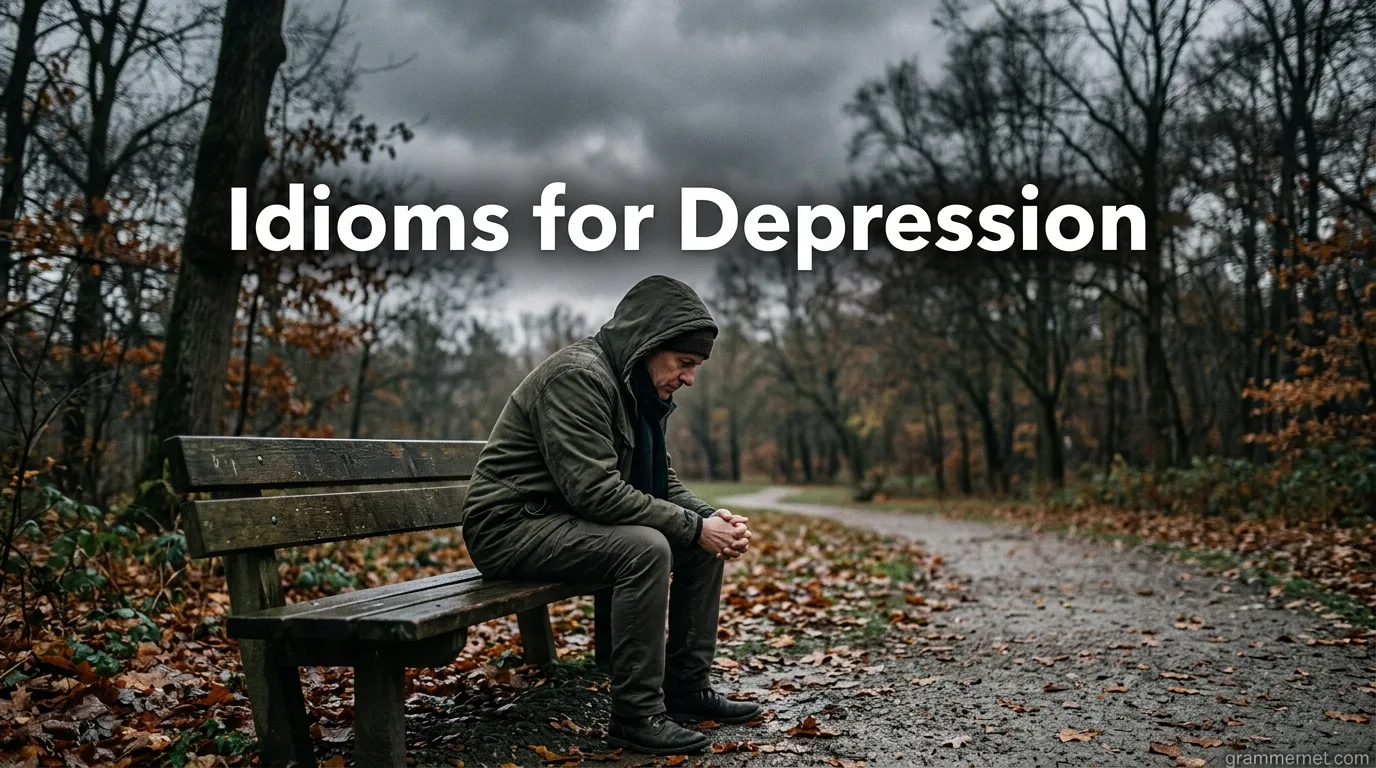
Talking about sadness, low mood, and emotional heaviness is an important part of English communication. Many speakers use idioms for depression and related expressions to describe feeling mentally low, overwhelmed, hopeless, or emotionally drained. Learning these phrases helps English learners understand conversations, movies, books, and everyday speech more naturally. It can also help you express feelings with more accuracy and empathy in real life.
These idioms are especially useful because people often talk about difficult emotions indirectly. Instead of saying “I feel depressed” every time, English speakers may say they feel blue, in a funk, or down in the dumps. Understanding these expressions will improve your fluency, listening skills, and emotional vocabulary. It also gives you a more natural way to recognize and respond to difficult conversations with care.
What Are Idioms for Depression?
Idioms for depression are figurative expressions used to describe sadness, emotional exhaustion, hopelessness, or a prolonged low mood. They often do not mean literal depression in a medical sense, but they may describe feelings that are close to it.
For example:
- “Feeling blue” does not mean a blue color.
- “In the doldrums” does not mean being on a ship every time.
- “The black dog” is not a real dog.
These idioms are common in:
- everyday conversation
- storytelling
- literature and poetry
- mental health discussions
- films, songs, and news articles
Why Learn Idioms for Depression?
Learning depression-related idioms gives you several benefits:
Practical benefits
- You understand native speakers more easily.
- You can describe emotions with more variety.
- You become better at reading books, articles, and subtitles.
- You sound more natural in conversation and writing.
Emotional benefits
- You can express difficult feelings more clearly.
- You can respond to others with more empathy.
- You build language that reflects human emotion.
- You learn how English speakers talk about sadness and stress in nuanced ways.
Important note
These idioms are helpful for language learning, but they are not a substitute for mental health support. If a topic feels personal, it is always okay to talk to someone you trust or reach out to a mental health professional.
Common Idioms for Depression and Low Mood
1. Feel Blue / Have the Blues
Meaning: To feel sad, low, or emotionally down.
Example: “She’s feeling blue after moving to a new city.”
Alternative expressions:
- feel sad
- feel low
- feel downhearted
Typical use cases:
- temporary sadness
- loneliness
- disappointment
Tone: Casual and common
Fun fact / origin: The color blue has long been associated with sadness in English. The phrase “the blues” is also connected to music that expresses sorrow and emotion.
2. Down in the Dumps
Meaning: Feeling sad, gloomy, or depressed.
Example: “He’s been down in the dumps since the breakup.”
Alternative expressions:
- feeling miserable
- feeling low
- in a bad mood
Typical use cases:
- heartbreak
- disappointment
- lonely periods
Tone: Informal and conversational
3. In the Doldrums
Meaning: Feeling depressed, inactive, or stuck in a low emotional state.
Example: “After the failed exam, she was in the doldrums for weeks.”
Alternative expressions:
- emotionally stuck
- not motivated
- in a low phase
Typical use cases:
- sadness after setbacks
- loss of motivation
- emotional stagnation
Fun fact / origin: This phrase comes from sailing. The doldrums were areas where ships got stuck with no wind, which became a metaphor for feeling stuck emotionally.
4. In a Funk
Meaning: Feeling depressed, moody, or mentally stuck for a while.
Example: “I’ve been in a funk lately and don’t feel like doing much.”
Alternative expressions:
- in a bad mood
- emotionally flat
- feeling low
Typical use cases:
- lack of motivation
- emotional numbness
- temporary sadness
Tone: Casual, often used in everyday speech
5. The Black Dog
Meaning: A symbol or metaphor for depression.
Example: “He spoke openly about being followed by the black dog.”
Alternative expressions:
- deep depression
- a heavy sadness
- a long dark period
Typical use cases:
- serious emotional discussions
- writing
- mental health awareness
Fun fact / origin: Winston Churchill famously used “black dog” to describe his own depression, which helped the phrase become well known in modern English.
Tone: Serious and emotional
6. At Rock Bottom
Meaning: At the lowest point emotionally, financially, or personally.
Example: “After losing her job and apartment, she felt like she had hit rock bottom.”
Alternative expressions:
- at the lowest point
- completely defeated
- at the end of the line
Typical use cases:
- serious life struggles
- emotional collapse
- recovery stories
Tone: Strong and dramatic
7. A Heavy Heart
Meaning: A feeling of deep sadness or emotional burden.
Example: “He left the meeting with a heavy heart.”
Alternative expressions:
- deep sadness
- sorrow
- emotional burden
Typical use cases:
- grief
- difficult decisions
- emotional writing
Tone: Poetic and respectful
8. Carry the Weight of the World on One’s Shoulders
Meaning: To feel extremely burdened by problems or responsibilities.
Example: “She feels like she carries the weight of the world on her shoulders.”
Alternative expressions:
- feel overwhelmed
- feel burdened
- be under too much pressure
Typical use cases:
- stress
- caregiving
- work pressure
Fun fact / origin: This image comes from the idea of carrying something enormous and exhausting, like the world itself.
9. See No Light at the End of the Tunnel
Meaning: To feel hopeless and unable to see improvement.
Example: “During the difficult year, he felt he could see no light at the end of the tunnel.”
Alternative expressions:
- feel hopeless
- see no way out
- feel trapped
Typical use cases:
- long-term struggles
- recovery from setbacks
- emotional despair
Tone: Serious and often used in difficult situations
10. A Shadow of One’s Former Self
Meaning: To be much weaker, sadder, or less energetic than before.
Example: “After months of stress, he was only a shadow of his former self.”
Alternative expressions:
- much less lively
- emotionally drained
- weakened by sadness
Typical use cases:
- long-term sadness
- health and emotional decline
- grief or burnout
11. Low Spirits
Meaning: A state of sadness, discouragement, or emotional low energy.
Example: “She has been in low spirits since the bad news.”
Alternative expressions:
- feeling down
- feeling discouraged
- emotionally low
Typical use cases:
- everyday sadness
- disappointment
- stressful life periods
12. Out of Sorts
Meaning: Feeling unwell, uneasy, or emotionally off balance.
Example: “He’s been out of sorts all week.”
Alternative expressions:
- not myself
- off balance
- emotionally uneasy
Typical use cases:
- mild emotional discomfort
- confusion
- stress or tiredness
Note: This is not always about depression specifically, but it is often used when someone feels emotionally off.
13. Burned Out
Meaning: Emotionally and mentally exhausted, usually from too much stress or work.
Example: “After months of overtime, she felt completely burned out.”
Alternative expressions:
- exhausted
- drained
- emotionally spent
Typical use cases:
- work stress
- study pressure
- caregiving
Important note: Burnout is not exactly the same as depression, but it can feel similar and is often used in emotional contexts.
14. Feeling Empty
Meaning: Feeling emotionally hollow, numb, or disconnected.
Example: “After the loss, he said he felt empty inside.”
Alternative expressions:
- emotionally numb
- hollow
- disconnected
Typical use cases:
- grief
- heartbreak
- severe sadness
15. Lose One’s Spark
Meaning: To lose energy, happiness, or enthusiasm.
Example: “After the difficult year, she seemed to lose her spark.”
Alternative expressions:
- lose motivation
- feel drained
- become less lively
Typical use cases:
- long stress periods
- disappointment
- emotional exhaustion
Idioms for Depression by Context
Mild Sadness or Low Mood
- feel blue
- in a funk
- out of sorts
- down in the dumps
Deep Sadness or Heavy Emotion
- a heavy heart
- the black dog
- low spirits
- feeling empty
Hopelessness and Struggle
- at rock bottom
- see no light at the end of the tunnel
- carry the weight of the world on one’s shoulders
Long-Term Exhaustion or Decline
- burned out
- a shadow of one’s former self
- lose one’s spark
Grouping idioms by context makes them easier to remember and use naturally.
How to Use These Idioms Naturally
Match the intensity
Some expressions are mild and casual, while others are serious and emotional.
- Mild: feel blue, in a funk
- Strong: the black dog, at rock bottom
Use them with care
Because depression is a sensitive topic, choose your words thoughtfully.
Know your audience
Use more formal or neutral language in professional or serious situations.
Practice in full sentences
Idioms are easier to remember when you see them in complete sentences.
Learn the emotional tone
Some idioms sound poetic, some sound casual, and some sound very serious.
Common Mistakes to Avoid
Taking idioms literally
“The black dog” is not a real dog. It is a metaphor for depression.
Using informal idioms in serious situations
“Down in the dumps” may be too casual for a sensitive mental health discussion.
Confusing similar expressions
- in a funk = low mood, stuck feeling
- burned out = exhausted from stress
- at rock bottom = at the lowest point
Overusing idioms
Too many emotional idioms can sound unnatural or dramatic.
Using them without context
Always make sure the idiom fits the situation and tone.
Fun Facts About Depression Idioms
The Black Dog
This phrase became widely known because Winston Churchill used it to describe his depression.
In the Doldrums
This comes from sailing and the image of ships being stuck with no wind.
Feeling Blue
The color blue has long been linked with sadness in English culture, and the music genre the blues reflects that emotional tradition.
Understanding origins can make idioms easier to remember.
Interactive Practice Section
Exercise 1: Fill in the Blanks (Easy)
- She’s been feeling ______ since the exam results.
- He says he is in a ______ lately and has no motivation.
- The news left her with a ______ heart.
Answers
- blue
- funk
- heavy
Exercise 2: Match the Idiom to the Meaning (Medium)
IdiomMeaningThe black dogA. Emotionally drained from too much stressBurned outB. A metaphor for depressionIn the doldrumsC. Feeling stuck and low
Answers
- The black dog → B
- Burned out → A
- In the doldrums → C
Exercise 3: Choose the Best Idiom (Advanced)
- “She feels completely overwhelmed by responsibilities.”
- “He is at the lowest point in his life.”
- “After months of stress, she feels tired and emotionally drained.”
Answers
- Carry the weight of the world on one’s shoulders
- At rock bottom
- Burned out
Quick Quiz
Question 1
Which idiom means “to feel sad or low”?
A. Feeling blue B. On cloud nine C. Full of beans
Answer: A
Question 2
Which idiom means “at the lowest point”?
A. In a funk B. At rock bottom C. Out of sorts
Answer: B
Question 3
Which idiom means “not seeing hope for improvement”?
A. See no light at the end of the tunnel B. Catch some Zs C. Hit the books
Answer: A
Tips for Remembering Depression Idioms
Use emotional images
Picture a dark dog, a tunnel with no light, or a heavy load on someone’s shoulders.
Practice with short stories
Write a few sentences about sadness, stress, or recovery using the idioms.
Review by intensity
Group idioms from mild sadness to deep hopelessness.
Read carefully
These idioms often appear in novels, songs, and articles about emotional life.
Suggested Visuals and Infographics
To make this topic easier to understand, you could include:
- a depression idiom intensity chart
- a mood ladder from mild sadness to deep hopelessness
- flashcards with emotional tone labels
- a literal vs figurative meaning comparison
- a context map showing when to use each idiom
Visuals help learners understand sensitive language more clearly and remember it longer.
Why Learning Idioms for Depression Matters
Idioms for depression are useful because English speakers often use indirect language to talk about emotional pain. These expressions appear in daily speech, literature, music, and mental health conversations. Learning them helps you understand more English and express emotions more naturally and sensitively.
These idioms are especially helpful when discussing:
- sadness
- stress
- burnout
- grief
- hopelessness
- emotional exhaustion
FAQs
What are idioms for depression?
They are figurative expressions used to describe sadness, low mood, hopelessness, or emotional exhaustion.
Why should English learners study depression idioms?
They help learners sound natural and understand emotional English in conversations and writing.
What does “feeling blue” mean?
It means feeling sad or low.
What does “the black dog” mean?
It is a metaphor for depression.
What does “burned out” mean?
It means emotionally and mentally exhausted, usually from too much stress or work.
Are depression idioms formal?
Some are casual, some are poetic, and some are serious. Choose based on context.
Can I use these idioms in writing?
Yes, especially in stories, reflections, and emotional essays, but use sensitive ones carefully.
Conclusion
Learning idioms for depression helps you talk about sadness, emotional struggle, burnout, and hopelessness in a more natural and meaningful way. These expressions are common in English and can help you understand books, films, and real conversations more clearly. From feeling blue and in a funk to the black dog, at rock bottom, and see no light at the end of the tunnel, these idioms show the many ways English describes low emotional states.
The best way to master them is through practice, careful reading, and learning them in context. Use them respectfully, choose the right tone, and keep building your vocabulary. Over time, these idioms will help you communicate difficult feelings more clearly and become a more fluent, empathetic English speaker.
