
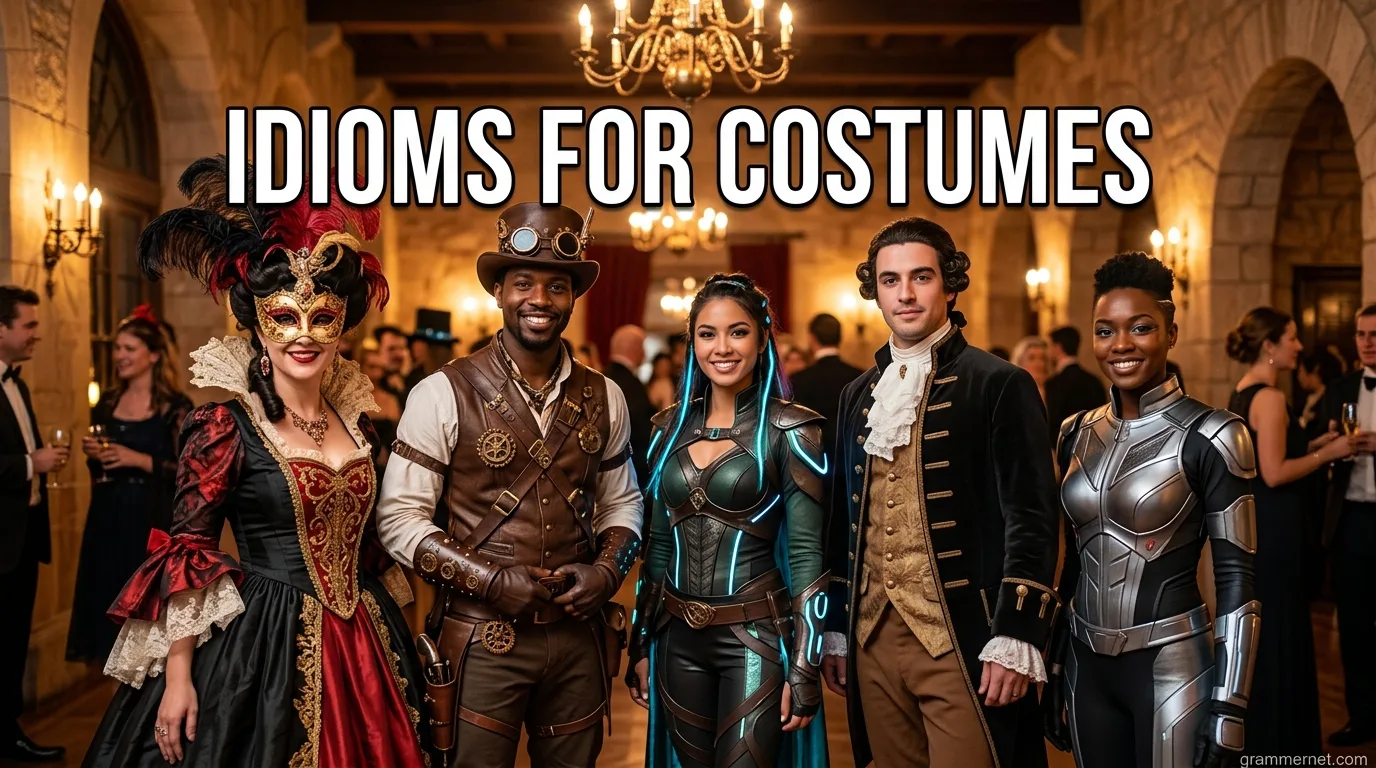
Costumes are more than clothes. They help people become characters, express creativity, and step into new roles at parties, plays, festivals, and online content. Learning idioms for costumes helps English learners talk about dressing up, appearances, disguises, and playful identity in a natural way.
These expressions are useful in everyday conversation, school events, theater, Halloween, cosplay, and storytelling.
They also help you understand how English speakers describe the difference between what people wear and how they present themselves. With the right idioms, you can speak more vividly, sound more fluent, and describe costume-related moments with confidence.
What Are Idioms for Costumes?
Idioms are expressions whose meanings are not literal. Idioms for costumes are phrases that use clothing, masks, disguises, and appearance to describe style, identity, behavior, or hidden meaning.
For example, if someone says “dressed to the nines,” they do not mean the number nine. They mean the person is dressed very elegantly or stylishly.
These idioms appear in conversations about parties, performances, fashion, roles, and even personality. Some are directly linked to costumes and dressing up, while others use costume-like images to talk about how people present themselves.
Why Learning Costume Idioms Matters
Learning idioms for costumes helps you:
- describe appearance in a more colorful way
- talk naturally about parties, theater, and dressing up
- understand movies, books, and social conversations
- express style, confidence, and creativity
- recognize hidden meaning when people are not being fully honest
These idioms are especially useful for students, performers, teachers, travelers, and English learners who want to understand real-world English.
Common Idioms for Costumes
1. Dressed to the Nines
Meaning: Dressed very elegantly or in expensive, stylish clothes.
Example: She was dressed to the nines for the wedding.
Alternative expressions: dressed elegantly, dressed in style, looking fabulous
Typical use cases: weddings, formal events, parties, red-carpet moments
Fun fact / origin: The exact origin is unclear, but “the nines” has long been associated with perfection or excellence.
2. Dressed to Kill
Meaning: Dressed in a very attractive or striking way.
Example: He arrived dressed to kill at the awards ceremony.
Alternative expressions: stylishly dressed, looking impressive, fashion-forward
Typical use cases: date nights, parties, formal gatherings
Tone: This phrase is often playful and flattering.
3. In Disguise
Meaning: Wearing something to hide one’s identity.
Example: The actor visited the event in disguise.
Alternative expressions: hidden identity, masked, concealed
Typical use cases: costumes, secret visits, spy stories, Halloween
Fun fact / origin: This phrase has long been used in storytelling and theater to describe hidden identity.
4. Behind the Mask
Meaning: Hiding one’s true feelings, identity, or intentions.
Example: Behind the mask, he was actually very nervous.
Alternative expressions: hiding emotions, concealing identity
Typical use cases: emotions, social behavior, dramatic writing
Fun fact / origin: This image comes from theater and performance, where masks hide the actor’s true face.
5. Wear Many Hats
Meaning: To have several roles or responsibilities.
Example: At work, she wears many hats.
Alternative expressions: do many jobs, handle multiple roles
Typical use cases: workplaces, leadership, family life
Note: This is not a costume idiom in the strictest sense, but it is a common clothing metaphor that fits role-based costume language.
6. Put on a Front
Meaning: To pretend to be something you are not.
Example: He puts on a front, but he is actually shy.
Alternative expressions: pretend, hide true feelings, act differently
Typical use cases: social behavior, emotions, relationships
Fun fact / origin: The “front” suggests a face shown to the public, like a costume hiding the real person.
7. A Wolf in Sheep’s Clothing
Meaning: Someone who looks harmless but is dangerous or dishonest.
Example: He seemed nice, but he was a wolf in sheep’s clothing.
Alternative expressions: hidden danger, deceptive person
Typical use cases: stories, warnings, character description
Fun fact / origin: This phrase comes from an old fable about a wolf pretending to be a sheep by wearing its skin.
8. Put on a Mask
Meaning: To hide your real emotions or identity.
Example: She put on a mask and smiled, even though she was upset.
Alternative expressions: hide feelings, conceal true self
Typical use cases: emotional situations, acting, social behavior
Tone: Useful both literally and figuratively.
9. Costume Drama
Meaning: A film, play, or show set in a historical period with special costumes.
Example: She enjoys watching costume dramas.
Alternative expressions: period drama, historical drama
Typical use cases: theater, television, film discussion
Fun fact / origin: This phrase is widely used in British English and entertainment criticism.
10. Pull the Wool Over Someone’s Eyes
Meaning: To trick or deceive someone.
Example: He tried to pull the wool over her eyes with that fake story.
Alternative expressions: deceive, fool, trick
Typical use cases: lies, scams, hidden motives
Fun fact / origin: This idiom comes from old-fashioned wigs or hats and the idea of covering someone’s vision.
11. Look the Part
Meaning: To appear suitable for a role or situation.
Example: He looked the part of a superhero in his costume.
Alternative expressions: fit the role visually, appear appropriate
Typical use cases: performances, interviews, costumes
Why it matters: This phrase is perfect when discussing how a costume matches a character.
12. Put Your Best Foot Forward
Meaning: To make your best effort, especially in appearance or behavior.
Example: At the costume contest, she put her best foot forward.
Alternative expressions: make a good impression, try your best
Typical use cases: events, interviews, parties
Tone: Positive and motivational.
13. Out of Character
Meaning: Acting differently from what is normal or expected.
Example: It was out of character for him to dress that boldly.
Alternative expressions: unusual, not like oneself
Typical use cases: behavior, costumes, drama, acting
Fun fact / origin: This is often used in acting and storytelling, where a character behaves in an unexpected way.
14. Under Wraps
Meaning: Kept secret or hidden until revealed.
Example: The costume design was kept under wraps until the show.
Alternative expressions: secret, hidden, not announced
Typical use cases: events, plans, costume reveals
Tone: Common in media and event planning.
15. Fancy Dress
Meaning: A costume worn for a party, event, or performance.
Example: The children came in fancy dress for the school play.
Alternative expressions: costume outfit, dress-up clothing
Typical use cases: Halloween, parties, school events
Fun fact / origin: This is especially common in British English, where “fancy dress party” means a costume party.
Idioms for Costumes Grouped by Context
Grouping idioms by context makes them easier to remember and use naturally.
For Dressing Up and Looking Stylish
- dressed to the nines
- dressed to kill
- look the part
- put your best foot forward
Example: She was dressed to the nines, dressed to kill, and completely looked the part.
For Hidden Identity and Disguise
- in disguise
- behind the mask
- put on a mask
- pull the wool over someone’s eyes
Example: He came in disguise, behind the mask of a costume, trying to pull the wool over everyone’s eyes.
For Roles and Performance
- wear many hats
- costume drama
- out of character
Example: As an actor, she wears many hats and often appears in costume dramas.
For Secret or Deceptive Appearance
- put on a front
- a wolf in sheep’s clothing
- under wraps
Example: The plan stayed under wraps while he put on a front and seemed harmless.
Tips for Using Costume Idioms Effectively
Use the idiom that matches the situation. A formal event may call for “dressed to the nines,” while a costume party may fit “fancy dress.”
Pay attention to tone. Some idioms are flattering, while others are suspicious or critical.
Learn each idiom in a full sentence so it is easier to remember.
Use costume idioms naturally in speaking, storytelling, descriptions, and social media captions.
Common Mistakes to Avoid
Do not take the idioms literally. “Dressed to kill” does not mean violence.
Do not confuse “fancy dress” with just any fancy clothing. In British English, it often means a costume.
Do not use suspicious idioms like “pull the wool over someone’s eyes” in a playful situation unless the context fits.
Avoid mixing idioms incorrectly, such as changing their wording too much.
Fun Facts About Costume Idioms
Many costume-related idioms come from theater, fashion, and old storytelling traditions.
For example:
- “behind the mask” comes from stage performance
- “wolf in sheep’s clothing” comes from a fable
- “under wraps” refers to hidden items before a reveal
- “wear many hats” reflects multiple responsibilities, not actual hats
These images make the idioms memorable and visually rich.
Interactive Practice Activities
Easy Level: Fill in the Blanks
Complete the sentences with the correct idiom.
- She was dressed to the _______ at the party.
- He came to the event in _______.
- The costume reveal was kept under _______.
Answers:
- nines
- disguise
- wraps
Medium Level: Match the Idiom to the Meaning
Match each idiom with the correct meaning.
- A wolf in sheep’s clothing
- Look the part
- Put on a front
A. Appear suitable for a role B. Pretend to be someone else emotionally C. Seem harmless but be dangerous
Answers: 1-C 2-A 3-B
Advanced Level: Choose the Best Idiom
Choose the best idiom for each situation.
- A performer looks exactly right for a fantasy role.
- A person hides their sadness by smiling.
- A secret costume plan is not announced yet.
Answers:
- Look the part
- Put on a front / put on a mask
- Under wraps
Bonus Challenge: Write Your Own Sentences
Try using these idioms in your own writing or speaking:
- dressed to kill
- wear many hats
- out of character
- pull the wool over someone’s eyes
Sample answers:
- She arrived dressed to kill in a silver costume.
- In my job, I wear many hats every day.
- It was out of character for him to skip the party.
- He tried to pull the wool over her eyes, but she noticed.
Suggestions for Visuals and Infographics
A strong visual guide for idioms for costumes could include:
- a costume-themed chart showing literal vs figurative meaning
- icons like masks, hats, cloaks, and stage curtains
- a “role and disguise” infographic
- examples of costume party, theater, and fashion usage
- side-by-side pictures of real costume outfits and idiomatic meanings
These visuals help learners connect language with imagery and context.
Best Ways to Practice Costume Idioms
Read theater reviews, party stories, and fashion articles to notice how these idioms are used.
Write one sentence a day using a costume idiom.
Practice speaking them in situations like Halloween, drama class, or costume parties.
Group them by theme—style, disguise, role, and deception—so they are easier to remember.
FAQs
1. What are idioms for costumes?
They are expressions used to describe dressing up, disguises, roles, appearances, and hidden meaning in a figurative way.
2. Why should English learners study these idioms?
They help you understand English better and describe costume-related situations more naturally.
3. Is “fancy dress” an idiom?
It is more of a common expression, especially in British English, where it means costume dress-up.
4. Which costume idiom is most common?
“Dressed to the nines,” “dressed to kill,” and “in disguise” are among the most common.
5. Can I use these idioms in writing?
Yes, especially in storytelling, blog writing, captions, and creative descriptions.
6. How can I remember these idioms more easily?
Learn them with examples, group them by context, and connect them with visual images.
Conclusion
Learning idioms for costumes is a fun and practical way to improve your English. These expressions help you talk about dressing up, disguises, performances, and appearance in a natural and memorable way. They are especially useful for parties, theater, fashion, and storytelling.
The key is to understand the meaning, notice the tone, and practice in real situations. Start with a few common idioms, use them in your own sentences, and build confidence over time. With regular practice, you will be able to describe costumes and hidden identity with style, clarity, and creativity.
