
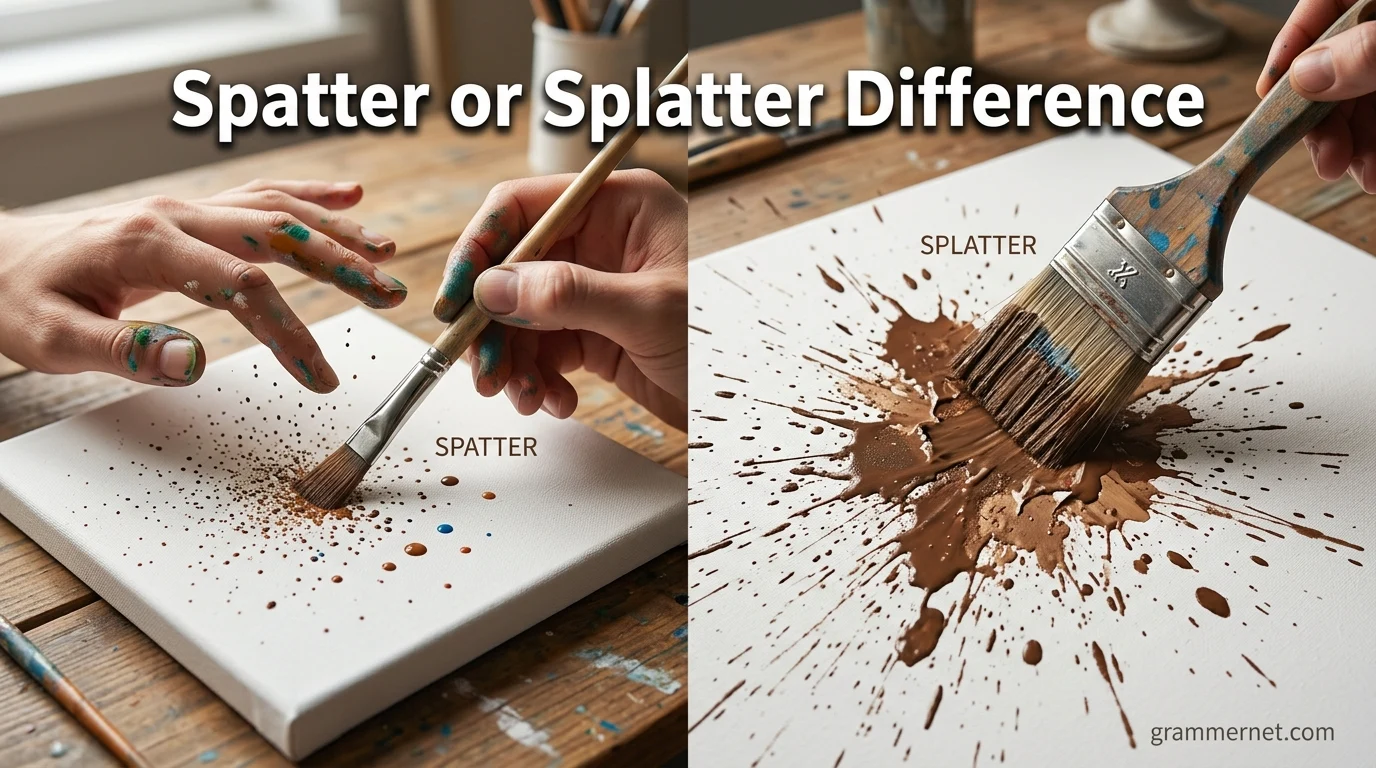
If you’ve ever written about paint on a wall, raindrops on a window, cooking oil on a stovetop, or scenes in a crime novel, you may have stopped to wonder: Should I use “spatter” or “splatter”? These two words look similar, sound alike, and often appear in the same contexts. Because of this, many English learners—and even native speakers—use them interchangeably.
The confusion is understandable. Both words describe liquid spreading in small drops after hitting a surface. Dictionaries sometimes overlap in their definitions, and casual conversations rarely distinguish between them. However, subtle differences in meaning, tone, and usage can make one word more appropriate than the other.
Understanding the spatter or splatter difference matters in everyday writing, academic assignments, journalism, creative storytelling, professional communication, and examinations. Choosing the more precise word improves clarity and helps you sound more confident as a writer.
This comprehensive guide explains the meanings, grammar rules, pronunciation, sentence examples, British versus American usage, common mistakes, and practical tips related to spatter and splatter. By the end, you’ll know exactly when to use each word and how to remember the distinction easily.
What Do “Spatter” and “Splatter” Mean?
At first glance, these words appear to mean the same thing. In many situations, they can indeed be used interchangeably. However, understanding their core meanings helps reveal their subtle differences.
What Does “Spatter” Mean?
Spatter generally means:
To scatter small drops of liquid or another substance lightly over a surface.
The emphasis is often on small, scattered droplets.
Examples:
- Mud spattered the side of the car.
- Rain spattered against the window.
- Paint spattered across the artist’s apron.
What Does “Splatter” Mean?
Splatter usually means:
To scatter liquid in larger, messier, or more forceful drops.
The emphasis is often on a heavier, noisier, or more dramatic spread.
Examples:
- Tomato sauce splattered across the kitchen counter.
- The children splattered water everywhere.
- The movie contained exaggerated splatter effects.
Basic Difference Table
| Word | General Meaning | Typical Impression |
| Spatter | Small scattered droplets | Light, fine distribution |
| Splatter | Larger, messier scattering | Forceful, dramatic spread |
The distinction isn’t absolute, but this guideline helps in most situations.
Spatter vs Splatter: The Main Difference
Although dictionaries acknowledge overlap, many writers prefer to distinguish the words based on intensity.
Spatter: Smaller and Lighter
Think of spatter as controlled or delicate.
Examples:
- Raindrops spattering a windshield
- Flecks of paint on clothing
- Small drops of mud
Splatter: Bigger and Messier
Think of splatter as energetic and chaotic.
Examples:
- Soup exploding from a blender
- Water fights at the pool
- Large amounts of sauce hitting a surface
Side-by-Side Comparison Table
| Feature | Spatter | Splatter |
| Size of Drops | Smaller | Larger |
| Force | Gentle to moderate | Stronger |
| Messiness | Limited | More extensive |
| Tone | Neutral | Dramatic |
| Common Contexts | Rain, paint, mud | Cooking, movies, accidents |
These distinctions help writers create more vivid imagery.
Correct Usage in English
Choosing between the two depends largely on context and the effect you want to achieve.
When to Use “Spatter”
Use spatter when describing:
- Fine droplets
- Light distribution
- Subtle effects
- Technical descriptions
Examples:
- The rain spattered softly on the roof.
- Paint spattered the canvas.
- Tiny drops of mud spattered her shoes.
When to Use “Splatter”
Use splatter when emphasizing:
- A messy result
- Larger amounts of liquid
- Dramatic movement
- Energetic action
Examples:
- The frying oil splattered across the stovetop.
- Children splattered each other with paint.
- Juice splattered onto the floor.
Usage Comparison Table
| Situation | Preferred Word |
| Fine paint droplets | Spatter |
| Violently thrown paint | Splatter |
| Gentle rain | Spatter |
| Sauce explosion | Splatter |
| Light mud marks | Spatter |
| Water fight mess | Splatter |
Context determines which choice feels more natural.
Grammar Rules and Word Forms
Both spatter and splatter function as verbs and nouns.
As Verbs
They describe the action of scattering droplets.
Examples:
- Mud spattered the tires.
- The sauce splattered the walls.
As Nouns
They refer to the droplets or marks themselves.
Examples:
- There was a spatter of rain on the pavement.
- The floor was covered in splatter.
Grammar Forms Table
| Form | Spatter | Splatter |
| Base Verb | spatter | splatter |
| Present | spatters | splatters |
| Present Participle | spattering | splattering |
| Past Tense | spattered | splattered |
| Past Participle | spattered | splattered |
| Noun | spatter | splatter |
Example Sentences
Verb:
- Rain spattered the windows.
- Oil splattered the counter.
Noun:
- A spatter of paint decorated the frame.
- Splatter covered the tiles.
Understanding both grammatical roles expands your vocabulary flexibility.
Pronunciation and Spelling Differences
The words differ by only one letter, making pronunciation particularly important.
How to Pronounce “Spatter”
IPA:
/ˈspæt.ər/
Sound Guide:
SPAT-er
Rhymes with:
- matter
- chatter
Examples:
- spatter marks
- mud spatter
How to Pronounce “Splatter”
IPA:
/ˈsplæt.ər/
Sound Guide:
SPLAT-er
Rhymes with:
- flatter
- clatter
Examples:
- splatter paint
- sauce splatter
Pronunciation Comparison Table
| Word | IPA | Sound Guide |
| Spatter | /ˈspæt.ər/ | SPAT-er |
| Splatter | /ˈsplæt.ər/ | SPLAT-er |
Memory Tip
Notice the extra “l” in splatter.
Many learners associate it with:
L = Larger mess
This simple trick helps you remember the distinction.
British vs American English Usage
Unlike some vocabulary debates, British and American English show only minor differences here.
Shared Understanding
Both varieties recognize:
- spatter
- splatter
Frequency Differences
American English often uses splatter more frequently in entertainment contexts.
Examples:
- splatter films
- splatter effects
British English may favor spatter in technical or descriptive writing.
However, neither preference is absolute.
Regional Comparison Table
| Variety | Spatter | Splatter |
| American English | Common | Very common |
| British English | Common | Common |
| Academic Writing | Preferred for precision | Less frequent |
| Entertainment Reviews | Occasional | Frequent |
Learners can generally use either form according to context.
Sentence Examples in Real-Life Situations
Examples help reinforce usage patterns.
Cooking
Spatter:
- Small drops of oil spattered the stovetop.
Splatter:
- The boiling sauce splattered all over the kitchen.
Weather
Spatter:
- Raindrops spattered against the umbrella.
Splatter:
- Mud splattered onto the hikers after the truck passed.
Art
Spatter:
- The artist intentionally spattered paint across the canvas.
Splatter:
- The children splattered paint on each other during the activity.
Entertainment
Spatter:
- The detective examined the blood spatter pattern.
Splatter:
- Critics described it as a classic splatter horror movie.
Usage Examples Table
| Context | Spatter Example | Splatter Example |
| Cooking | Oil spattered lightly. | Soup splattered everywhere. |
| Weather | Rain spattered the glass. | Mud splattered the car. |
| Art | Paint spattered the paper. | Kids splattered paint around. |
| Entertainment | Blood spatter analysis | Splatter horror film |
Notice how splatter often suggests greater intensity.
Common Mistakes and How to Avoid Them
Because the words overlap, learners frequently misuse them.
Mistake 1: Assuming They Mean Exactly the Same Thing
Incorrect assumption:
- The words are perfect synonyms.
Reality:
They overlap but carry slightly different shades of meaning.
Mistake 2: Ignoring Tone
Example:
- The gentle rain splattered softly on the leaves.
Better:
- The gentle rain spattered softly on the leaves.
Mistake 3: Using Spatter for Dramatic Messes
Less Natural:
- The exploding sauce spattered across the entire kitchen.
More Natural:
- The exploding sauce splattered across the entire kitchen.
Mistake 4: Misspelling
Incorrect:
- Splater
- Spater
Correct:
- Splatter
- Spatter
Common Mistakes Table
| Incorrect Usage | Better Choice |
| Gentle rain splattered softly | Gentle rain spattered softly |
| Sauce spattered everywhere after exploding | Sauce splattered everywhere |
| Splater | Splatter |
| Spater | Spatter |
Awareness of nuance improves precision.
FAQs
Are spatter and splatter interchangeable?
Sometimes.
Many dictionaries recognize overlapping meanings, but subtle differences often influence word choice.
Which word refers to smaller droplets?
Generally, spatter.
Which word suggests a bigger mess?
Usually, splatter.
Is blood spatter correct?
Yes.
The phrase blood spatter is common in forensic contexts.
What is a splatter movie?
A splatter movie is a horror film emphasizing graphic visual effects.
Are there British and American spelling differences?
No.
Both varieties use the same spellings.
Which word should I use in formal writing?
Choose the word that most accurately describes the situation.
Precision matters more than preference.
Conclusion
Understanding the spatter or splatter difference can help you become a more accurate and expressive English writer. Although the two words are closely related and sometimes interchangeable, they often convey different levels of intensity.
As a simple rule to remember:
- Spatter usually suggests small, scattered droplets and lighter distribution.
- Splatter often implies larger, messier, or more dramatic scattering.
Think of raindrops gently hitting a window:
- The rain spattered the glass.
Now imagine a pan of sauce erupting across the kitchen:
- The sauce splattered everywhere.
Both words are grammatically correct, recognized in British and American English, and useful in everyday communication. The key is choosing the one that best matches the image you want readers to see.
By understanding their meanings, pronunciation, grammar forms, common contexts, and typical mistakes, you’ll be able to use spatter and splatter confidently in exams, professional writing, creative projects, and daily conversations. The next time you describe flying droplets, you’ll know exactly which word paints the clearest picture.
