
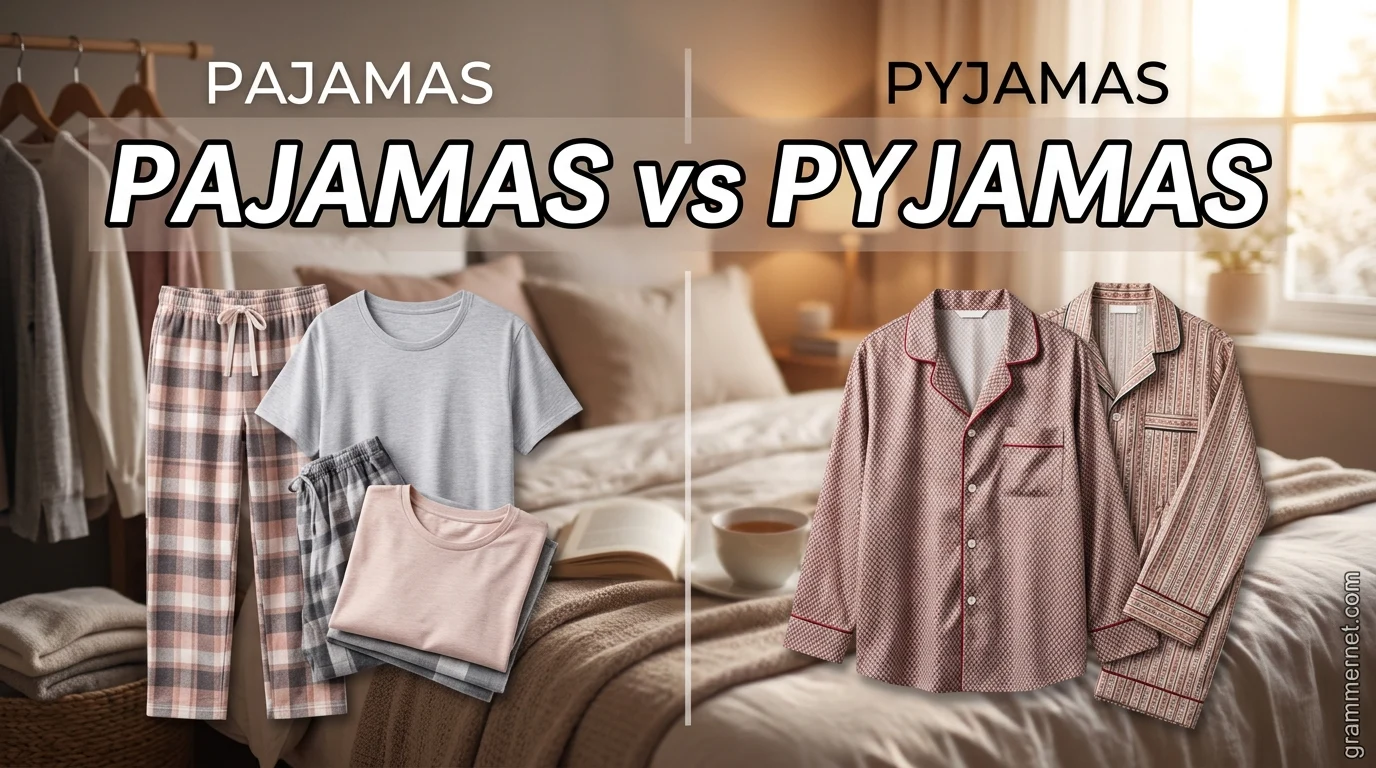
Many English learners are surprised to discover that both pajamas and pyjamas refer to the same thing. The confusion usually arises when people encounter different spellings in books, websites, clothing stores, or exams. One source may use pajamas, while another uses pyjamas, leaving readers wondering which version is correct.
Understanding the difference matters because spelling conventions vary between countries. Whether you are writing an academic paper, preparing professional content, communicating with international audiences, or simply improving your English skills, knowing when to use pajamas or pyjamas can help you write more accurately and confidently.
In this guide, we’ll explore the meaning, spelling differences, pronunciation, grammar rules, regional preferences, examples, common mistakes, and frequently asked questions about pajamas vs pyjamas.
What Do Pajamas and Pyjamas Mean?
Both pajamas and pyjamas refer to loose-fitting clothes worn for sleeping or relaxing at home.
The two words have exactly the same meaning. The only difference is the spelling preference used in different varieties of English.
Definition
Pajamas/Pyjamas (noun):
A set of clothes worn in bed or around the house, usually consisting of a top and matching trousers or shorts.
Examples
- I bought a new pair of pajamas for winter.
- She changed into her pyjamas before going to bed.
- The children wore matching pajamas on Christmas Eve.
- He spent the weekend relaxing in his pyjamas.
In every example, the meaning remains identical regardless of spelling.
Pajamas vs Pyjamas: What Is the Difference?
The primary difference is regional spelling.
| Feature | Pajamas | Pyjamas |
| Meaning | Sleepwear | Sleepwear |
| Pronunciation | Same | Same |
| American English | Preferred | Rare |
| British English | Less common | Preferred |
| Australian English | Less common | Common |
| Canadian English | Often pajamas | Both accepted |
The word itself originates from the Hindi and Urdu word paijama, meaning loose leg garments. As English adopted the term, different spelling conventions developed.
Quick Rule
- Pajamas = American English
- Pyjamas = British English
Both spellings are correct.
British English vs American English Usage
One of the most common reasons people search for “pajamas vs pyjamas” is to determine which spelling fits a specific audience.
American English
In the United States, pajamas is the standard spelling.
Examples:
- I need new pajamas.
- The store sells children’s pajamas.
- She packed her pajamas for the trip.
American dictionaries, schools, publishers, and businesses overwhelmingly prefer this spelling.
British English
In the United Kingdom, pyjamas is generally the preferred spelling.
Examples:
- He wore striped pyjamas.
- The children changed into their pyjamas.
- I bought cotton pyjamas for summer.
British dictionaries and publications typically use the version with y.
Comparison Table
| Country | Preferred Spelling |
| United States | Pajamas |
| United Kingdom | Pyjamas |
| Australia | Pyjamas |
| New Zealand | Pyjamas |
| Canada | Pajamas (more common) |
| International English | Either |
When writing for an international audience, consistency is more important than choosing one particular spelling.
Pronunciation of Pajamas and Pyjamas
An interesting fact is that although the spelling changes, the pronunciation remains essentially the same.
Standard Pronunciation
Pajamas
- puh-JAH-muhz
Pyjamas
- puh-JAH-muhz
Pronunciation Guide
| Word | Pronunciation |
| Pajamas | puh-JAH-muhz |
| Pyjamas | puh-JAH-muhz |
The second syllable receives the strongest stress.
Example Sentences
- My pajamas are in the drawer.
- His pyjamas are hanging on the door.
Both sentences sound nearly identical when spoken.
Grammar Rules for Pajamas and Pyjamas
Many learners wonder whether pajamas is singular or plural.
The answer is slightly unusual.
Usually Treated as a Plural Noun
Like:
- pants
- trousers
- shorts
- glasses
pajamas/pyjamas are generally treated as plural.
Examples:
✓ My pajamas are clean.
✓ These pyjamas are comfortable.
✗ My pajamas is clean.
✗ These pyjamas is comfortable.
Using “A Pair Of”
When referring to one set, English often uses a pair of.
Examples:
- I bought a pair of pajamas.
- She packed a pair of pyjamas.
This construction is especially common in formal and written English.
Grammar Comparison Table
| Expression | Correct? |
| My pajamas are new. | Yes |
| My pajamas is new. | No |
| These pyjamas are comfortable. | Yes |
| These pyjamas is comfortable. | No |
| A pair of pajamas is on the bed. | Yes |
| A pair of pyjamas is on the bed. | Yes |
Common Usage Examples in Everyday English
Seeing words in context helps learners understand them naturally.
At Home
- I spent the evening in my pajamas.
- She relaxed in her pyjamas after work.
- The dog slept beside my pajamas on the floor.
During Travel
- Don’t forget to pack your pajamas.
- I always carry extra pyjamas when traveling.
Shopping
- These pajamas are made from cotton.
- The store has winter pyjamas on sale.
Family Situations
- The children wore matching pajamas.
- Everyone opened gifts in their pyjamas.
Formal Writing
- Residents should wear appropriate sleepwear rather than pajamas in common areas.
- Hospital patients may wear their own pyjamas if permitted.
Pajamas vs Pyjamas in Writing and Exams
Students often worry about losing marks for choosing the wrong spelling.
The answer depends on the type of English being used.
Use Pajamas When
- Following American English conventions
- Writing for U.S. audiences
- Using American spelling throughout a document
Examples:
- color
- favorite
- pajamas
Use Pyjamas When
- Following British English conventions
- Writing for UK audiences
- Using British spelling throughout a document
Examples:
- colour
- favourite
- pyjamas
Consistency Matters
Do not mix spelling styles in the same document.
Incorrect:
- My favourite pajamas are blue.
Correct (British):
- My favourite pyjamas are blue.
Correct (American):
- My favorite pajamas are blue.
Consistency Table
| British Style | American Style |
| Colour | Color |
| Favourite | Favorite |
| Centre | Center |
| Pyjamas | Pajamas |
Maintaining one style throughout your writing creates a more professional appearance.
Common Mistakes and How to Avoid Them
Even though the spelling difference is simple, learners still make several common errors.
Mistake 1: Thinking One Is Incorrect
Incorrect assumption:
✗ Pyjamas is wrong.
✗ Pajamas is wrong.
Reality:
✓ Both spellings are correct.
The choice depends on the variety of English being used.
Mistake 2: Mixing Spelling Systems
Incorrect:
- My favourite pajamas are comfortable.
Better (British):
- My favourite pyjamas are comfortable.
Better (American):
- My favorite pajamas are comfortable.
Mistake 3: Using Singular Verbs
Incorrect:
- My pajamas is dirty.
Correct:
- My pajamas are dirty.
Mistake 4: Confusing the Word With Other Clothing Terms
Some learners mistakenly use pajamas for any casual clothing.
Remember:
Pajamas specifically refer to sleepwear or loungewear designed for sleeping or relaxing.
Mistake 5: Misspelling the Word
Common incorrect spellings:
pajama’s
pyjama’s
pajamases
pijamas
Correct:
✓ pajamas
✓ pyjamas
Related Words and Expressions
Learning related vocabulary can improve your overall English fluency.
Sleepwear Vocabulary
| Word | Meaning |
| Pajamas/Pyjamas | Sleepwear set |
| Nightgown | Loose sleeping garment |
| Nightshirt | Long sleeping shirt |
| Robe | Loose outer garment worn over sleepwear |
| Slippers | Indoor footwear |
| Loungewear | Comfortable clothing for relaxing |
Example Sentences
- She wore a robe over her pajamas.
- He put on slippers before breakfast.
- The hotel provided comfortable loungewear.
History and Origin of the Word
The word has an interesting international history.
It entered English during the period of British influence in South Asia.
The original Hindi and Urdu word paijama referred to loose-fitting trousers tied at the waist.
English speakers adopted the term in the eighteenth and nineteenth centuries.
Over time:
- British English developed the spelling pyjamas.
- American English simplified it to pajamas.
This pattern resembles many other spelling differences between British and American English.
Historical Development
| Period | Form |
| Hindi/Urdu Origin | Paijama |
| Early English | Pyjama |
| Modern British English | Pyjamas |
| Modern American English | Pajamas |
Despite the spelling changes, the meaning has remained largely unchanged.
Pajamas vs Pyjamas: Which Should You Use?
The best choice depends on your audience.
Use Pajamas If
- You write primarily in American English.
- Your audience is in the United States.
- Your organization follows American style guides.
Use Pyjamas If
- You write primarily in British English.
- Your audience is in the United Kingdom.
- Your school or employer follows British spelling rules.
When Either Is Acceptable
For international audiences, both are usually understood.
Examples:
- Product descriptions
- Travel blogs
- Language-learning materials
- International business communication
The key requirement is consistency.
FAQs
Is pajamas or pyjamas correct?
Both are correct. Pajamas is the preferred American spelling, while pyjamas is the preferred British spelling.
Why do Americans spell it pajamas?
American English simplified several spellings over time. As a result, pajamas became the standard American form.
Why do British people write pyjamas?
British English retained the spelling pyjamas, which reflects earlier forms of the word.
Are pajamas singular or plural?
They are generally treated as a plural noun.
Correct:
- My pajamas are clean.
Not:
- My pajamas is clean.
Can I say a pajama?
Usually, English speakers say:
- a pair of pajamas
- a pair of pyjamas
Using “a pajama” is uncommon unless referring to a single piece of the set.
Is there a difference in pronunciation?
No significant difference exists. Both spellings are pronounced essentially the same way.
Which spelling should I use in an exam?
Follow the variety of English required by your school, teacher, or exam board. Consistency is more important than the specific spelling choice.
Conclusion
The debate over pajamas vs pyjamas is not really about right versus wrong. Both spellings refer to the same sleepwear and are fully accepted in English. The difference lies primarily in regional spelling preferences: pajamas is standard in American English, while pyjamas is preferred in British English and many other Commonwealth countries.
The most important rule is consistency. If you are writing in American English, use pajamas throughout your document. If you are writing in British English, use pyjamas consistently. Remember that both words are usually treated as plural nouns, so they take plural verbs such as are rather than is.
By understanding the spelling difference, grammar rules, pronunciation, and common usage patterns, you can confidently choose the correct form for your audience and avoid one of the most common spelling questions in English.
