
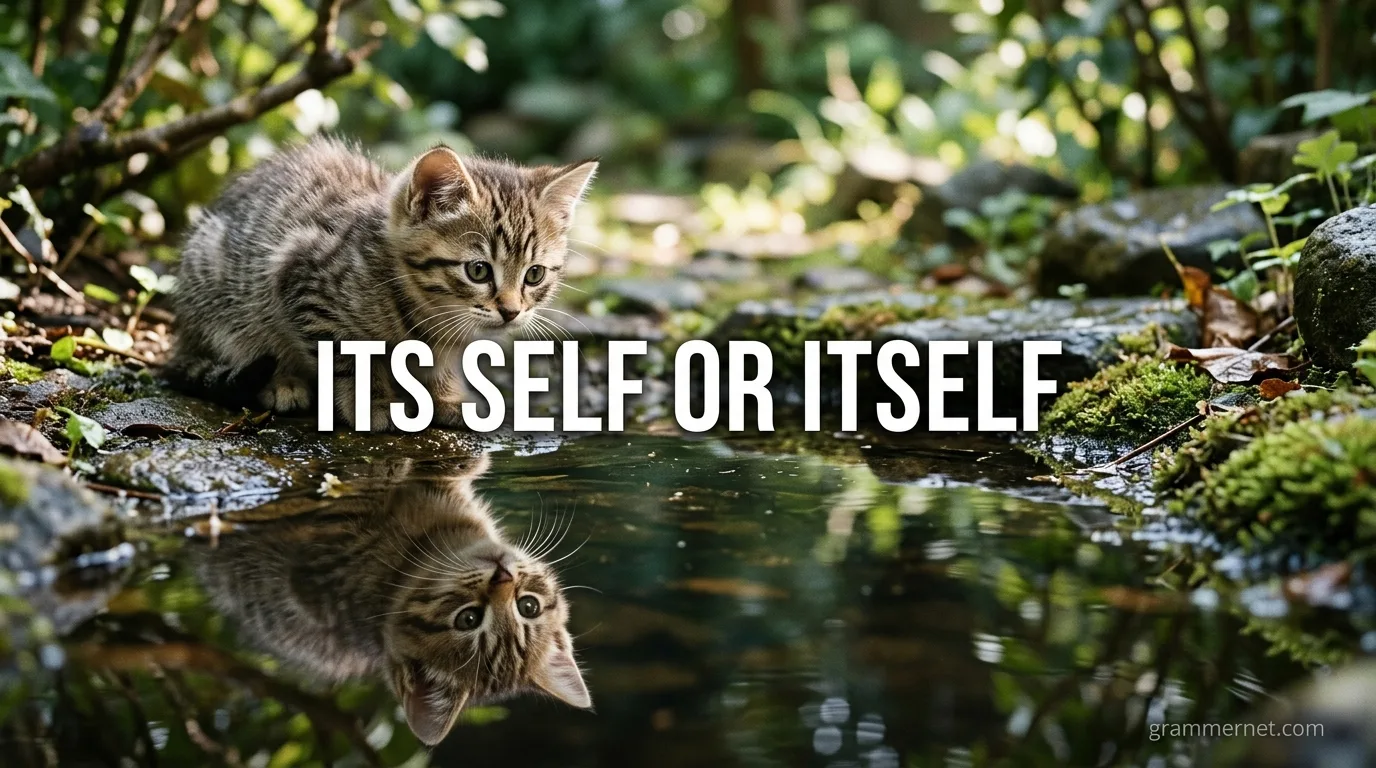
People often get confused about its self and itself because the two look similar and both seem to refer to the same idea: something referring back to “it.” The confusion matters in everyday writing, speaking, exams, and professional communication because a small spelling or grammar error can make your English look less polished. The good news is that the correct form is usually easy to remember once you understand how the words work. In this article, you will learn the meaning, correct usage, spelling differences, grammar rules, pronunciation, sentence examples, common mistakes, and simple memory tips so you can use the right form confidently.
What Do “Its Self” and “Itself” Mean?
The correct standard word is itself. It is a reflexive pronoun used when the subject and object refer to the same thing.
Examples:
- The dog hurt itself.
- The machine turned itself off.
- The city is proud of itself.
In these sentences, itself refers back to “it,” and the action returns to the same subject.
What about “its self”?
In most modern English writing, its self is not the standard form when you mean the reflexive pronoun. It is usually a mistake for itself.
However, the word self is a real noun, so in some very rare or special contexts, a writer might use its self to mean “its own self” or “its inner self.” That is uncommon and usually not what learners mean.
Simple meaning table
| Form | Standard meaning | Common use |
| itself | reflexive pronoun for “it” | correct and very common |
| its self | “its own self” in rare special use | usually incorrect in everyday English |
Easy memory trick
If you mean the thing referring back to itself, use itself.
If you are unsure, itself is almost always the correct answer.
Correct Usage of “Itself”
Use itself when the subject and the object are the same thing.
Common sentence patterns
- subject + verb + itself
- subject + verb + prep. + itself
- subject + itself + verb phrase
Examples
- The baby is trying to feed itself.
- The company introduced itself to the new employees.
- The door locked itself.
- The plant grows by itself in the wild.
Correct and incorrect examples
| Correct | Incorrect |
| The cat cleaned itself. | The cat cleaned its self. |
| The phone turned itself off. | The phone turned its self off. |
| The machine repaired itself. | The machine repaired its self. |
When “itself” is especially useful
You will often see it in:
- everyday descriptions
- science writing
- technical instructions
- formal reports
- academic examples
Real-life examples
- The system resets itself every night.
- The river changes course by itself over time.
- The organization is trying to rebuild itself after the crisis.
Important note
Do not separate it and self in normal modern English unless you have a special stylistic reason. For practical writing, itself is the form to use.
Spelling Differences: Why “Its Self” Looks Right but Usually Isn’t
The confusion comes from the spelling of its and it’s, and from the fact that self is a real word.
The key spelling facts
- itself = correct reflexive pronoun
- its self = usually incorrect in normal usage
- it’s = contraction of it is or it has
Spelling comparison table
| Word/phrase | Meaning | Example |
| itself | reflexive pronoun | The dog hurt itself. |
| its self | unusual phrase, rare special meaning | not normal in everyday writing |
| its | possessive determiner | The dog lost its collar. |
| it’s | it is / it has | It’s raining. |
Why the mistake happens
Many learners think:
- its + self = its self
But English does not normally build the reflexive pronoun that way. Instead, the reflexive form is a single word: itself.
Visual comparison
Look closely:
- its = possessive
- itself = reflexive pronoun
These are different jobs.
Incorrect spelling patterns to avoid
- its self
- it self
- it’s self when meaning reflexive
Correct:
- itself
Memory tip
If the word refers back to “it,” think of the whole unit:
- itself, not “its self”
Grammar Rules: How Reflexive Pronouns Work
Itself belongs to the family of reflexive pronouns. These are words that refer back to the same noun or pronoun already mentioned.
Reflexive pronouns list
- myself
- yourself
- himself
- herself
- itself
- ourselves
- yourselves
- themselves
Grammar comparison table
| Subject | Reflexive pronoun | Example |
| I | myself | I taught myself. |
| you | yourself | You should help yourself. |
| he | himself | He blamed himself. |
| she | herself | She prepared herself. |
| it | itself | The machine shut itself down. |
| we | ourselves | We enjoyed ourselves. |
| they | themselves | They introduced themselves. |
Rule 1: Use a reflexive pronoun when the subject and object are the same
Examples:
- The bird freed itself.
- The system updates itself.
- The package opened itself.
Rule 2: Do not confuse reflexive pronouns with possessive determiners
Compare:
- The cat licked its paw.
(“its” shows possession) - The cat cleaned itself.
(“itself” refers back to the cat)
Rule 3: Reflexive pronouns can emphasize
Sometimes itself is used for emphasis, not only as a reflexive object.
Examples:
- The company itself announced the change.
- The machine itself is not the problem.
- The city itself is beautiful.
Rule 4: The form is fixed
Unlike some other English expressions, itself does not change spelling based on the sentence. It remains itself in standard English.
Correct and incorrect examples
| Correct | Incorrect |
| The computer restarted itself. | The computer restarted its self. |
| The committee made the decision itself. | The committee made the decision its self. |
| The dog hurt itself. | The dog hurt it self. |
Simple rule to remember
If it is the subject and it acts on itself, use itself.
British vs American English: Is There a Difference?
There is no major British vs American English difference for itself. Both varieties use the same spelling and the same grammar.
What stays the same
- itself is correct in both British and American English
- its self is not the standard reflexive form in either variety
Style comparison table
| Variety | Correct form | Notes |
| British English | itself | same as standard English |
| American English | itself | same as standard English |
Why this matters
Sometimes learners expect a British or American spelling difference, but this is not one of those cases. The issue is not regional spelling. It is simply the correct reflexive pronoun.
Practical takeaway
No matter where you are writing:
- school essay
- business email
- website content
- exam answer
Use itself.
Pronunciation of “Itself”
The word itself is pronounced as a single unit.
Pronunciation
- itself → /ɪtˈself/
Syllable breakdown
- it
- self
Spoken examples
- The door closed itself.
- The machine fixed itself.
- The team introduced itself.
Why pronunciation matters
When spoken, itself sounds like one smooth word. That may be one reason learners sometimes imagine it should be written as two parts, like “its self.” But spelling in English does not always match the way a word feels in speech.
Memory tip
Say it slowly:
- it-self
Then remember: even though it sounds like two parts, it is written as one word.
Sentence Examples: Correct and Incorrect Uses
Examples are the easiest way to understand the difference.
Correct examples with “itself”
- The cat cleaned itself after eating.
- The engine turned itself off.
- The problem solved itself over time.
- The child dressed itself in the costume.
- The company is trying to improve itself.
Examples of emphasis
- The city itself is very old.
- The project itself is not difficult.
- The machine itself is fine; the problem is the power supply.
Incorrect examples
- The cat cleaned its self after eating.
- The engine turned its self off.
- The problem solved its self over time.
- The company is trying to improve it self.
Correct and incorrect table
| Correct | Incorrect |
| The phone switched itself off. | The phone switched its self off. |
| The machine reset itself. | The machine reset it self. |
| The dog hurt itself. | The dog hurt its self. |
Real-life usage
You will often see itself in:
- instructions: “The device shuts itself down.”
- descriptions: “The system updates itself automatically.”
- formal writing: “The organization must rebuild itself.”
One sentence with both “its” and “itself”
- The dog lost its collar and then cleaned itself.
This shows the difference clearly:
- its = possession
- itself = reflexive pronoun
Common Mistakes Learners Make
The biggest mistake is splitting the word into two parts: its self.
Mistake 1: Writing “its self” instead of “itself”
Wrong:
- The machine fixed its self.
Correct:
- The machine fixed itself.
Mistake 2: Mixing up “its” and “it’s”
Wrong:
- The cat cleaned it’s self.
Correct:
- The cat cleaned itself.
Why?
- it’s = it is / it has
- its = possession
- itself = reflexive pronoun
Mistake 3: Using “itself” when “its” is needed
Wrong:
- The dog lost itself bone.
Correct:
- The dog lost its bone.
Mistake 4: Using two words in formal writing
Wrong:
- The organization improved its self over time.
Correct:
- The organization improved itself over time.
Common mistake table
| Wrong | Right |
| its self | itself |
| it’s self | itself |
| it self | itself |
| its collar | its collar |
| it’s collar | its collar |
Why learners make this mistake
- “its” and “it’s” are easy to confuse
- “self” is a real word
- speech can make the phrase sound like two parts
- spellcheck may not always explain the grammar
Best proofreading strategy
Ask:
- Does the word refer back to it?
- Is the sentence about the same thing acting on itself?
- If yes, write itself
FAQs
Is “its self” correct?
In normal modern English, no. The correct reflexive pronoun is itself.
Is “itself” one word or two?
It is one word.
What does “itself” mean?
It is a reflexive pronoun that refers back to “it.” It can also be used for emphasis.
Is “its” the same as “itself”?
No. Its shows possession, while itself refers back to the subject.
Is there a British or American difference?
No. Both varieties use itself.
Can “its self” ever be used?
Only in very rare or special writing, when someone literally means “its own self” or wants a stylistic effect. For everyday English, use itself.
How can I remember the correct spelling?
Think:
- its = possession
- itself = reflexive pronoun
- if it refers back to the thing, use itself
Is “itself” always reflexive?
Mostly yes, but it can also be used for emphasis:
- The company itself made the announcement.
Conclusion
The correct standard form is itself. In modern English, its self is usually a mistake when you mean the reflexive pronoun. The word itself is a single reflexive pronoun used when “it” acts on or refers back to the same thing. It can also be used for emphasis, such as in “The city itself is beautiful.”
A simple memory trick will help:
- its = possession
- itself = reflexive pronoun
- its self = usually incorrect in everyday English
So, the next time you are writing an essay, email, report, or message, remember this rule: if you mean “it + self” in the reflexive sense, write itself as one word. That small choice will make your writing clearer, more correct, and more professional every time.
