
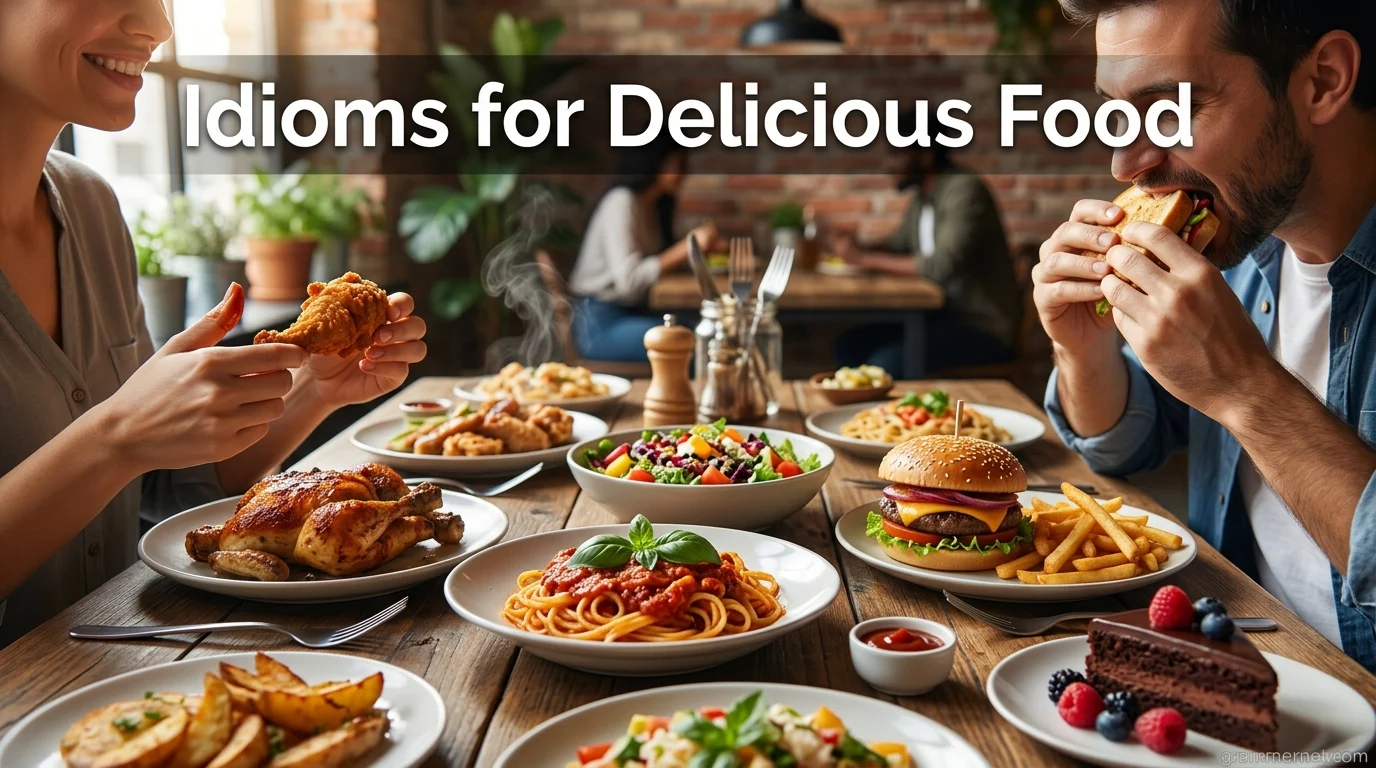
Food is more than just something we eat—it is part of culture, conversation, celebration, and emotion. Learning idioms for delicious food helps English learners sound more natural, expressive, and confident in everyday conversations. These idioms are commonly used in restaurants, family gatherings, social media captions, and casual chats.
By understanding food-related expressions, students and professionals can improve vocabulary, communication skills, and cultural understanding. Whether you want to describe a mouthwatering meal or compliment a cook creatively, these idioms will make your English more colorful and engaging.
Why idioms for delicious food matter
Food is a universal topic. People talk about it every day—at home, in restaurants, and online. Native English speakers often use idioms to describe how good food tastes.
Using idioms helps you:
- sound more fluent and natural
- express excitement and enjoyment
- understand restaurant reviews and cooking shows
- describe food in a more creative way
- connect better in social and professional situations
For students and professionals, these idioms are especially useful in hospitality, travel, blogging, and everyday communication.
What “delicious food” means in idiomatic English
In simple terms, “delicious food” means food that tastes very good. But idiomatic English uses fun and imaginative expressions to describe this feeling.
For example:
- “This cake is to die for.”
- “That dish is finger-licking good.”
- “The meal was out of this world.”
These idioms show strong enjoyment and emotional reaction to food.
What Are Idioms for Delicious Food?
Idioms for delicious food are expressions used to describe food that tastes amazing, satisfying, or irresistible. These phrases often have meanings beyond the literal words and are widely used in spoken and written English.
For example, if someone says, “This cake is to die for,” they do not literally mean dying. They simply mean the cake tastes extremely good.
Learning these idioms can help you:
- Speak English more naturally
- Understand movies, TV shows, and native speakers
- Describe food creatively
- Improve conversational fluency
- Make your writing more engaging
Popular Idioms for Delicious Food
Finger-licking good
Meaning: Extremely tasty food.
Example:
“The fried chicken was finger-licking good.”
Alternative Expressions:
- Mouthwatering
- Delicious
- Tasty as ever
Typical Use Cases:
Used for fast food, BBQ, fried food, and homemade meals.
Fun Fact:
This idiom became famous through advertising slogans.
To die for
Meaning: So delicious that it feels irresistible.
Example:
“The chocolate brownies are to die for.”
Alternative Expressions:
- Heavenly
- Incredible
- Amazing
Use Scenario:
Restaurants, dessert reviews, food blogs.
Common Mistake:
Do not use this phrase in serious or tragic situations because it is informal and exaggerated.
Piece of cake
Meaning: Something very easy.
Although not directly about taste, it is a famous food idiom.
Example:
“The cooking exam was a piece of cake.”
Alternative Expressions:
- Easy as pie
- No problem
Origin:
The phrase became popular in American English during the 20th century.
Easy as pie
Meaning: Very simple or effortless.
Example:
“Making this pasta recipe is easy as pie.”
Alternative Expressions:
- Piece of cake
- Simple task
Use Case:
Cooking tutorials, school discussions, workplace conversations.
Full of beans
Meaning: Energetic and lively.
Example:
“After breakfast, the kids were full of beans.”
Connection to Food:
Beans symbolize energy and strength.
Spice things up
Meaning: To make something more exciting or interesting.
Example:
“They added chili sauce to spice things up.”
Alternative Meanings:
Can also describe exciting activities or relationships.
Bring home the bacon
Meaning: To earn money for the family.
Example:
“She works hard to bring home the bacon.”
Fun Fact:
This idiom dates back hundreds of years when bacon was considered valuable food.
Food for thought
Meaning: Something worth thinking deeply about.
Example:
“The documentary gave me food for thought about healthy eating.”
Alternative Expressions:
- Something to consider
- Thought-provoking idea
Eat like a horse
Meaning: To eat a very large amount of food.
Example:
“After football practice, he ate like a horse.”
Use Case:
Casual conversations with friends and family.
Have bigger fish to fry
Meaning: To have more important things to do.
Example:
“I cannot worry about dessert right now; I have bigger fish to fry.”
Idioms Grouped by Context
Restaurant Conversations
| Idiom | Meaning | Example |
|---|---|---|
| Finger-licking good | Very tasty | “The wings were finger-licking good.” |
| To die for | Extremely delicious | “Their cheesecake is to die for.” |
| Eat like a king | Eat luxuriously | “We ate like kings at the buffet.” |
Cooking and Recipes
| Idiom | Meaning | Example |
|---|---|---|
| Spice things up | Make exciting | “Add herbs to spice things up.” |
| Piece of cake | Very easy | “This recipe is a piece of cake.” |
| Easy as pie | Very simple | “Baking cookies is easy as pie.” |
Idioms About Eating Habits
| Idiom | Meaning | Example |
|---|---|---|
| Eat like a horse | Eat a lot | “Teenagers often eat like horses.” |
| In a pickle | In trouble | “I forgot the recipe and got in a pickle.” |
| Cry over spilled milk | Complain about the past | “The cake burned, but don’t cry over spilled milk.” |
Common idioms for delicious food
1. To die for
Meaning: Extremely delicious.
Example: This chocolate cake is to die for.
Alternative expressions: amazing, incredible, heavenly, irresistible
Typical use case: Used when food tastes so good that it feels unforgettable.
Fun note: The phrase exaggerates enjoyment—it does not mean actual danger.
2. Finger-licking good
Meaning: So tasty that you want to lick your fingers.
Example: The fried chicken was finger-licking good.
Alternative expressions: very tasty, mouthwatering, delicious
Typical use case: Common in casual conversation and food advertising.
Fun fact: This phrase became famous through fast-food marketing.
3. Out of this world
Meaning: Extremely good, beyond normal experience.
Example: The pasta was out of this world.
Alternative expressions: amazing, fantastic, extraordinary
Typical use case: Used to strongly praise food or experiences.
4. Mouthwatering
Meaning: Looks or smells so good that it makes you want to eat.
Example: The aroma of the curry was mouthwatering.
Alternative expressions: tempting, appetizing, delicious-looking
Typical use case: Common in writing, menus, and food blogs.
5. Melt in your mouth
Meaning: Very soft and delicious.
Example: The cookies just melt in your mouth.
Alternative expressions: soft and tasty, smooth, rich
Typical use case: Often used for desserts, chocolates, or tender meat.
6. Packed with flavor
Meaning: Full of strong and enjoyable taste.
Example: The dish was packed with flavor.
Alternative expressions: rich taste, full of spices, flavorful
Typical use case: Used in cooking shows and food reviews.
7. A taste of heaven
Meaning: Extremely delicious and satisfying.
Example: That dessert was a taste of heaven.
Alternative expressions: divine, heavenly, amazing
Typical use case: Used when food feels comforting and perfect.
8. Food coma (informal)
Meaning: Feeling very full and happy after eating delicious food.
Example: After that meal, I’m in a food coma.
Alternative expressions: very full, satisfied, sleepy after eating
Typical use case: Used humorously after a big meal.
9. Lip-smacking
Meaning: Very tasty and enjoyable.
Example: The biryani was lip-smacking.
Alternative expressions: delicious, tasty, flavorful
Typical use case: Common in South Asian English and food descriptions.
10. Bursting with flavor
Meaning: Extremely rich in taste.
Example: The fruit was bursting with flavor.
Alternative expressions: full of taste, juicy, rich
Typical use case: Used for fruits, sauces, and fresh dishes.
Idioms for delicious food by context
In restaurants and dining
People use idioms to describe meals and dishes.
Examples:
- “The steak was melt in your mouth.”
- “The dessert was to die for.”
- “Everything was packed with flavor.”
In food reviews and blogging
Food writers use expressive idioms to attract readers.
Examples:
- “A mouthwatering experience.”
- “The dish was bursting with flavor.”
- “A taste of heaven in every bite.”
In everyday conversation
Friends and family often use simple idioms.
Examples:
- “That was finger-licking good.”
- “I’m in a food coma.”
- “This is out of this world!”
In professional settings
Chefs and food professionals may use more refined expressions.
Examples:
- “The dish is rich and flavorful.”
- “Perfectly balanced taste.”
- “A delightful culinary experience.”
Polite and professional alternatives
Instead of informal idioms, use:
- delicious and well-prepared
- rich in flavor
- highly enjoyable
- expertly cooked
- well-balanced taste
These are ideal for formal writing, reviews, and business communication.
Tone guide: choosing the right idiom
Casual and fun
- finger-licking good
- food coma
- lip-smacking
Expressive and emotional
- to die for
- taste of heaven
- out of this world
Neutral and descriptive
- mouthwatering
- packed with flavor
- bursting with flavor
Choosing the right tone helps you sound natural and appropriate.
Common mistakes to avoid
Using idioms in formal writing
Avoid phrases like “to die for” in professional reports.
Overusing strong expressions
Not every meal is “out of this world.” Use variety.
Using idioms incorrectly
Example mistake: “The soup is melt in your mouth” → correct: “melts in your mouth.”
Ignoring cultural context
Some idioms may sound too dramatic or informal in certain cultures.
Literal misunderstanding
Idioms are figurative. “Food coma” does not mean a real medical condition.
Fun facts and origins
Many food idioms come from sensory experiences:
- mouthwatering comes from physical reaction to smell
- finger-licking good reflects real eating behavior
- taste of heaven connects food with pleasure and comfort
These make idioms easy to remember and fun to use.
How to use idioms for delicious food effectively
Start simple
Use easy idioms like:
- delicious
- mouthwatering
- packed with flavor
Practice in real situations
Describe meals you eat daily.
Match the situation
Use casual idioms with friends, formal phrases at work.
Combine with adjectives
Example: “The dessert was absolutely mouthwatering.”
Listen and observe
Watch cooking shows, food vlogs, and restaurant reviews.
Interactive exercise 1: Match the idiom
Easy
- to die for
- mouthwatering
- food coma
- melt in your mouth
A. very soft and tasty B. extremely delicious C. feeling full after eating D. looks very tasty
Answers: 1-B, 2-D, 3-C, 4-A
Interactive exercise 2: Fill in the blanks
Medium
- The cake was ________. I want another slice!
- The smell of the food was ________.
- After dinner, I felt like I was in a ________.
- The meat just ________.
Answers:
- to die for
- mouthwatering
- food coma
- melts in your mouth
Interactive exercise 3: Choose the best option
Advanced
Which phrase is best for a formal review?
A. The dish was finger-licking good. B. The meal was to die for. C. The dish was rich in flavor and expertly prepared. D. I had a food coma.
Answer: C. The dish was rich in flavor and expertly prepared.
Mini quiz
Easy
Which idiom means “very tasty”?
A. food coma B. finger-licking good C. cold dish
Answer: B
Medium
Which idiom describes appearance or smell?
A. mouthwatering B. food coma C. walk in the park
Answer: A
Advanced
Why should idioms be used carefully in professional settings?
Suggested answer: Because they can sound too informal or exaggerated.
Suggested visuals and infographics
To make learning easier, include:
- a flavor intensity chart
- icons (cake, fire, spoon, heart) for each idiom
- before-and-after sentences (basic vs idiomatic)
- restaurant scenario illustrations
- tone comparison charts (formal vs informal)
These visuals improve memory and understanding.
Best idioms to learn first
Start with:
- to die for
- mouthwatering
- finger-licking good
- melt in your mouth
- packed with flavor
These are common and easy to use.
FAQs
Q1: What are idioms for delicious food?
They are expressions used to describe food as very tasty using creative language.
Q2: Which idiom is most common?
“To die for” and “finger-licking good” are very popular.
Q3: Can I use these idioms in formal writing?
It’s better to use neutral expressions like “rich in flavor.”
Q4: Are these idioms useful for speaking English?
Yes, they make your speech more natural and expressive.
Q5: What is the safest idiom to use?
“Mouthwatering” is widely accepted and less informal.
Q6: Do these idioms work in all cultures?
Most are understood globally, but tone and context still matter.
Conclusion
Learning idioms for delicious food is a fun and effective way to improve English vocabulary and communication skills. These expressions make conversations more colorful, emotional, and natural. From “finger-licking good” to “piece of cake,” food idioms are commonly used in daily life, restaurants, movies, and social interactions.
The best way to master these idioms is through regular practice, real conversations, and engaging exercises. Start using them naturally in your speaking and writing, and you will sound more fluent and confident in English. Food brings people together, and food idioms can help bring your English to life too
