
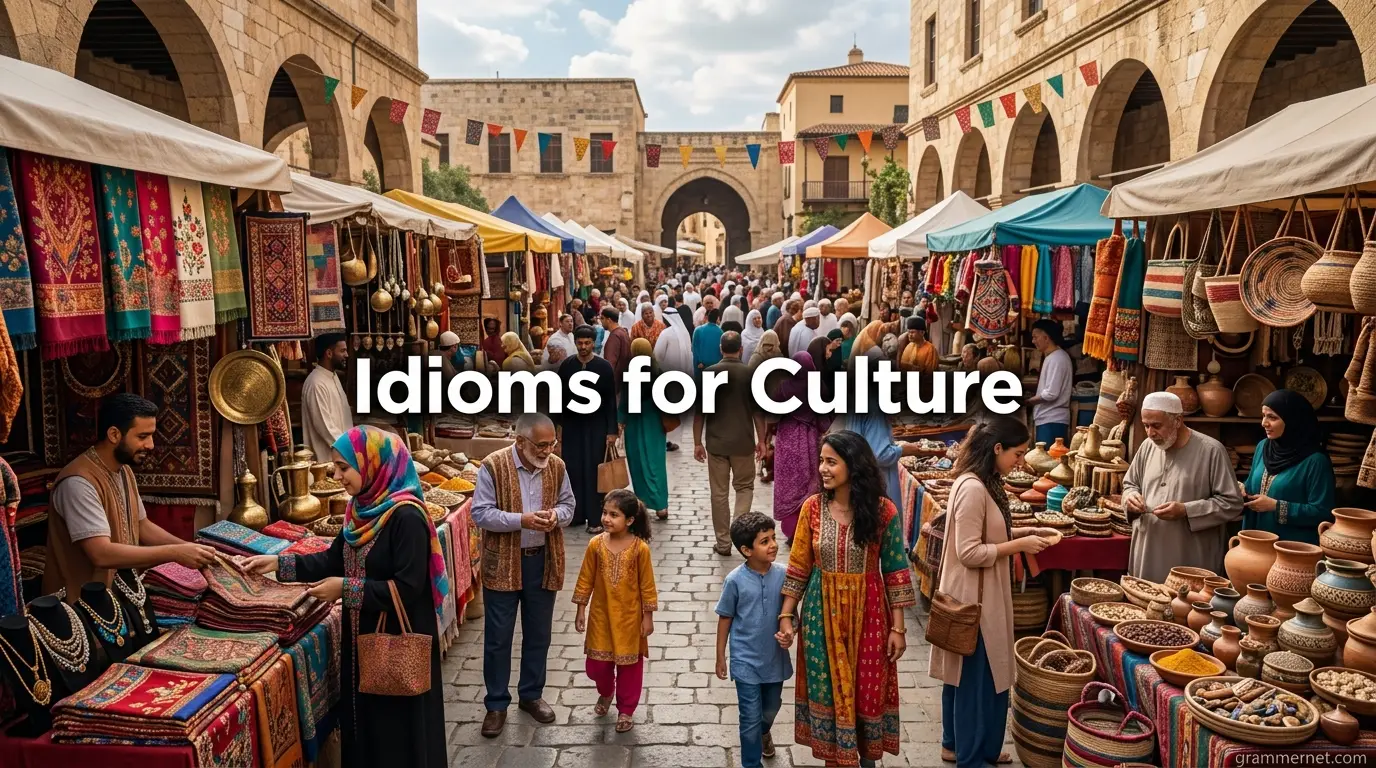
Culture shapes how people speak, think, behave, and connect with one another. That is why learning idioms for culture is so useful for English learners, students, and professionals who want to communicate more naturally and understand real-life English in context. These expressions help you talk about traditions, diversity, customs, social values, and different ways of living in a more vivid and memorable way. They also make your English sound more fluent, especially in conversations, presentations, writing, and cultural discussions.
What Are Idioms for Culture?
Idioms for culture are expressions that describe cultural ideas, traditions, social habits, identity, and the differences or similarities between groups of people. These phrases often go beyond literal meanings and reflect how English speakers talk about society and shared values.
For example, when someone says “a melting pot,” they are not talking about a real cooking pot. They mean a place where many cultures come together and blend.
These idioms are especially useful when discussing:
- diversity
- traditions
- social behavior
- customs
- globalization
- communication between cultures
Why Learn Idioms About Culture?
Learning culture idioms has both practical and emotional benefits.
Practical benefits
- Helps you understand native speakers more easily
- Improves reading and listening comprehension
- Gives you stronger vocabulary for essays, interviews, and discussions
- Helps you talk about social issues more naturally
Emotional benefits
- Makes you more confident when discussing identity and traditions
- Helps you show respect for different cultures
- Makes your English sound thoughtful and mature
- Helps you connect better with people from different backgrounds
Culture idioms are important because culture is everywhere in language: in food, behavior, history, and everyday life.
Common Idioms for Culture
1. Melting Pot
Meaning: A place or society where people from different cultures mix together and create something new.
Example: “New York is often described as a melting pot of cultures.”
Alternative expressions:
- multicultural society
- diverse community
- cultural mix
Typical use cases:
- cities
- countries
- schools
- workplaces
Fun fact / origin: This phrase became popular in the United States to describe immigrants from many backgrounds living together and blending their traditions.
2. Cultural Mosaic
Meaning: A society made up of different cultural groups that keep their own identities while living together.
Example: “Canada is often called a cultural mosaic.”
Alternative expressions:
- multicultural society
- diverse nation
- variety of cultures
Typical use cases:
- national identity
- immigration
- diversity discussions
Fun fact / origin: A mosaic is made of many different colored pieces that form one picture, which is a strong image for cultural diversity.
3. When in Rome, Do as the Romans Do
Meaning: When you are in a different place or culture, follow its customs and behavior.
Example: “When in Rome, do as the Romans do, so I tried the local food and greeted people the way they do.”
Alternative expressions:
- adapt to local customs
- follow local traditions
- respect local culture
Typical use cases:
- travel
- international business
- cultural etiquette
Fun fact / origin: This proverb dates back many centuries and is often linked to advice about adapting to different religious and social customs.
4. The Way of the World
Meaning: The usual way society works; the normal behavior or patterns of people.
Example: “Competition is just the way of the world in many industries.”
Alternative expressions:
- social norm
- common practice
- usual behavior
Typical use cases:
- social commentary
- cultural analysis
- everyday observations
5. Home Sweet Home
Meaning: A pleasant way to describe the comfort and warmth of one’s home and familiar culture.
Example: “After traveling for weeks, I was happy to be back—home sweet home.”
Alternative expressions:
- comfortable home
- familiar place
- cozy environment
Typical use cases:
- travel returns
- family life
- nostalgic writing
Fun fact / origin: This expression became popular in English literature and songs as a celebration of home and belonging.
6. A Country Mile
Meaning: A large difference; a long distance in terms of quality, size, or amount.
Example: “The local version is better by a country mile.”
Alternative expressions:
- by far
- much better
- a long way ahead
Typical use cases:
- comparisons
- sports
- product reviews
Cultural note: It often appears in British English and may sound slightly rural or old-fashioned.
7. A World Apart
Meaning: Very different from each other.
Example: “Urban and rural lifestyles can be a world apart.”
Alternative expressions:
- completely different
- vastly different
- very unlike
Typical use cases:
- comparing societies
- travel experiences
- cultural differences
8. A Whole New Ball Game
Meaning: A completely different situation, often more complex or challenging.
Example: “Living in another country is a whole new ball game.”
Alternative expressions:
- completely different experience
- new challenge
- different situation
Typical use cases:
- immigration
- work changes
- cultural adjustment
Fun fact / origin: The phrase comes from sports, especially baseball, where a new game means a new set of conditions.
9. A Fish Out of Water
Meaning: A person who feels uncomfortable or out of place in a new environment.
Example: “At the formal dinner, he felt like a fish out of water.”
Alternative expressions:
- out of place
- uncomfortable
- not fitting in
Typical use cases:
- social events
- cultural adaptation
- first-time experiences
Fun fact / origin: A fish cannot survive well outside water, which makes this image a strong symbol for discomfort.
10. Like a Small Fish in a Big Pond
Meaning: Someone who is not very important or experienced in a large, competitive environment.
Example: “When she joined the big company, she felt like a small fish in a big pond.”
Alternative expressions:
- beginner in a large system
- low-level person in a big organization
- inexperienced newcomer
Typical use cases:
- school
- work
- new environments
11. Learn the Ropes
Meaning: To learn how something works, especially a system, job, or culture.
Example: “It took him a few weeks to learn the ropes at the new school.”
Alternative expressions:
- learn the basics
- get familiar with
- understand how things work
Typical use cases:
- new jobs
- new countries
- training periods
12. Cross-Cultural
Meaning: Involving people, ideas, or communication between different cultures.
Example: “The course focuses on cross-cultural communication.”
Alternative expressions:
- multicultural
- intercultural
- international
Typical use cases:
- education
- business
- travel
- diplomacy
Note: This is more of a common phrase than a classical idiom, but it is extremely useful in culture-related English.
13. In the Same Boat
Meaning: In the same difficult situation as other people.
Example: “Many international students are in the same boat when they first arrive.”
Alternative expressions:
- in the same situation
- sharing the same problem
- facing the same challenge
Typical use cases:
- shared experiences
- teamwork
- support discussions
14. A Glocal Mindset
Meaning: Thinking globally while acting locally.
Example: “Companies need a glocal mindset to succeed in international markets.”
Alternative expressions:
- global and local awareness
- worldwide thinking with local sensitivity
Typical use cases:
- business
- marketing
- education
- international communication
Note: This is a modern phrase rather than a traditional idiom, but it is highly relevant in cultural discussions.
15. Blow One’s Own Horn
Meaning: To brag or talk proudly about oneself.
Example: “Some brands blow their own horn when advertising cultural products.”
Alternative expressions:
- brag
- boast
- self-promote
Typical use cases:
- personal branding
- business marketing
- casual criticism
Fun fact / origin: The phrase comes from the image of announcing oneself loudly with a horn.
Idioms for Culture by Context
Diversity and Identity
- melting pot
- cultural mosaic
- cross-cultural
- glocal mindset
Adaptation and Etiquette
- when in Rome, do as the Romans do
- learn the ropes
- home sweet home
Difference and Comparison
- a world apart
- a country mile
- a whole new ball game
Belonging and Discomfort
- a fish out of water
- in the same boat
- a small fish in a big pond
Grouping idioms by context makes them much easier to remember and use naturally.
How to Use Culture Idioms Naturally
Think about the setting
Some idioms are great for casual conversation, while others are better for academic or professional writing.
- Casual: a fish out of water
- Formal: cross-cultural
- Reflective: home sweet home
Learn with examples
It is easier to remember an idiom if you learn it in a complete sentence.
Listen to real English
Movies, podcasts, interviews, and cultural documentaries are great sources.
Practice comparing cultures
Use the idioms when talking about:
- traditions
- travel
- adaptation
- customs
- diversity
Common Mistakes to Avoid
Taking idioms literally
A melting pot is not an actual cooking pot in this context.
Using the wrong tone
Some idioms sound casual or even old-fashioned, so use them carefully.
Confusing similar expressions
- melting pot = cultures blend together
- cultural mosaic = cultures coexist while staying distinct
- a world apart = very different
Overusing idioms
Too many idioms in one paragraph can sound unnatural.
Using cultural idioms without context
Always make sure the idiom fits the situation and audience.
Fun Facts Behind Culture Idioms
Melting Pot
This phrase became especially popular in immigration-related discussions in the United States.
Cultural Mosaic
The mosaic image is powerful because it shows diversity without loss of identity.
When in Rome
This phrase has been used for centuries to encourage adaptability and respect.
Fish Out of Water
This is one of the most widely used idioms for feeling out of place in a cultural setting.
Knowing origins can make idioms more memorable and meaningful.
Practice Exercises
Exercise 1: Fill in the Blanks (Easy)
- Canada is often described as a cultural ________.
- He felt like a fish out of ________ at the formal dinner.
- When in ________, do as the Romans do.
Answers
- mosaic
- water
- Rome
Exercise 2: Match the Idiom to the Meaning (Medium)
IdiomMeaningA world apartA. Adapt to local customsWhen in RomeB. Very differentLearn the ropesC. Understand how something works
Answers
- A world apart → B
- When in Rome → A
- Learn the ropes → C
Exercise 3: Choose the Best Idiom (Advanced)
- “The two cultures were completely different.”
- “He was uncomfortable in the new environment.”
- “I need to understand how this new system works.”
Answers
- A world apart / a whole new ball game
- A fish out of water
- Learn the ropes
Quick Quiz
Question 1
Which idiom means “a society with many cultures blending together”?
A. Cultural mosaic B. Home sweet home C. In the same boat
Answer: A
Question 2
Which idiom means “to follow local customs”?
A. Blow one’s own horn B. When in Rome, do as the Romans do C. A country mile
Answer: B
Question 3
Which idiom means “feeling uncomfortable in a new place”?
A. A fish out of water B. A whole new ball game C. Cross-cultural
Answer: A
Tips for Remembering Culture Idioms
Use visual images
Picture a mosaic, a fish out of water, or people from different backgrounds sharing one space.
Make flashcards
Write each idiom with:
- meaning
- example
- your own sentence
- tone or context
Study in themes
Group idioms into:
- diversity
- adaptation
- comparison
- belonging
- globalization
Read about real cultures
Travel writing, anthropology articles, and international news are great sources.
Suggested Visuals and Infographics
To make this topic more engaging, you could include:
- a cultural idiom chart by theme
- a comparison table of “melting pot” vs “cultural mosaic”
- a world map infographic with examples of cultural diversity language
- flashcards with example sentences
- a “adaptation vs belonging” visual
Visuals help learners remember figurative meanings more easily.
Why Learning Idioms for Culture Matters
Culture idioms are useful because language and culture are always connected. English speakers often use these expressions to talk about diversity, traditions, differences, and social behavior. These idioms appear in everyday speech, academic writing, business communication, and international discussions. Learning them helps you understand cultural nuance and express your ideas more naturally.
These idioms are especially helpful when talking about:
- diversity
- travel
- international business
- customs
- identity
- adaptation
FAQs
What are idioms for culture?
They are expressions used to describe cultural differences, traditions, identity, and social behavior in figurative language.
Why should English learners study culture idioms?
They help learners understand real English conversations and speak more naturally about cultural topics.
What does “melting pot” mean?
It means a society where many cultures blend together.
What does “when in Rome, do as the Romans do” mean?
It means to follow local customs when you are in another culture or place.
What does “a fish out of water” mean?
It means feeling uncomfortable or out of place in a new environment.
Is “cultural mosaic” the same as “melting pot”?
No. A cultural mosaic keeps different cultures distinct, while a melting pot blends them together.
Can culture idioms be used in formal writing?
Yes, especially terms like cross-cultural, cultural mosaic, and glocal mindset, but some casual idioms are better for conversation.
Conclusion
Learning idioms for culture is a valuable way to improve your English and understand how language reflects society. These expressions help you talk about diversity, traditions, identity, and adaptation in a vivid and natural way. From melting pot and cultural mosaic to when in Rome, a fish out of water, and a world apart, these idioms are widely used in real English and can make your speaking and writing more expressive.
The best way to master them is through regular practice, reading examples, and using them in real situations. Over time, these culture idioms will become a natural part of your vocabulary and help you communicate with more confidence, respect, and cultural awareness.
