
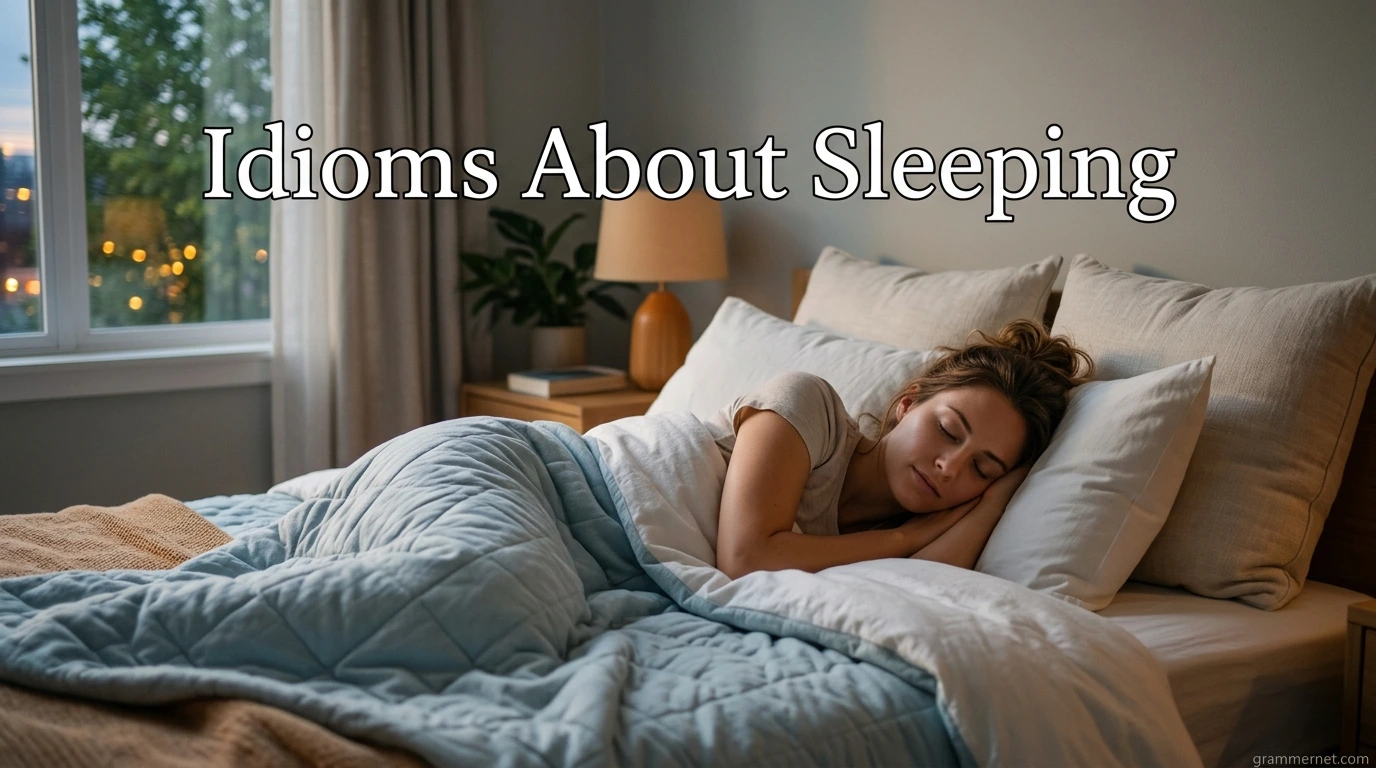
Idioms about sleeping are a useful and fun way to describe rest, tiredness, laziness, alertness, and even life situations in English. For learners, students, and professionals, these expressions make communication more natural and expressive. Instead of saying “I’m very tired,” you can say “I’m dead to the world,” which sounds more vivid and engaging. By learning these idioms, you can improve your fluency, understand native speakers better, and confidently use English in daily conversations, storytelling, and workplace communication.
What Are Idioms About Sleeping?
Idioms about sleeping are figurative expressions related to sleep, rest, dreams, or tiredness. They are not meant to be understood literally. Instead, they reflect real-life situations like exhaustion, relaxation, awareness, or even ignoring something important.
For example:
- “Sleep like a log” means sleeping very deeply
- “Lose sleep over something” means worrying about something
These idioms are widely used in both casual and semi-formal English.
Common Idioms About Sleeping (With Meaning & Examples)
1. Sleep Like a Log
Meaning: To sleep very deeply
Example:
- “After the long journey, I slept like a log.”
Alternative Expressions:
- sleep deeply
- sleep soundly
- sleep heavily
Typical Use Cases:
- after physical work
- long travel
- exhaustion
Fun Fact / Origin: A log (a piece of wood) does not move, which makes it a perfect symbol of deep, still sleep.
2. Sleep Like a Baby
Meaning: To sleep peacefully and comfortably
Example:
- “The baby slept like a baby all night.”
Alternative Expressions:
- sleep peacefully
- rest well
- sleep calmly
Typical Use Cases:
- good rest
- peaceful sleep
Fun Fact: Although babies often wake up at night, this idiom focuses on their calm and relaxed sleeping moments.
3. Dead to the World
Meaning: Sleeping very deeply and unaware of surroundings
Example:
- “He was dead to the world after studying all night.”
Alternative Expressions:
- completely asleep
- deeply unconscious
- fast asleep
Typical Use Cases:
- extreme tiredness
- long sleep
4. Hit the Sack / Hit the Hay
Meaning: To go to bed
Example:
- “I’m really tired, so I’m going to hit the sack.”
Alternative Expressions:
- go to bed
- turn in
- go to sleep
Typical Use Cases:
- casual conversation
- evening routines
Fun Fact / Origin: “Hay” refers to old mattresses filled with hay, and “sack” refers to a bed or sleeping bag.
5. Burn the Midnight Oil
Meaning: To stay awake late working or studying
Example:
- “She burned the midnight oil to prepare for exams.”
Alternative Expressions:
- stay up late
- pull an all-nighter
- work late
Typical Use Cases:
- students
- professionals
- deadlines
6. Lose Sleep Over Something
Meaning: To worry too much about something
Example:
- “Don’t lose sleep over small problems.”
Alternative Expressions:
- worry a lot
- stress about something
- feel anxious
Typical Use Cases:
- stress
- personal concerns
7. Catch Some Z’s
Meaning: To get some sleep
Example:
- “I need to catch some Z’s before the meeting.”
Alternative Expressions:
- take a nap
- get some rest
- sleep a little
Typical Use Cases:
- informal speech
- short rest
Fun Fact / Origin: The letter “Z” represents the sound of snoring in cartoons and comics.
8. Sleep On It
Meaning: To think about something overnight before making a decision
Example:
- “I’ll sleep on it before accepting the job offer.”
Alternative Expressions:
- think it over
- decide later
- reflect
Typical Use Cases:
- decision-making
- problem-solving
9. Not Sleep a Wink
Meaning: To not sleep at all
Example:
- “I didn’t sleep a wink because I was nervous.”
Alternative Expressions:
- stay awake all night
- no sleep
- insomnia
Typical Use Cases:
- anxiety
- stress
- exams
10. Let Sleeping Dogs Lie
Meaning: Avoid bringing up old problems
Example:
- “Let’s not talk about that argument—let sleeping dogs lie.”
Alternative Expressions:
- avoid trouble
- don’t reopen old issues
- leave things as they are
Typical Use Cases:
- relationships
- conflict resolution
11. Fast Asleep
Meaning: Sleeping deeply
Example:
- “The child was fast asleep by 9 PM.”
Alternative Expressions:
- deeply asleep
- sound asleep
Idioms About Sleeping by Context
1. Deep Sleep
- sleep like a log
- dead to the world
- fast asleep
Example:
- “After work, I was dead to the world.”
2. Going to Bed
- hit the sack
- hit the hay
- catch some Z’s
Example:
- “Let’s hit the sack early tonight.”
3. Lack of Sleep or Worry
- not sleep a wink
- lose sleep over something
Example:
- “He didn’t sleep a wink before the exam.”
4. Thinking and Decisions
- sleep on it
- let sleeping dogs lie
Example:
- “I’ll sleep on it and tell you tomorrow.”
Tips for Using Idioms About Sleeping
- Use casual idioms in conversation, not formal writing
- Practice speaking them aloud
- Understand the emotion behind each idiom
- Use them in storytelling or daily conversations
- Learn 3–5 idioms at a time to avoid confusion
Common Mistakes to Avoid
- Taking idioms literally
- Using informal idioms in professional emails
- Mixing idioms incorrectly
- Overusing idioms in one sentence
- Using them without understanding context
Interactive Practice Section
Exercise 1: Fill in the Blanks (Easy)
- I was so tired that I slept like a ______.
- I didn’t sleep a ______ last night.
- Let’s hit the ______ early today.
Answers:
- log
- wink
- sack
Exercise 2: Match the Idiom (Medium)
IdiomMeaningA. Catch some Z’s1. Avoid old problemsB. Let sleeping dogs lie2. Get some sleepC. Sleep on it3. Think before deciding
Answers: A–2, B–1, C–3
Exercise 3: Sentence Creation (Advanced)
Use these idioms:
- Lose sleep over something
- Dead to the world
Sample Answer: “He was dead to the world after losing sleep over his exams.”
Quick Quiz
Question 1
Which idiom means “to go to bed”? A. Sleep on it B. Hit the sack C. Lose sleep
Answer: B
Question 2
Which idiom means “to worry”? A. Lose sleep over something B. Catch some Z’s C. Fast asleep
Answer: A
Real-Life Scenarios
At School
- “I didn’t sleep a wink before the exam.”
At Work
- “I’ll sleep on it before making the decision.”
In Daily Life
- “I’m going to catch some Z’s.”
In Conversations
- “He was dead to the world after the trip.”
Visual and Infographic Ideas
- Sleep cycle charts with idioms
- Cartoon illustrations of idioms
- Flashcards with meanings and examples
- Comparison charts (sleep vs worry idioms)
- Timeline visuals (day vs night expressions)
Why Idioms About Sleeping Matter
Idioms about sleeping are widely used in everyday English. They help describe emotions like tiredness, stress, relaxation, and decision-making. Learning these idioms improves fluency, enhances communication, and makes your speech more engaging and natural.
FAQs
1. What are idioms about sleeping?
They are expressions that use sleep-related words to describe situations like rest, worry, or decisions.
2. Why should I learn sleeping idioms?
They improve fluency and help you communicate naturally.
3. What does “sleep like a log” mean?
It means to sleep very deeply.
4. What does “sleep on it” mean?
It means to think about something before making a decision.
5. Are these idioms formal or informal?
Most are informal and used in daily conversation.
6. How can I practice these idioms?
Use them in sentences, conversations, and exercises.
Conclusion
Idioms about sleeping are an important part of everyday English that help you express tiredness, rest, worry, and decision-making in a natural way. From “sleep like a log” to “let sleeping dogs lie,” these expressions add color and meaning to your communication.
By practicing them regularly, using them in context, and avoiding common mistakes, you can improve your fluency and confidence. Keep learning, keep practicing, and let your English become as smooth and natural as a good night’s sleep.
