
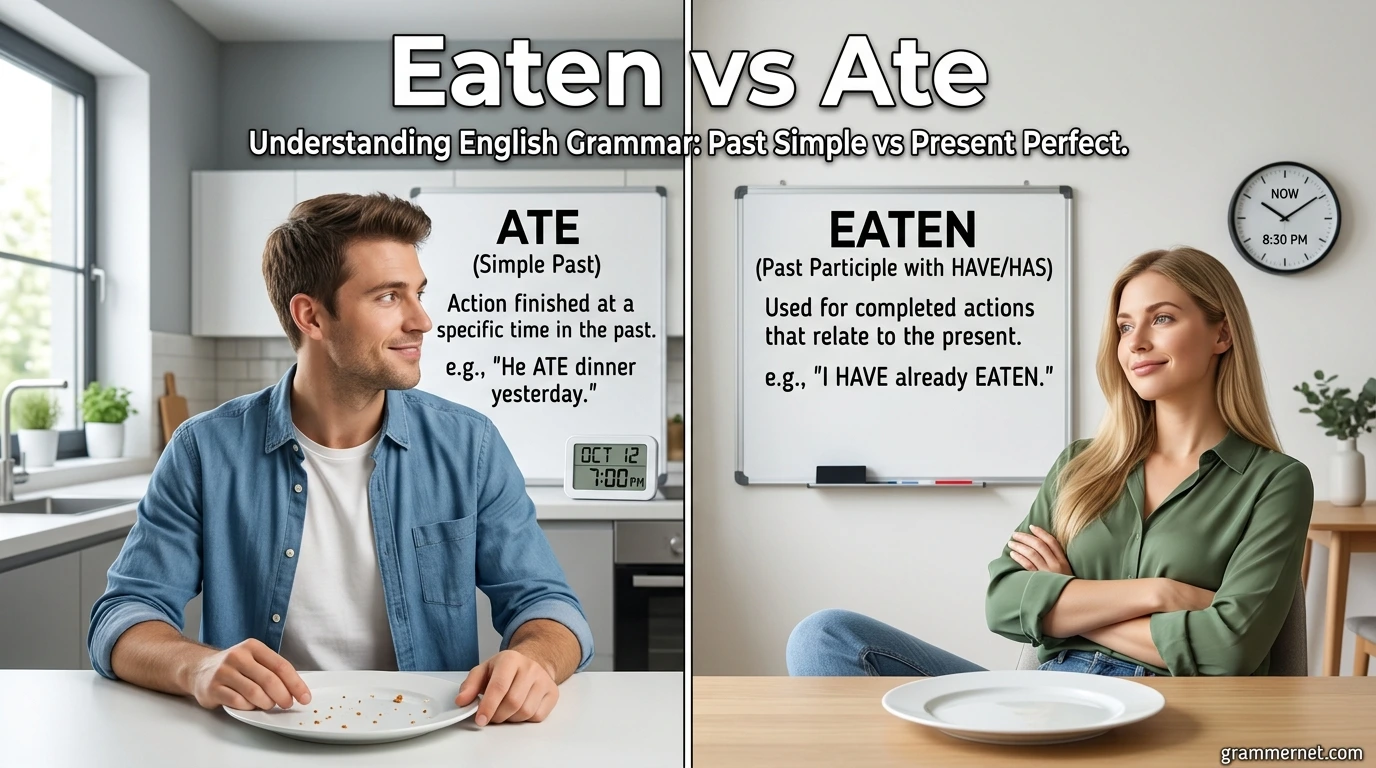
Many English learners struggle with eaten vs ate because both words come from the same verb, eat, and both refer to actions involving food. Since they look similar and relate to the same activity, it is easy to use one when the other is required. This confusion appears in everyday conversations, emails, school assignments, exams, and professional writing.
Understanding the difference between ate and eaten is important because using the wrong form can make a sentence sound unnatural or grammatically incorrect. Fortunately, the distinction is simple once you understand how English verb tenses work. This guide explains everything you need to know about eaten vs ate, including meanings, grammar rules, pronunciation, examples, common mistakes, and practical tips to remember the difference.
Understanding the Meaning of Ate and Eaten
Both ate and eaten come from the verb eat, which means to consume food.
The verb forms are:
- Base form: eat
- Past simple: ate
- Past participle: eaten
Example of all three forms
- I eat breakfast every morning.
- I ate breakfast at 8 a.m.
- I have eaten breakfast already.
Although both words refer to eating, they perform different grammatical functions.
Quick Definition
| Form | Word | Function |
| Base Verb | Eat | Present tense form |
| Past Simple | Ate | Describes a completed action in the past |
| Past Participle | Eaten | Used with helping verbs such as have, has, had |
| Present Participle | Eating | Used in continuous tenses |
The biggest rule to remember is:
Ate can stand alone as the main verb. Eaten usually cannot stand alone and needs a helping verb.
What Does Ate Mean?
Ate is the simple past tense of the verb eat.
It describes an action that happened and finished in the past.
Examples
- I ate lunch at noon.
- She ate an apple yesterday.
- We ate dinner before the movie.
- They ate all the cookies.
In each example, the eating action happened in the past and is complete.
When to Use Ate
Use ate when:
- Talking about a specific time in the past
- Describing a completed action
- Using the simple past tense
Correct Examples
I ate pizza last night.
She ate breakfast before school.
We ate at a new restaurant yesterday.
Incorrect Examples
I have ate pizza already.
She has ate breakfast.
They had ate dinner before arriving.
In these examples, the helping verbs require eaten, not ate.
What Does Eaten Mean?
Eaten is the past participle form of eat.
Unlike ate, it usually requires a helping verb such as:
- have
- has
- had
- had been
- have been
- has been
Examples
- I have eaten lunch.
- She has eaten already.
- They had eaten before we arrived.
- The cake was eaten quickly.
Notice that eaten works with another verb.
When to Use Eaten
Use eaten in:
- Present perfect tense
- Past perfect tense
- Passive voice
- Perfect continuous constructions
Correct Examples
I have eaten dinner.
She has eaten the sandwich.
They had eaten before the meeting.
The food was eaten by the guests.
Incorrect Examples
I eaten dinner.
She eaten breakfast.
They eaten all the cake.
These sentences need helping verbs.
Eaten vs Ate: The Main Difference
The simplest difference is grammatical.
| Ate | Eaten |
| Past tense verb | Past participle verb |
| Can stand alone | Usually needs a helping verb |
| Used in simple past tense | Used in perfect tenses and passive voice |
| Example: I ate lunch. | Example: I have eaten lunch. |
Side-by-Side Comparison
| Sentence Type | Correct Form |
| Yesterday I ___ lunch. | ate |
| I have ___ lunch already. | eaten |
| She had ___ before arriving. | eaten |
| They ___ dinner at 7 p.m. | ate |
| The cake was ___ quickly. | eaten |
Simple Rule
If there is have, has, had, was, were, or been, use eaten.
If there is no helping verb and you are describing a past action, use ate.
Grammar Rules for Ate and Eaten
Understanding verb tenses makes the difference much easier.
Rule 1: Use Ate for Simple Past Tense
Simple past describes something completed in the past.
Examples
- I ate breakfast.
- He ate too much cake.
- We ate together yesterday.
Formula:
Subject + ate + object
Rule 2: Use Eaten with Perfect Tenses
Perfect tenses require a helping verb.
Present Perfect
Formula:
Subject + have/has + eaten
Examples:
- I have eaten lunch.
- She has eaten already.
Past Perfect
Formula:
Subject + had + eaten
Examples:
- We had eaten before the show started.
- They had eaten everything.
Rule 3: Use Eaten in Passive Voice
Examples:
- The cake was eaten by the children.
- The food has been eaten.
- The leftovers were eaten quickly.
Grammar Table
| Tense | Example |
| Present Simple | I eat fruit daily. |
| Past Simple | I ate fruit yesterday. |
| Present Perfect | I have eaten fruit today. |
| Past Perfect | I had eaten fruit before noon. |
| Passive Voice | The fruit was eaten quickly. |
Pronunciation of Ate and Eaten
1Pronunciation can also help distinguish the two words.
| Word | Pronunciation |
| Ate | /eɪt/ |
| Eaten | /ˈiː.tən/ |
Pronunciation Examples
Ate
- rhymes with “late”
- single syllable
Eaten
- two syllables
- sounds like “EE-tun”
Spoken Examples
- I ate too much.
- I have eaten too much.
Native speakers clearly pronounce these words differently, making them easier to identify in conversation.
Common Sentence Examples
Here are practical examples from everyday English.
Ate Examples
- I ate breakfast at home.
- She ate sushi for the first time.
- We ate dinner together.
- They ate all the snacks.
- He ate quickly because he was late.
Eaten Examples
- I have eaten enough.
- She has eaten already.
- We had eaten before the guests arrived.
- The cookies were eaten overnight.
- They have eaten at that restaurant before.
Business Examples
- The team ate lunch after the meeting.
- Employees have eaten in the cafeteria.
- The guests had eaten before the presentation.
Academic Examples
- Students ate during the break.
- The participants had eaten before the exam started.
Common Mistakes with Ate and Eaten
Many learners make predictable errors.
1: Using Ate After Have, Has, or Had
Incorrect:
I have ate lunch.
Correct:
I have eaten lunch.
Why?
Perfect tenses require the past participle.
2: Using Eaten Without a Helping Verb
Incorrect:
She eaten breakfast.
Correct:
She ate breakfast.
Or:
She has eaten breakfast.
3: Confusing Past Tense with Past Participle
Incorrect:
They had ate dinner.
Correct:
They had eaten dinner.
4: Incorrect Passive Voice
Incorrect:
The cake was ate by the children.
Correct:
The cake was eaten by the children.
Common Error Table
| Incorrect | Correct |
| I have ate lunch. | I have eaten lunch. |
| She eaten breakfast. | She ate breakfast. |
| They had ate already. | They had eaten already. |
| The cake was ate. | The cake was eaten. |
| We has eaten. | We have eaten. |
Ate and Eaten in British and American English
Unlike some words that differ between British and American English, ate and eaten are used the same way in both varieties.
American English
- I ate dinner.
- I have eaten dinner.
British English
- I ate dinner.
- I have eaten dinner.
The grammar remains identical.
The only minor difference may involve frequency of certain perfect tense constructions. British English often uses the present perfect slightly more frequently in everyday speech.
Example
American English:
- Did you eat yet?
British English:
- Have you eaten yet?
However, ate and eaten themselves do not change.
Memory Tricks to Remember the Difference
Learning a simple memory trick can prevent future mistakes.
Trick 1: Look for a Helping Verb
If you see:
- have
- has
- had
- been
- was
- were
Use eaten.
Examples:
- has eaten
- have eaten
- had eaten
Trick 2: Remember the Three Forms
Think:
Eat → Ate → Eaten
This sequence helps you identify the correct verb form instantly.
Trick 3: Simple Past = Ate
If the action happened in the past and no helper is present, choose ate.
Example:
- Yesterday I ate pizza.
Trick 4: Perfect Tense = Eaten
If the sentence contains have, has, or had, choose eaten.
Example:
- I have eaten pizza.
Everyday Situations Where People Mix Them Up
Text Messages
Incorrect:
- I have ate already.
Correct:
- I have eaten already.
Job Interviews
Incorrect:
- I had ate before coming.
Correct:
- I had eaten before coming.
Classroom Writing
Incorrect:
- The lunch was ate by students.
Correct:
- The lunch was eaten by students.
Social Media Posts
Incorrect:
- Just ate? Actually, I have ate enough today.
Correct:
- I have eaten enough today.
These small corrections make writing appear much more professional.
FAQs
Is it correct to say “I have ate”?
No.
The correct phrase is:
✓ I have eaten.
Is “ate” past tense?
Yes.
Ate is the simple past tense form of eat.
Example:
- I ate breakfast.
Is “eaten” a past participle?
Yes.
Eaten is the past participle form of eat.
Example:
- I have eaten breakfast.
Which is correct: “had ate” or “had eaten”?
Had eaten is correct.
✓ We had eaten before the meeting.
✗ We had ate before the meeting.
Can eaten be used without a helping verb?
Usually no.
Incorrect:
✗ I eaten lunch.
Correct:
✓ I ate lunch.
✓ I have eaten lunch.
Which is more common, ate or eaten?
Both are common because they serve different grammatical purposes.
- Use ate for simple past actions.
- Use eaten for perfect tenses and passive voice.
Is “The cake was eaten” correct?
Yes.
This is a correct passive sentence.
Why do learners confuse ate and eaten?
Because both words come from the same verb and refer to the same action. The difference lies in grammar rather than meaning.
Conclusion
Understanding eaten vs ate is essential for speaking and writing correct English. Although both words come from the verb eat, they serve different grammatical purposes.
Use ate as the simple past tense when describing a completed action in the past:
- I ate breakfast.
- She ate lunch yesterday.
Use eaten as the past participle with helping verbs such as have, has, and had, or in passive constructions:
- I have eaten breakfast.
- She had eaten before arriving.
- The cake was eaten quickly.
The easiest rule to remember is this: if a helping verb is present, use “eaten”; if you are simply describing a past action, use “ate.” Mastering this distinction will improve your grammar, boost your confidence, and help you communicate more clearly in school, exams, professional writing, and everyday conversations.
