
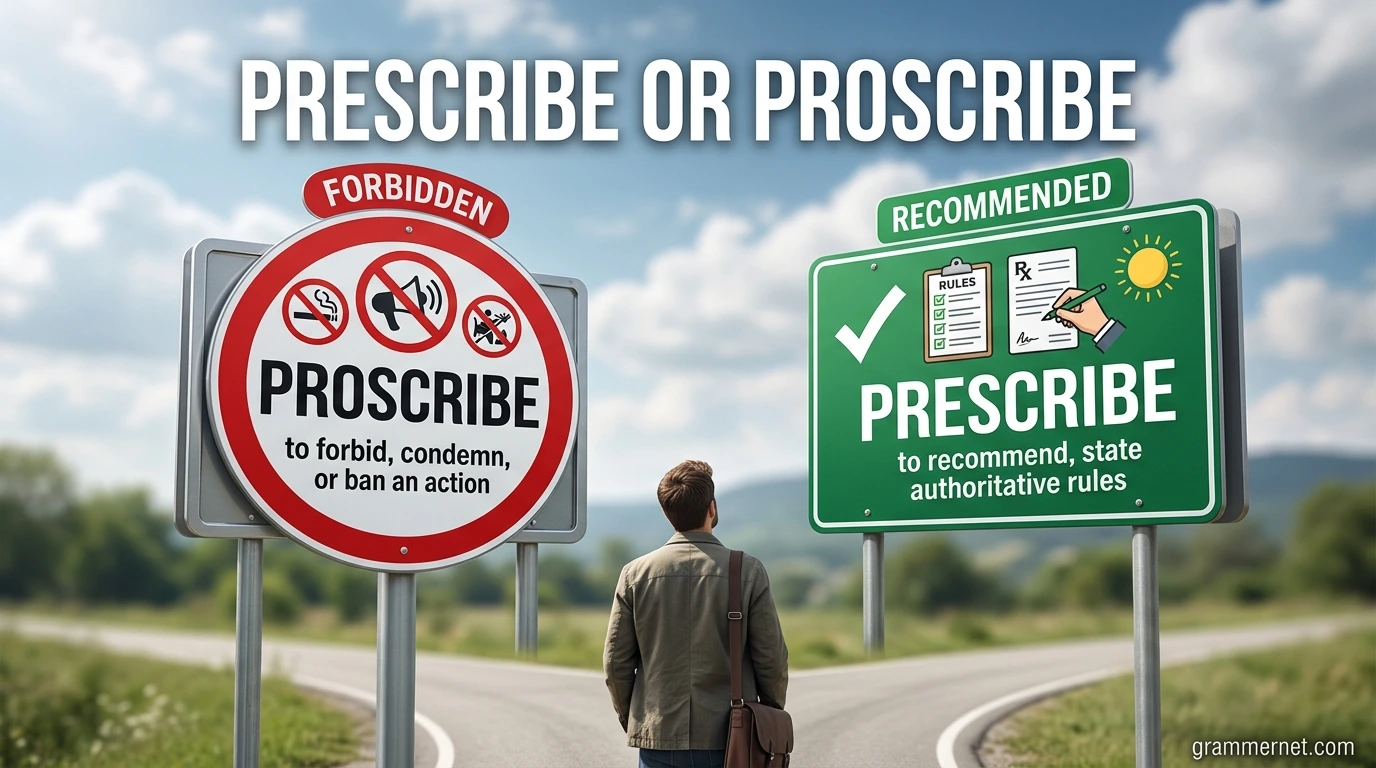
People often confuse prescribe and proscribe because the two words look almost identical and sound very similar. The mistake matters in everyday writing, speaking, exams, and professional communication because the two verbs mean nearly opposite things. Merriam-Webster defines prescribe as either giving medical orders or laying down a rule, while proscribe means to condemn or forbid as harmful or unlawful. Oxford Learner’s Dictionaries gives the same basic split: prescribe is used when a doctor tells someone to take medicine or an authority says what should be done, and proscribe means to say officially that something is banned.
That is why this pair is worth learning carefully. If you say a doctor “proscribed” medicine, you have reversed the meaning. If you say a law “prescribed” a banned act, you may accidentally suggest the opposite of what you intended. A small spelling difference can completely change the message.
Meaning: What Do “Prescribe” and “Proscribe” Mean?
The simplest way to understand the difference is to treat them as near-opposites. Prescribe means to recommend, direct, order, or authorize, especially in medicine or formal rules. Oxford’s learner entry says a doctor prescribes medicine or treatment, and an organization with authority may prescribe what should be done. Merriam-Webster also lists the idea of laying down a rule and giving medical prescriptions.
Proscribe, by contrast, means to officially ban, forbid, or prohibit something. Oxford defines it as saying officially that something is banned, and Merriam-Webster explains that it means to condemn or forbid as harmful or unlawful. Merriam-Webster also notes the word’s older legal history, where it once meant publicly condemning someone.
Meaning Comparison Table
| Word | Core meaning | Easy idea |
| prescribe | recommend, order, direct, authorize | “do this” |
| proscribe | forbid, ban, prohibit | “do not do this” |
A practical memory trick is simple: prescribe gives instructions; proscribe gives prohibitions.
Correct Usage: When Should You Use Each Word?
Use prescribe when someone with authority tells another person what to take, what to do, or what rules to follow. In medicine, that usually means a doctor gives a prescription. Oxford’s examples show this clearly, including medicine prescribed for anxiety or a cough. The word also appears in formal contexts when regulations or syllabuses say what must happen.
Use proscribe when something is officially forbidden. Oxford says it is used for things that are “officially” banned, and Merriam-Webster says it means to forbid as harmful or unlawful. That makes it common in legal, policy, and formal writing.
Usage Comparison Table
| Situation | Correct word | Example idea |
| doctor gives medicine | prescribe | prescribe antibiotics |
| rule says what to do | prescribe | prescribe the form |
| law forbids conduct | proscribe | proscribe bribery |
| policy bans behavior | proscribe | proscribe smoking |
Correct and Incorrect Examples
| Correct | Incorrect |
| The doctor prescribed antibiotics. | The doctor proscribed antibiotics. |
| The school proscribed cheating. | The school prescribed cheating. |
| The syllabus prescribes required books. | The syllabus proscribes required books. |
| The law proscribes bribery. | The law prescribes bribery. |
In short: prescribe = recommend or direct; proscribe = ban or forbid
Spelling and Word-Family Clues
The spelling difference is tiny: one begins with pre-, the other with pro-. That small change is exactly why people mix them up. Both words are Latin-derived and historically had legal meanings. Merriam-Webster’s word history notes that prescribe and proscribe both contain a Latin-derived prefix attached to scribe (“to write”), and that both had legal implications in early use. Oxford also gives the Latin-based origin of proscribe as proscribere, from pro- plus scribere (“write”), and the origin of prescribe from praescribere.
Spelling Clue Table
| Word | Prefix | Word family clue |
| prescribe | pre- | prescription, prescriptive |
| proscribe | pro- | proscription, proscriptive |
If you remember the related nouns, the spelling becomes easier to hold in memory. Oxford lists prescription as the noun for a doctor’s order or medicine, and proscription as the noun for something being banned or the act of banning it. Oxford also lists prescriptive as the adjective related to telling people what should be done.
Word-Family Table
| Base verb | Related noun | Related adjective |
| prescribe | prescription | prescriptive |
| proscribe | proscription | proscriptive |
Helpful memory trick
- Prescription goes with prescribe.
- Proscription goes with proscribe.
That pairing is one of the easiest ways to remember which spelling belongs to which meaning.
Grammar Rules and Word Forms
Both words are regular verbs in modern English. Oxford lists the forms for prescribe as prescribes, prescribed, and prescribing; its American English entry shows the same pattern. Oxford’s American English entry for proscribe gives proscribes, proscribed, and proscribing.
Grammar Forms Table
| Verb | Present | Past | -ing form |
| prescribe | prescribes | prescribed | prescribing |
| proscribe | proscribes | proscribed | proscribing |
How “Prescribe” Works in a Sentence
- The doctor prescribed medicine.
- The rules prescribe a uniform.
- The syllabus prescribes certain books.
How “Proscribe” Works in a Sentence
- The law proscribes bribery.
- The organization proscribed the practice.
- The government proscribes unlawful activity.
Correct and Incorrect Forms
| Correct | Incorrect |
| The doctor prescribed treatment. | The doctor proscribed treatment. |
| The law proscribed the conduct. | The law prescribed the conduct. |
| They are prescribing guidelines. | They are proscribing guidelines. |
| Officials have proscribed the group. | Officials have prescribed the group. |
A useful grammar reminder is that prescribe often appears in a medical or rule-setting context, while proscribe appears in a forbidding or banning context.
Pronunciation: Why They Sound So Similar
The words are close in sound because they share the same root scribe and differ mainly in the first vowel sound. Oxford gives prescribe as /prɪˈskraɪb/ and proscribe as /proʊˈskraɪb/ in American English, while the British pronunciation of proscribe is /prəʊˈskraɪb/. Merriam-Webster also shows the pronunciation differences and notes that proscribe is pronounced like “pro-SCRYBE.”
Pronunciation Table
| Word | Oxford / Merriam-Webster style | Sound guide |
| prescribe | /prɪˈskraɪb/ | prih-SCRIBE |
| proscribe | /proʊˈskraɪb/ or /prəʊˈskraɪb/ | pro-SCRIBE |
Simple Speaking Tip
Say the first syllable slowly:
- pre- in prescribe
- pro- in proscribe
The second half sounds the same: -scribe. That is why the first syllable is the part you need to watch most carefully.
British vs American English
There is no major British-versus-American difference in meaning or spelling for these two verbs. Both varieties use prescribe for medical or rule-setting meanings and proscribe for banning or forbidding. Oxford’s learner entries show the same basic definitions in both British and American forms, with only pronunciation varying slightly in the case of proscribe.
Regional Comparison Table
| Feature | British English | American English |
| prescribe meaning | same | same |
| proscribe meaning | same | same |
| spelling | same | same |
| pronunciation of proscribe | /prəʊˈskraɪb/ | /proʊˈskraɪb/ |
That means learners do not need two separate rules. You only need to remember the meaning difference and the slight pronunciation variation.
Sentence Examples and Common Mistakes
Examples are the fastest way to lock in the difference.
Prescribe Examples
- The doctor prescribed medicine for the cough. Oxford gives this medical sense directly, and Merriam-Webster also lists the act of giving medical prescriptions.
- The regulations prescribe what must be done. Oxford says authorities can prescribe what should be done or how it should be done.
- The syllabus prescribes specific books. Oxford gives this exact type of authority-based use.
Proscribe Examples
- The law proscribes bribery. Oxford defines proscribe as officially saying something is banned.
- The organization proscribed the activity. This fits Merriam-Webster’s “forbid as harmful or unlawful” sense.
- The school proscribes bullying. This is a natural extension of the ban/prohibition meaning.
Common Mistakes Table
| Incorrect sentence | Correct sentence |
| The doctor proscribed antibiotics. | The doctor prescribed antibiotics. |
| The law prescribed bribery. | The law proscribed bribery. |
| The school prescribed cheating. | The school proscribed cheating. |
| Officials prescribed the organization. | Officials proscribed the organization. |
Easy Contrast Sentence Pair
- The doctor prescribed rest.
- The hospital proscribed smoking.
That contrast is useful because it puts the two meanings side by side: one gives direction, the other bans behavior.
Common Mistakes
A common mistake is assuming the words are synonyms because they look similar. Merriam-Webster explicitly notes that the pair has “very distinct, often nearly opposite meanings.” Another frequent error is using the wrong spelling clue: prescribe is linked to medicine, a prescription, or rules; proscribe is linked to prohibition and proscription.
Common Mistake Checklist
- Confusing medical treatment with prohibition.
- Using prescribe when you mean “ban.”
- Using proscribe when you mean “recommend” or “order.”
- Forgetting the related nouns prescription and proscription.
FAQs
1: Is “prescribe” only a medical word?
No. Oxford and Merriam-Webster both show that prescribe also means to lay down a rule or say what should be done, not just to write a medicine order.
2: Is “proscribe” formal?
Yes. Oxford labels it formal, and Merriam-Webster’s definition also places it in a formal, official register.
3: What is the noun form of prescribe?
Oxford lists prescription as the noun related to medicine or an official plan/suggestion, and it also notes the act of prescribing medicine.
4: What is the noun form of proscribe?
Oxford lists proscription as the noun for the act or state of being banned. Merriam-Webster also gives proscription as the act of proscribing.
5: How can I remember the difference quickly?
Try this memory rule:
- Prescribe = prescribe a plan, medicine, or rule
- Proscribe = prohibit or forbid
That is the shortest and most reliable shortcut.
Conclusion
The difference between prescribe and proscribe is small in spelling but very large in meaning. Prescribe means to recommend, direct, authorize, or give medical treatment; proscribe means to forbid, ban, or officially prohibit something. Oxford and Merriam-Webster both confirm these meanings, and both also show that the words are regular verbs with clear forms such as prescribed, prescribing, proscribed, and proscribing.
A simple way to remember it is this:
- Prescribe = do this
- Proscribe = do not do this
If you keep that contrast in mind, you will avoid one of the most common vocabulary mistakes in formal English. And when in doubt, remember the related nouns: prescription for prescribed medicine or a formal plan, and proscription for something officially banned.
