
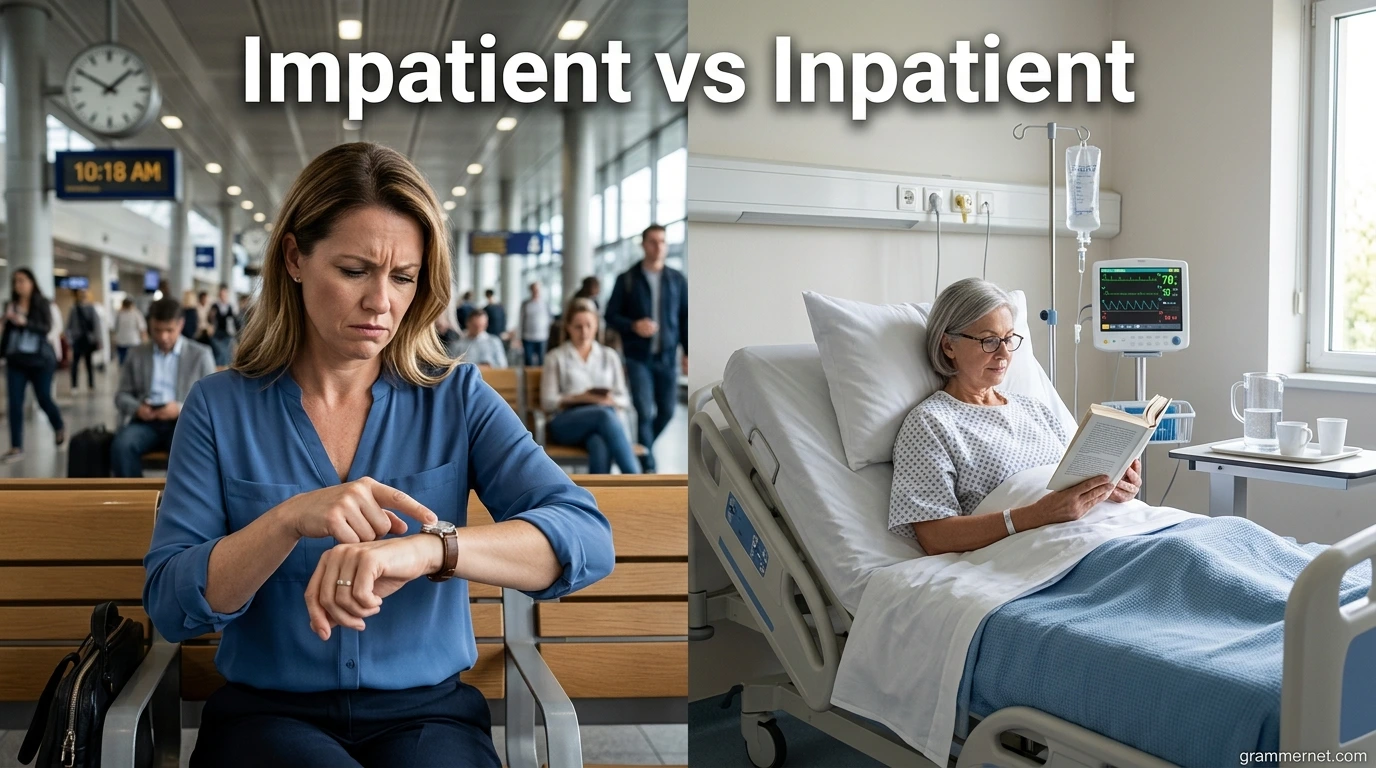
People often confuse impatient and inpatient because the words look almost identical, and only one small letter separates them. That tiny spelling difference can create big confusion in writing, speaking, exams, and professional communication. The problem is even more noticeable because impatient is a common everyday word, while inpatient is used mainly in medical and hospital settings. In this article, you will learn the meaning, correct usage, pronunciation, grammar, examples, common mistakes, and simple memory tricks so you can use both words correctly with confidence.
1) Meaning of Impatient and Inpatient
The best way to understand impatient vs inpatient is to begin with meaning. These words are not interchangeable, even though they look similar.
Impatient
Impatient is an adjective. It means:
- not willing to wait calmly
- restless or annoyed by delay
- eager for something to happen soon
Examples:
- She became impatient while waiting for the bus.
- He is impatient to start his new job.
- The children were impatient for the movie to begin.
Inpatient
Inpatient is usually a noun or adjective used in medicine. It means:
- a patient who stays in a hospital for treatment
- someone admitted to a hospital overnight or for a longer stay
Examples:
- The hospital has a new inpatient ward.
- He was treated as an inpatient after surgery.
- Inpatient care is more expensive than outpatient care.
Quick comparison table
| Word | Part of speech | Meaning | Common context |
| impatient | adjective | not willing to wait; restless | everyday English |
| inpatient | noun/adjective | a hospital patient who stays overnight or longer | medical English |
Easy memory trick
- impatient = “I want it now”
- inpatient = “in the hospital”
If you remember that one word describes a feeling and the other describes a hospital patient, the confusion becomes much easier to manage.
2) Correct Usage of Impatient
Use impatient when describing a person who does not like waiting or who wants something to happen quickly.
Common situations
- waiting in line
- expecting a reply
- waiting for an event
- wanting quick progress
- feeling irritated by delay
Examples
- I get impatient when meetings start late.
- The customer became impatient after waiting 30 minutes.
- She is impatient to see the final results.
- He was impatient with slow service.
Sentence patterns
Impatient often appears with:
- to + verb
- She is impatient to leave.
- He is impatient to begin.
- with + noun/pronoun
- I was impatient with the delay.
- They became impatient with the process.
- for + noun
- The students were impatient for the exam results.
Correct and incorrect examples
| Correct | Incorrect |
| She was impatient while waiting. | She was inpatient while waiting. |
| He is impatient to get home. | He is inpatient to get home. |
| I became impatient with the long delay. | I became inpatient with the long delay. |
Real-life examples
- A child waiting for ice cream may become impatient.
- A worker waiting for approval may feel impatient.
- A student waiting for feedback may grow impatient.
Important note
Impatient is not a noun. You would not say:
- “He is an impatient.”
Instead, use:
- He is impatient.
- She is an impatient person.
3) Correct Usage of Inpatient
Use inpatient when talking about a person who receives medical care in a hospital and stays there for treatment.
Common medical contexts
- hospitals
- clinics
- surgery
- treatment plans
- insurance
- patient care
Examples
- The doctor recommended inpatient treatment.
- She was admitted as an inpatient for observation.
- Inpatient services are available at this hospital.
- The hospital has 200 inpatient beds.
Common sentence patterns
Inpatient can work as:
- Noun
- He is an inpatient.
- The ward has several inpatients.
- Adjective
- inpatient care
- inpatient treatment
- inpatient services
Comparison table
| Form | Use | Example |
| inpatient | noun | The inpatient was discharged today. |
| inpatient | adjective | She received inpatient treatment. |
| inpatients | plural noun | The ward has 20 inpatients. |
Correct and incorrect examples
| Correct | Incorrect |
| The patient became an inpatient after the accident. | The patient became impatient after the accident. |
| He needs inpatient care. | He needs impatient care. |
| The hospital has separate inpatient rooms. | The hospital has separate impatient rooms. |
Why this word matters
In medical writing, using impatient instead of inpatient can be more than a grammar mistake. It can completely change the meaning and confuse the reader.
For example:
- impatient care would sound like care that is annoyed or in a hurry.
- inpatient care clearly means hospital-based care.
4) Grammar Rules: Adjective vs Noun and Adjective Use
Understanding the grammar behind these words helps you avoid mistakes.
Impatient is mainly an adjective
It describes a person, mood, or attitude.
Examples:
- She felt impatient.
- He is impatient with slow drivers.
- They grew impatient as time passed.
Inpatient is a noun and adjective
It can describe:
- a hospital patient
- care or treatment provided in a hospital
Examples:
- The inpatient waited for surgery.
- The hospital offers inpatient care.
Grammar comparison table
| Word | Grammar role | Example |
| impatient | adjective | He was impatient during the delay. |
| inpatient | noun | The inpatient was moved to a new room. |
| inpatient | adjective | She received inpatient treatment. |
Common grammar mistake
Wrong:
- He was inpatient for the results.
Correct:
- He was impatient for the results.
Why? Because the sentence is about a feeling, not a medical patient.
Wrong:
- The hospital gave him impatient care.
Correct:
- The hospital gave him inpatient care.
Why? Because the sentence is about hospital treatment, not a personality trait.
Sentence repair tip
Ask yourself:
- Is the sentence about emotion or waiting? → use impatient
- Is the sentence about hospital stay or medical treatment? → use inpatient
That simple test solves many problems immediately.
5) Spelling Differences and Why They Are Easy to Mix Up
The spelling difference is tiny, but the meaning difference is huge.
Visual comparison
| Word | Spelling clue |
| impatient | begins with im- + patient |
| inpatient | begins with in- + patient |
At a glance, both words seem to contain “patient,” which is why many learners mix them up.
Why the confusion happens
These words are confusing because:
- they sound similar
- they are close in spelling
- both are connected to the word patient
- one letter changes the meaning completely
Helpful breakdown
- impatient = prefix im- + patient
- inpatient = prefix in- + patient
The prefixes matter:
- im- in impatient is related to a lack of patience
- in- in inpatient points to being inside a hospital as a patient
Side-by-side table
| Word | Prefix | Meaning clue | Example |
| impatient | im- | not patient; restless | I’m impatient to leave. |
| inpatient | in- | inside the hospital | She was admitted as an inpatient. |
Common spelling mistake examples
| Mistake | Correct form |
| impatiant | impatient |
| inpatent | inpatient |
| impatent | impatient |
| inpatien | inpatient |
Simple spelling memory trick
Think:
- impatient = “I can’t wait”
- inpatient = “in patient care”
If the sentence is about waiting, patience, or annoyance, the im- word is usually right.
6) British vs American English: Is There a Difference?
For impatient and inpatient, there is no major British vs American spelling difference. Both varieties of English use the same spellings.
What stays the same
- impatient = impatient
- inpatient = inpatient
What may differ
The difference is not spelling, but usage frequency or healthcare vocabulary style in some contexts. For example, hospital terminology can vary slightly by country, organization, or system, but the words themselves are still understood in both British and American English.
Comparison table
| Variety | impatient | inpatient |
| British English | common | common in medical contexts |
| American English | common | common in medical contexts |
Practical note
If you are writing for:
- hospitals
- insurance documents
- medical websites
- healthcare forms
then inpatient is the standard term in both British and American English.
If you are writing general English:
- impatient is the much more common everyday word
No hyphen needed
Neither word normally takes a hyphen:
- impatient
- inpatient
Do not write:
- im-patient
- in-patient
Those forms are usually incorrect in modern standard English.
7) Pronunciation of Impatient and Inpatient
Pronunciation can help you remember the difference because the two words sound similar but not identical.
Pronunciation guide
- impatient → /ɪmˈpeɪʃənt/
- inpatient → /ˈɪnpeɪʃənt/
Syllable breakdown
- im-pa-tient
- in-pa-tient
Spoken examples
- She is impatient with slow service.
- He was admitted as an inpatient.
What to listen for
The first sound changes:
- im- in impatient
- in- in inpatient
That small sound difference often matches the meaning:
- impatient = emotional state
- inpatient = hospital context
Speaking tip
Say the sentence slowly:
- “I’m impatient.”
- “He is an inpatient.”
Even though the words are close, the context makes the meaning clear.
8) Sentence Examples and Common Mistakes
Examples are the fastest way to build confidence. Below are many real-life uses of both words.
Examples with impatient
- I became impatient while waiting for the train.
- The audience grew impatient during the long speech.
- She is impatient to hear the news.
- He was impatient with the slow internet connection.
- The driver looked impatient at the traffic light.
Examples with inpatient
- The patient was moved to inpatient care.
- He spent three days as an inpatient.
- The hospital offers both outpatient and inpatient services.
- Inpatient treatment is necessary for severe cases.
- The clinic has a large inpatient department.
Correct and incorrect examples table
| Correct | Incorrect |
| She was impatient to leave the room. | She was inpatient to leave the room. |
| The doctor prescribed inpatient care. | The doctor prescribed impatient care. |
| The inpatient was discharged yesterday. | The impatient was discharged yesterday. |
| He felt impatient during the delay. | He felt inpatient during the delay. |
Common mistake patterns
- Using inpatient for feelings
Wrong: “I’m inpatient with waiting.”
Correct: “I’m impatient with waiting.” - Using impatient for hospital treatment
Wrong: “The patient needs impatient care.”
Correct: “The patient needs inpatient care.” - Mixing them in one sentence
Wrong: “The impatient was impatient for discharge.”
Correct: “The inpatient was impatient for discharge.”
This is actually possible because one word is a noun and the other is an adjective, but the meaning must still fit.
Very helpful contrast
- The inpatient was impatient to go home.
This sentence is correct because:
- inpatient = hospital patient
- impatient = restless and eager to leave
That one sentence shows both words in one clear example.
FAQs About Impatient vs Inpatient
Is impatient the same as inpatient?
No. They are completely different words with different meanings.
What does impatient mean?
It means not willing to wait calmly, or eager for something to happen.
What does inpatient mean?
It means a hospital patient who stays for treatment, or something related to that kind of care.
Can inpatient be used outside medicine?
Almost always, it is used in medical or hospital contexts.
Is inpatient a noun or adjective?
It can be both:
- noun: an inpatient
- adjective: inpatient care
Is impatient only an adjective?
Yes, in standard English, impatient is mainly an adjective.
Which one is more common?
Impatient is far more common in everyday conversation and writing. Inpatient is common in medical language.
How can I remember the difference easily?
Use this:
- impatient = “I can’t wait”
- inpatient = “in patient care”
Can I say “inpatient with waiting”?
No. That is incorrect. Use impatient with waiting.
Can I say “impatient care”?
No. That is incorrect. Use inpatient care.
Conclusion: How to Remember the Difference Confidently
The difference between impatient and inpatient is simple once you focus on meaning. Impatient describes a person who does not like waiting or who feels restless, annoyed, or eager. Inpatient is a medical term for a patient who stays in a hospital, or for care provided in a hospital setting. Because the words look so similar, many learners mix them up, but the context almost always tells you which one is correct.
A simple memory trick is this:
- impatient = emotion, waiting, restlessness
- inpatient = hospital, treatment, medical stay
If you are talking about feelings, choose impatient.
If you are talking about hospital care, choose inpatient.
Once you remember that one is about patience and the other is about patients in a hospital, you will avoid the most common mistakes. That small difference can make your writing clearer, more accurate, and more professional in everyday English, academic work, and medical communication.
