
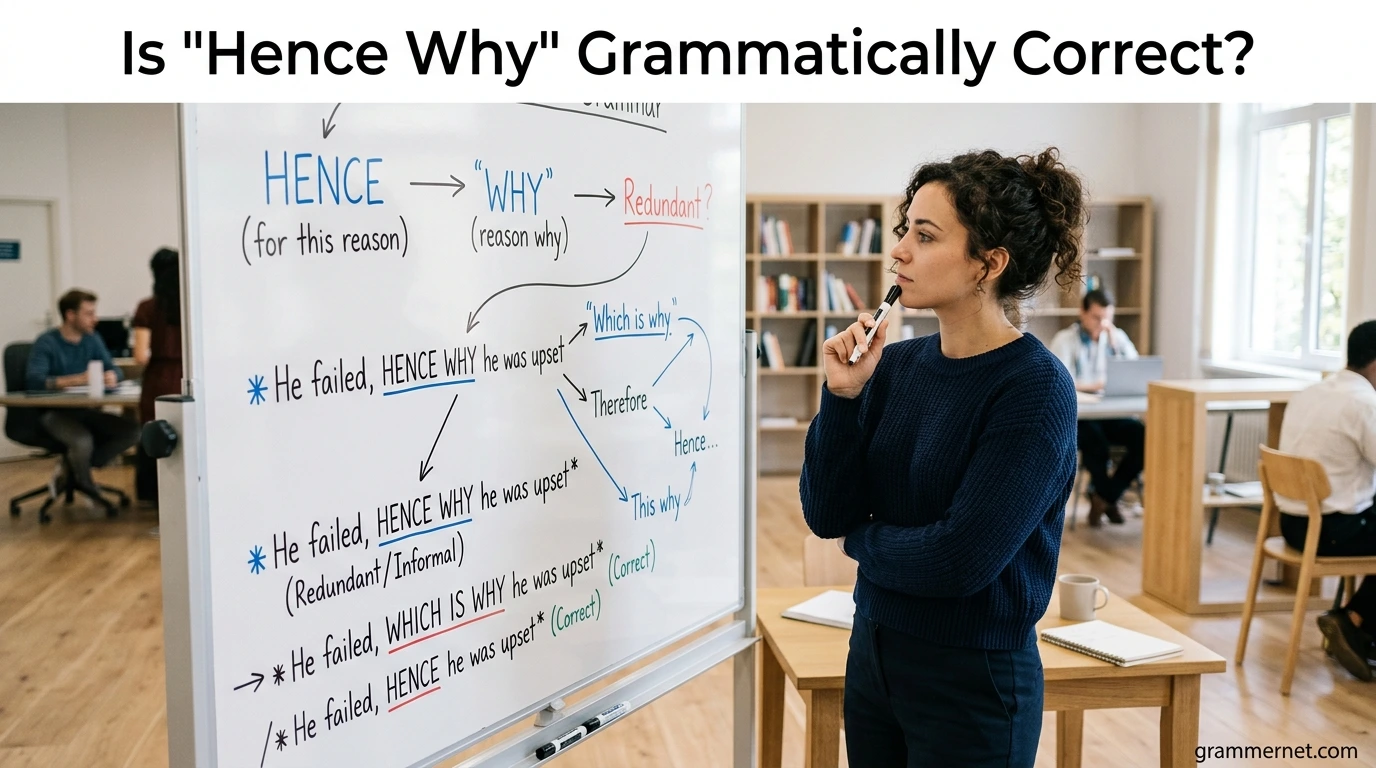
People often ask whether “hence why” is grammatically correct because the phrase appears in books, articles, spoken English, and casual writing. It sounds logical to many speakers, but it also sounds awkward to others. That is why learners, students, and even native speakers get unsure about it. This matters in everyday writing, speaking, exams, and professional communication because choosing the wrong connector can make your sentence sound redundant, unclear, or less polished. In this article, you will learn what hence why means, whether it is correct, when it works, what to use instead, and how to avoid common mistakes confidently.
1) What Does “Hence Why” Mean?
To understand whether hence why is grammatically correct, it helps to break the phrase apart.
The word “hence”
Hence means:
- therefore
- for this reason
- as a result
Examples:
- The roads were icy; hence, the delay.
- She studied hard; hence her good grade.
The word “why”
In a phrase like why he left or why we moved, why introduces a reason or explanation.
Examples:
- I know why he left.
- She explained why the meeting was canceled.
What people usually mean by “hence why”
When someone says:
- “He was late, hence why we started without him,”
they usually mean:
- “He was late, so we started without him.”
- “He was late; that is why we started without him.”
Simple meaning table
| Expression | Meaning | Naturalness |
| hence | therefore / for this reason | natural |
| why | reason / explanation | natural |
| hence why | therefore why / for this reason why | often awkward or redundant |
Why it sounds strange
The problem is that hence already means “therefore” or “for this reason,” and why already introduces a reason. Putting them together can repeat the same idea twice.
That is why many grammar teachers and style guides consider hence why redundant.
2) Is “Hence Why” Grammatically Correct?
The short answer is: it is often considered awkward or redundant, but it is not always treated as completely wrong in informal modern English.
That may sound confusing, so here is the clearer explanation.
In strict grammar
Many writers and editors prefer to avoid hence why because:
- hence already means “for this reason”
- why already signals explanation
- together they can sound repetitive
In real usage
You will still hear and see hence why in spoken English and casual writing, especially when people want a conversational tone.
Examples people say:
- He didn’t study, hence why he failed.
- It rained all night, hence why the ground is wet.
These are common in speech, but some readers consider them less elegant than alternatives.
Comparison table: status of the phrase
| View | Opinion on “hence why” | Notes |
| Strict grammar | avoid it | considered redundant |
| Everyday speech | sometimes acceptable | common in casual conversation |
| Formal writing | usually avoid it | better to use cleaner alternatives |
Best practical answer
If you want safe, polished English, it is better to avoid hence why and use:
- hence
- therefore
- that is why
- this is why
- so
Important distinction
The phrase is not usually a major grammar error in the sense of being unintelligible. The issue is more about style, repetition, and clarity.
So the best answer is:
- Technically understandable
- Often stylistically redundant
- Usually better replaced in formal writing
3) When “Hence Why” Sounds Natural and When It Does Not
English often allows phrases that are understandable but not ideal. Hence why is one of those expressions.
When it may sound natural
It can sound natural in:
- casual conversation
- spoken explanations
- informal writing
- dialogue
- quick speech
Examples:
- He forgot the file, hence why he had to go back.
- The shop was closed, hence why we went elsewhere.
When it sounds less natural
It sounds less polished in:
- essays
- academic writing
- business reports
- formal emails
- exam answers
Less natural:
- The event was canceled, hence why people were disappointed.
More natural:
- The event was canceled, so people were disappointed.
- The event was canceled; hence, people were disappointed.
- The event was canceled, which is why people were disappointed.
Naturalness table
| Context | “Hence why” | Better choice |
| casual speech | acceptable | hence why / so |
| informal text | acceptable | hence why / that’s why |
| school essay | avoid | therefore / because / which is why |
| business writing | avoid | therefore / as a result |
| academic writing | avoid | thus / therefore / because |
A good rule
If the sentence sounds better when simplified, that is a sign hence why may not be the strongest choice.
For example:
- Hence why he left early.
- That is why he left early.
- He left early because of that.
The alternatives usually sound cleaner.
4) Grammar Rules Behind the Problem
The confusion comes from how hence and why function in a sentence.
Rule 1: “Hence” is usually enough by itself
Hence can stand alone as an adverb.
Examples:
- The roads were flooded; hence, the school closed.
- He missed the train and hence arrived late.
Rule 2: “Why” already introduces reason
Why is already a reason word.
Examples:
- I know why she left.
- This is why we were late.
Rule 3: Avoid repeating the same idea twice
Using both together can create a kind of duplication.
Example:
- The manager was absent, hence why the meeting was delayed.
The sentence repeats the idea of cause:
- hence = for this reason
- why = reason/explanation
Rule 4: Better alternatives exist
Instead of forcing the two together, choose one clean structure.
Better structures
- The manager was absent, so the meeting was delayed.
- The manager was absent; hence, the meeting was delayed.
- The manager was absent, which is why the meeting was delayed.
- The manager was absent, therefore the meeting was delayed.
Grammar comparison table
| Structure | Example | Style |
| hence | The roads were bad; hence, the delay. | formal |
| that is why | The roads were bad; that is why we were late. | natural |
| which is why | The roads were bad, which is why we were late. | natural and clear |
| hence why | The roads were bad, hence why we were late. | often redundant |
A key point
Hence why is not the only way to express cause and effect. In fact, it is often the least polished choice among the common options.
5) British vs American English: Is There a Difference?
There is no major British vs American English rule that makes hence why correct in one variety and incorrect in the other.
What both varieties agree on
- hence is a formal connector
- why introduces explanation
- hence why may sound redundant
Style difference, not rule difference
British and American writers both tend to prefer clearer alternatives in formal writing.
Comparison table
| Variety | “Hence why” in speech | “Hence why” in formal writing |
| British English | sometimes heard | usually avoided |
| American English | sometimes heard | usually avoided |
Practical takeaway
The issue is not about British vs American spelling. It is about:
- clarity
- style
- repetition
So whichever variety you write in, the same advice applies:
- use hence carefully
- avoid hence why when a cleaner phrase works better
6) Pronunciation and Spoken English
Even if a phrase is not ideal in writing, it may still be common in speech. That is one reason learners hear hence why and wonder if it is correct.
Pronunciation
- hence → /hens/
- why → /waɪ/
Together:
- hence why → /hens waɪ/
Why speakers use it
In fast speech, people often choose expressions that feel natural in the moment, even if they are redundant.
Examples:
- I was tired, hence why I left early.
- The shop was closed, hence why we went home.
Spoken English note
In conversation, listeners usually understand the meaning immediately. But understanding something does not always mean it is the best written form.
Spoken vs written comparison table
| Form | Spoken English | Written English |
| hence why | common in casual speech | often avoided |
| that is why | common and clear | also very strong |
| which is why | common and natural | strong choice |
| therefore | common but more formal | good for writing |
Speaking tip
If you are speaking casually, hence why may pass without problem.
If you are writing anything that needs polish, choose a cleaner alternative.
7) Sentence Examples: Correct and Incorrect Uses
Examples are the easiest way to see the difference.
Examples where “hence why” appears
These are understandable, but some are less polished:
- He forgot his notes, hence why he was nervous.
- The road was blocked, hence why we took a detour.
- She missed breakfast, hence why she felt weak.
Better alternatives
- He forgot his notes, so he was nervous.
- The road was blocked, so we took a detour.
- She missed breakfast, so she felt weak.
Or:
- He forgot his notes; hence, he was nervous.
- The road was blocked, which is why we took a detour.
- She missed breakfast, which is why she felt weak.
Correct and improved examples table
| Less ideal | Better version |
| It was raining, hence why we stayed inside. | It was raining, so we stayed inside. |
| He was late, hence why the meeting started without him. | He was late, which is why the meeting started without him. |
| The store was closed, hence why we left. | The store was closed, so we left. |
1.Clear examples using “hence” alone
- The bridge was damaged; hence, traffic was diverted.
- She did not prepare; hence, the poor result.
- The evidence was weak; hence, the judge was unconvinced.
2.Clear examples using “that is why”
- He did not study; that is why he failed.
- The room was cold; that is why I closed the window.
- She worked hard; that is why she succeeded.
3.Clear examples using “which is why”
- The train was delayed, which is why we arrived late.
- He was sick, which is why he missed class.
- The project was rushed, which is why it needed revision.
What this shows
If your goal is clean English, the alternatives are usually stronger than hence why.
8) Common Mistakes Learners Make
This expression causes trouble because many learners think every logical-sounding phrase is automatically good grammar.
Mistake 1: Using “hence why” in formal writing
Wrong:
- The results were unclear, hence why the study was repeated.
Better:
- The results were unclear, so the study was repeated.
- The results were unclear; hence, the study was repeated.
Mistake 2: Treating it as an essential phrase
Wrong idea:
- English must use “hence why” to show cause and reason.
Reality:
- English has many better options for cause and reason.
Mistake 3: Overusing “hence”
Wrong:
- Hence why the reason is clear.
- Hence why we left early.
Better:
- That is why the reason is clear.
- That is why we left early.
- Hence, the reason is clear.
Even better: The reason is clear.
Mistake 4: Mixing style levels
A sentence may be grammatically understandable but too casual for an academic essay.
Example:
- The company cut costs, hence why profits improved.
Better:
- The company cut costs, which is why profits improved.
- The company cut costs; hence, profits improved.
Mistake 5: Confusing “hence” with “because”
They are not the same.
- hence means therefore, as a result
- because introduces a cause
Wrong:
- Hence we were late because of the traffic.
Better:
- We were late because of the traffic.
- There was heavy traffic; hence, we were late.
Mistake 6: Thinking awkward speech equals correct style
Some expressions become popular in speech even when they are not the most elegant in writing.
That is why hence why may sound okay in conversation but still be a weak choice on the page.
FAQs About “Is Hence Why Grammatically Correct?”
Is “hence why” grammatically correct?
It is understandable and sometimes used, but many grammar guides consider it redundant. In formal writing, it is better to avoid it.
Why is “hence why” considered wrong by some people?
Because hence already means “therefore,” and why already introduces a reason. Together, they can repeat the same idea.
Can I use “hence why” in speaking?
Yes, people often use it in casual speech. It is common in conversation, though not the most polished form.
What should I use instead?
Good alternatives include:
- so
- therefore
- that is why
- which is why
- hence
Is “hence” alone correct?
Yes. Hence is correct and often more elegant than hence why.
Is “that is why” better than “hence why”?
Usually, yes. It is clearer and more natural in most everyday sentences.
Is “which is why” grammatically correct?
Yes, and it is often a very natural and clear choice.
Can “hence why” be used in creative writing?
It can appear in dialogue or casual narration if you want natural spoken style, but it is still usually better to use clearer alternatives.
Should I avoid “hence why” completely?
Not completely. You may hear it and use it in casual speech, but for writing, it is safer to replace it with a cleaner phrase.
Conclusion
“Hence why” is understandable, but it is usually considered redundant and stylistically weak. In casual speech, people do say it, and readers will usually understand it. However, in formal writing, essays, reports, and professional communication, it is better to avoid it because both words carry similar meaning and the phrase can sound repetitive.
A simple rule will help you remember:
- Use hence when you want a formal “therefore.”
- Use that is why or which is why when you want a natural explanation.
- Use so when you want the simplest everyday choice.
- Avoid hence why in polished writing unless you deliberately want conversational style.
If you remember that hence already means “for this reason,” you will see why hence why feels repetitive. The strongest English is often the clearest English, and in this case, simpler choices usually sound better.
