
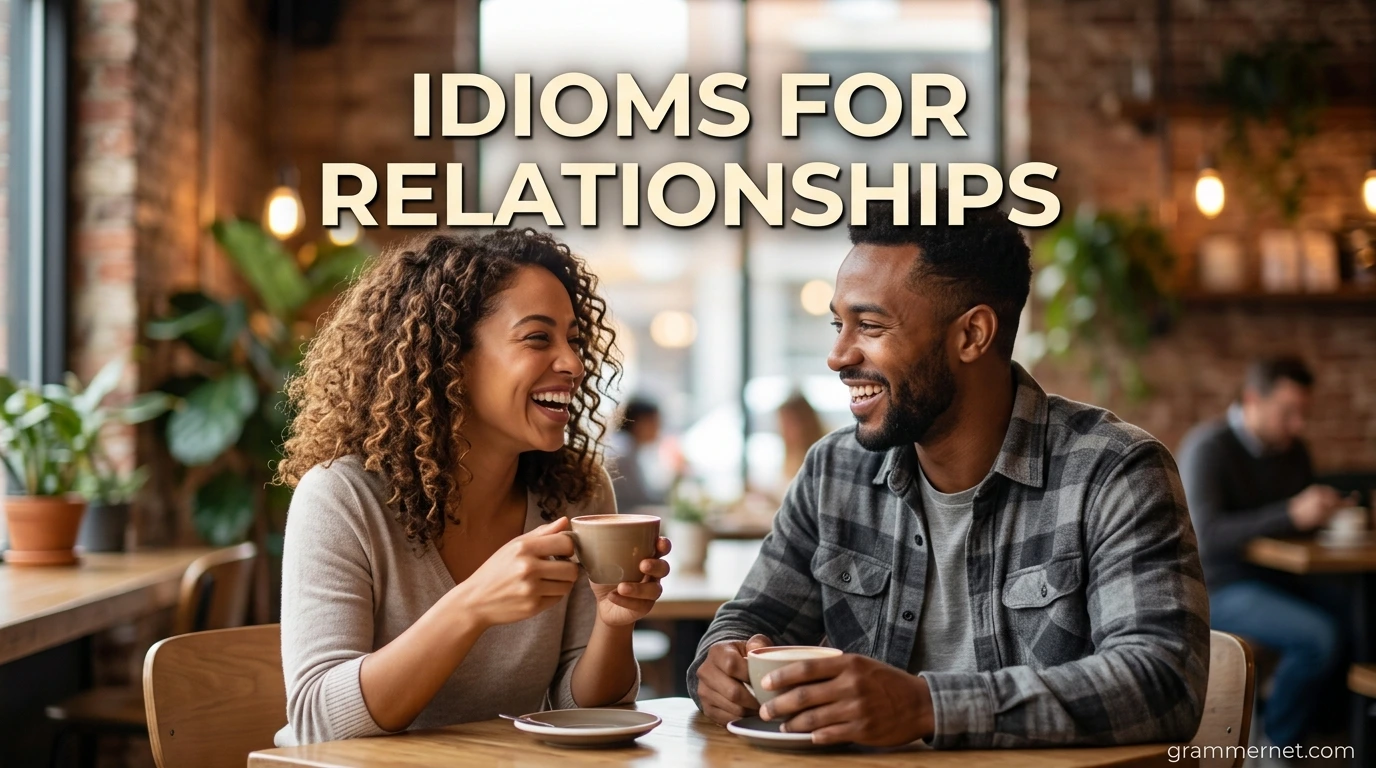
Relationships are one of the most important parts of human life—whether it’s love, friendship, family, or professional connections. In English, people rarely describe relationships in a direct way; instead, they use colorful idioms for relationships to express emotions, situations, and experiences more naturally.
Learning these idioms helps English learners sound more fluent, emotional, and culturally aware. It also improves your understanding of movies, songs, books, and real conversations.
From love and trust to conflict and breakups, relationship idioms allow you to describe complex feelings in simple but powerful ways. Let’s explore the most useful ones in detail.
Why Learn Idioms for Relationships?
Understanding relationship idioms is important because:
- They reflect real-life emotions more naturally
- They help you communicate like native speakers
- They improve speaking and writing skills
- They help you understand social and emotional context
For example, instead of saying “They started liking each other,” native speakers say: 👉 “They hit it off.”
Common Idioms for Relationships (With Meanings & Examples)
1. Hit it off
Meaning: To quickly become good friends or romantic partners.
Example:
- We hit it off the moment we met at the party.
Alternative expressions:
- Get along instantly
- Click with someone
Use case: First meetings, friendships, dating
Fun fact: “Hit” here means “start suddenly,” not physical hitting.
2. Tie the knot
Meaning: To get married.
Example:
- They tied the knot after five years of dating.
Use case: Weddings, marriage announcements
Origin: Comes from ancient wedding rituals where hands were tied together with a cloth or rope.
3. On the rocks
Meaning: A relationship that is going through problems.
Example:
- Their marriage has been on the rocks for months.
Use case: Breakups, relationship struggles
Alternative: Going through a rough patch
4. See eye to eye
Meaning: To agree with someone.
Example:
- They don’t see eye to eye on financial decisions.
Use case: Arguments, teamwork, friendships
5. Head over heels
Meaning: Deeply in love.
Example:
- She is head over heels for him.
Use case: Romantic relationships
Fun fact: It originally meant “upside down,” showing emotional imbalance due to love.
6. Go the extra mile
Meaning: To make extra effort in a relationship.
Example:
- He always goes the extra mile for his friends.
Use case: Friendships, romantic care, family support
7. Patch things up
Meaning: To repair a broken relationship.
Example:
- They patched things up after their argument.
Use case: Friend fights, family issues
8. Break someone’s heart
Meaning: To emotionally hurt someone in love.
Example:
- She broke his heart when she moved away.
Use case: Breakups, emotional pain
9. Get along like a house on fire
Meaning: To get along very well.
Example:
- They got along like a house on fire from day one.
Use case: Fast friendships
10. Drifting apart
Meaning: Slowly losing connection in a relationship.
Example:
- We started drifting apart after college.
Use case: Friendships, long-distance relationships
Idioms for Relationships by Context
Romantic Relationships
- Head over heels
- Tie the knot
- Break someone’s heart
Friendship
- Hit it off
- Get along like a house on fire
Conflict or Problems
- On the rocks
- See eye to eye (negated: don’t see eye to eye)
- Drift apart
Strong Bonds
- Go the extra mile
- Stick together through thick and thin
Tips for Using Relationship Idioms Naturally
- Use idioms that match emotional intensity
- Avoid mixing too many idioms in one sentence
- Practice with real-life conversations
- Watch movies or series for natural usage
- Learn idioms in categories (love, conflict, friendship)
Common Mistakes Learners Make
❌ Using idioms too literally ❌ Using romantic idioms in formal writing ❌ Overusing emotional expressions ❌ Mixing similar idioms incorrectly
✔ Focus on context and emotion before using any idiom.
Interactive Exercises
Exercise 1: Fill in the blanks (Easy)
- They ______ it off immediately at the meeting.
- She is ______ over heels in love.
Answers:
- hit
- head
Exercise 2: Choose the correct idiom (Medium)
- Their relationship is facing problems. a) on the rocks b) tied the knot
Answer: a) on the rocks
Exercise 3: Match the idioms (Advanced)
- Patch things up → ?
- Break someone’s heart → ?
- See eye to eye → ?
Answers:
- Patch things up → fix a broken relationship
- Break someone’s heart → emotional hurt in love
- See eye to eye → agree with someone
Quick Quiz
- Which idiom means “to get married”?
- Which idiom means “to slowly lose connection”?
- Which idiom means “to become very close quickly”?
Answers:
- Tie the knot
- Drifting apart
- Hit it off
Visual Learning Suggestions
To better remember idioms:
- Wedding rings → tie the knot
- Broken heart icon → break someone’s heart
- Two people shaking hands → see eye to eye
- Two friends laughing → hit it off
FAQs About Idioms for Relationships
1. Why are idioms important in relationships vocabulary?
They help express emotions and situations more naturally and clearly.
2. Are relationship idioms used in daily English?
Yes, they are very common in conversations, movies, and books.
3. Can I use these idioms in formal writing?
Some idioms are informal, but many can be used in semi-formal contexts.
4. What is the most common relationship idiom?
“Hit it off” and “head over heels” are widely used.
5. How can I remember these idioms easily?
Learn them in groups (love, friendship, conflict) and practice using them in sentences.
Conclusion
Mastering idioms for relationships helps you talk about love, friendship, and emotional connections in a natural and expressive way. Instead of simple sentences, you can use phrases like “head over heels,” “on the rocks,” or “hit it off” to sound more fluent and native-like.
These idioms are not just vocabulary—they reflect real human emotions and experiences. By practicing them regularly in speaking and writing, you will improve both your English fluency and emotional expression.
