
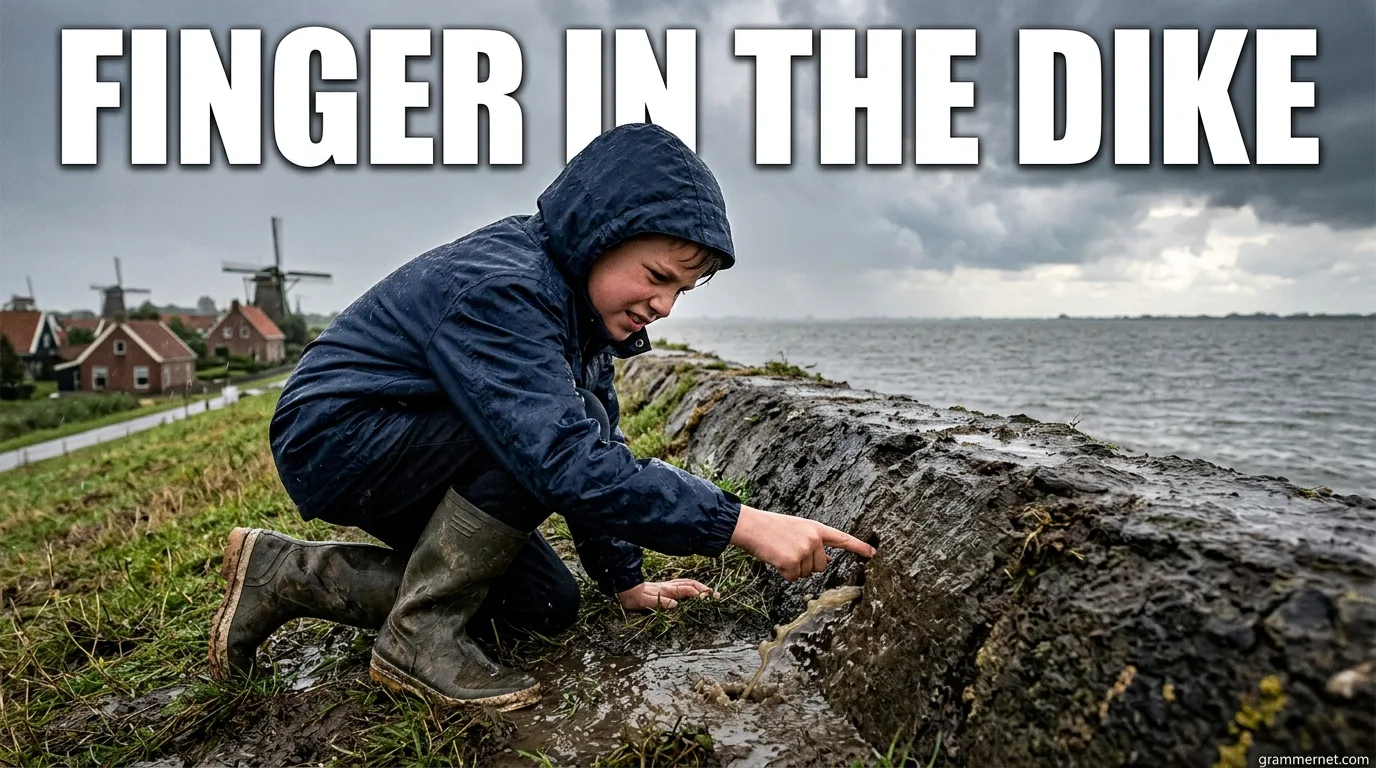
People often get confused about finger in the dike because it looks like a strange literal phrase, but it is actually an idiom with a figurative meaning. It is also easy to mix up the spelling dike and dyke, and that matters because both spellings exist in English, but they are not used in exactly the same way across varieties of English. In everyday writing, speaking, exams, and professional communication, knowing the correct form helps you avoid awkward wording and understand the phrase when you see it in books, articles, or news writing. Dictionaries show that dike is a standard word for a water barrier or ditch, while dyke is the chiefly British spelling of that word and also has an unrelated, offensive slang meaning in another sense. The idiom itself comes from the old story about a boy plugging a leak with his finger, and today it means a temporary effort to stop a serious problem from getting worse.
What Does “Finger in the Dike” Mean?
The idiom finger in the dike means a quick, temporary attempt to stop a problem from becoming worse. Idiom sources explain it as plugging a leak or preventing disaster, usually with the sense that the solution is only a stopgap and may not last. The expression refers to the famous story of a child who supposedly blocked a leak in a dike with his finger to prevent flooding.
In plain English, the phrase suggests one or more of these ideas:
- someone is holding back a bigger problem,
- the solution is only temporary,
- the danger may return if the real issue is not fixed,
- one person may be doing the work of preventing a larger disaster.
Meaning comparison table
| Expression | Literal meaning | Figurative meaning |
| finger in the dike | a finger placed in a water barrier | a temporary fix for a serious problem |
| plug a leak | stop water from escaping | stop a problem before it spreads |
| stopgap measure | a temporary solution | a short-term fix, not the final answer |
The key idea is not the finger itself. The finger is a symbol of a small action that stands between safety and disaster. That is why the idiom often appears in politics, business, and problem-solving contexts.
Is It Correct to Say “Finger in the Dike”?
Yes. Finger in the dike is a correct idiom in English. Idiom references explain that it is used to mean stopping a leak or preventing a larger problem from getting out of control. The phrase is also recognized in examples that show it being used figuratively in modern writing.
When to use it
Use the idiom when you want to say that:
- a temporary fix is being used,
- someone is trying to hold back a bigger issue,
- a small action is keeping a large problem under control,
- a real solution has not been found yet.
Correct usage examples
- The new policy is only a finger in the dike; the system still needs a full overhaul.
- One volunteer was a finger in the dike while the team looked for a long-term solution.
- The repairs were just a finger in the dike and did not solve the deeper problem.
Incorrect usage examples
- The phrase does not mean a literal finger in a water barrier in normal conversation.
- It does not mean “a lucky guess” or “a small success.”
- It does not mean the same thing as “best effort” unless the context is clearly about stopping disaster.
Usage comparison table
| Correct sense | Example | What it implies |
| temporary fix | It was only a finger in the dike. | the real problem remains |
| emergency stop | They used it as a finger in the dike. | short-term protection |
| inadequate solution | That patch was a finger in the dike. | not enough for the long run |
So, yes, the idiom is correct. The main challenge is knowing what it means and how to spell it.
Spelling Differences: Dike or Dyke?
This is where many learners get stuck. The spelling depends on the variety of English and on the meaning of the word dike/dyke outside the idiom. Merriam-Webster defines dike as a ditch or a bank of earth built to control water, and Oxford Learner’s Dictionaries notes that dike is the preferred spelling in North American English for that sense, while dyke is a chiefly British spelling. Merriam-Webster also notes that dyke has an unrelated, usually offensive slang sense meaning lesbian.
Spelling comparison table
| Form | Region / use | Notes |
| dike | North American spelling for the water-barrier sense | safest choice in U.S. English |
| dyke | chiefly British spelling for the water-barrier sense | also has an offensive slang meaning in another sense |
| finger in the dike | common idiom form | clear in American English writing |
| finger in the dyke | possible in British-style writing | may be avoided by some writers because of the unrelated slang meaning |
Which spelling should you use?
If you are writing for an American audience, finger in the dike is the safer and more common spelling. If you are writing in British English, finger in the dyke may appear, but many writers still prefer dike to avoid confusion with the other meaning of dyke. Oxford and Merriam-Webster both make the regional spelling distinction clear.
Simple memory tip
- dike = U.S. spelling for the water barrier
- dyke = chiefly British spelling for the water barrier
- In the idiom, the safer modern default is often dike, especially in international writing.
Common spelling mistakes
| Wrong | Better |
| finger in the dikee | finger in the dike |
| finger in the dik | finger in the dike |
| finger in the dykee | finger in the dyke |
Grammar Rules and Structure of the Idiom
The phrase finger in the dike is an idiom, so its meaning is not literal word-by-word grammar. Still, it behaves like a normal noun phrase in sentences. The base word finger is a noun, in is a preposition, and the dike is the object of the preposition. Cambridge defines finger as the long thin part of the hand, and Merriam-Webster defines dike as a water channel or embankment.
Basic structure
| Part | Grammar role | Example |
| finger | noun | a finger |
| in | preposition | in the dike |
| the dike | noun phrase | the dike |
Common sentence patterns
- a finger in the dike
- the finger in the dike
- his finger in the dike
- a political finger in the dike
(used figuratively to mean one person or one small action holding back a larger problem)
Grammar examples
- The emergency patch was only a finger in the dike.
- They were acting as a finger in the dike while the engineers arrived.
- Her efforts were just a finger in the dike against the larger crisis.
What not to do
Because it is an idiom, you should not change it too much. The phrase usually keeps its structure:
- finger in the dike
- not “finger on the dike”
- not “finger at the dike”
unless you are speaking literally about placing a finger somewhere.
Grammar comparison table
| Correct idiom use | Incorrectly altered form |
| a finger in the dike | a finger on the dike |
| his finger in the dike | his finger at the dike |
| a finger in the dyke | a finger above the dyke |
British vs American English: Does the Idiom Change?
The idiom’s meaning stays the same in both British and American English: a temporary measure to prevent a larger disaster. The main difference is the spelling of dike/dyke. Cambridge and Oxford both note that dike is the North American spelling of the water-barrier sense, while dyke is the chiefly British spelling. Merriam-Webster gives the same distinction and also notes the unrelated offensive slang sense of dyke.
Variety comparison table
| Variety | Idiom spelling | Notes |
| American English | finger in the dike | most natural choice |
| British English | finger in the dyke / finger in the dike | both may appear, but dike avoids ambiguity |
| International writing | finger in the dike | clearest neutral choice |
Practical advice
If you are writing for:
- school,
- exams,
- business,
- international readers,
finger in the dike is usually the clearest and least confusing option. That is especially useful because dyke has an unrelated offensive meaning in Merriam-Webster’s dictionary entry.
Pronunciation: How Do You Say It?
The pronunciation of the idiom is simple once you separate the words. Cambridge gives finger as /ˈfɪŋ.ɡər/ in American English, and Oxford gives dyke as /daɪk/; Merriam-Webster gives dike as /ˈdīk/. So the idiom is roughly pronounced FING-ger in the DIKE or FING-guh in the DYKE, depending on accent and spelling choice.
Pronunciation table
| Word | Pronunciation clue |
| finger | FING-ger |
| dike | dike / dyke = like “bike” with a d |
| finger in the dike | FING-ger in the dike |
Why pronunciation matters
The phrase sounds a little old-fashioned because it comes from a traditional story, but it is still understood when used figuratively. The pronunciation does not change the meaning; only the regionally preferred spelling may change.
Sentence Examples: Correct and Incorrect Uses
The best way to learn an idiom is to see it in context. Idiom references explain that the phrase can mean stopping a leak, preventing disaster, or acting as the only thing holding a bigger problem back. That meaning shows up well in examples about work, politics, repairs, and emergencies.
Correct examples
- The temporary repair was only a finger in the dike.
- She became a finger in the dike while the team looked for a permanent fix.
- The new rule is just a finger in the dike; the real issue is still there.
- For now, they are using a finger in the dike to stop the leak.
Correct examples in different contexts
- Business: The extra staff member was a finger in the dike while the company hired more people.
- Politics: The new policy was only a finger in the dike against rising costs.
- Home repair: The towel was a finger in the dike until the plumber arrived.
Incorrect examples
- A finger in the dike means a successful long-term solution.
That is wrong; it usually means a temporary fix. - He literally put his finger in the dike at the office.
This is only literal if you are actually describing a physical dike. - The finger on the dike solved everything.
This alters the idiom and is not standard.
Usage comparison table
| Correct idiom use | Incorrect idea |
| temporary fix | permanent solution |
| emergency stop | full repair |
| leak prevention | unrelated gesture |
The important point is that the phrase usually suggests urgency and inadequacy at the same time: it helps, but it is not enough on its own.
Common Mistakes
Many learners make the same few mistakes with this idiom. The first is confusing the spelling dike and dyke. Another is treating the phrase as if it were a literal instruction rather than an idiom. A third is forgetting that the phrase implies a temporary fix, not a complete answer. Merriam-Webster’s and Oxford’s dictionary entries make the spelling distinction clear, and the idiom sources explain the figurative meaning.
Common mistakes checklist
- writing finger in the dyke when your style guide prefers dike
- using the idiom to mean a permanent solution
- changing the preposition and saying finger on the dike
- forgetting the phrase’s temporary, emergency meaning
Mistake table
| Mistake | Why it is wrong | Better version |
| finger on the dike | not the idiom | finger in the dike |
| finger in the dike = permanent fix | wrong meaning | temporary fix |
| finger in the dyke in U.S. writing | can look inconsistent | finger in the dike |
FAQs
Is “finger in the dike” a real idiom?
Yes. Idiom sources define it as a temporary measure to stop a leak or prevent disaster.
What does it mean in simple English?
It means a quick, temporary fix that may not solve the whole problem.
Should I write dike or dyke?
For North American English, dike is preferred. For British English, dyke can appear as the spelling of the water-barrier word, but dike is often the clearer neutral choice.
Is dyke offensive?
Merriam-Webster notes that dyke also has an unrelated, usually offensive slang meaning. In the idiom, that is not the intended meaning, but the dictionary note is one reason many writers avoid dyke when possible.
Is there an American spelling for the idiom?
Yes: finger in the dike. Oxford says dike is the preferred North American spelling for the water-barrier sense.
Conclusion
Finger in the dike is a traditional idiom meaning a temporary effort to stop a serious problem from getting worse. The phrase comes from the old story of a child plugging a hole in a dike with a finger, and modern dictionaries and idiom references still explain it in terms of plugging a leak or holding back disaster.
To remember the correct spelling, think:
- dike = preferred North American spelling for the water-barrier sense
- dyke = chiefly British spelling of the same water-barrier word
- in international or formal writing, finger in the dike is usually the safest choice.
The easiest memory trick is this: a finger in the dike is a small fix holding back a bigger flood. If you remember that image, you will understand both the meaning and the spelling much more confidently.
