
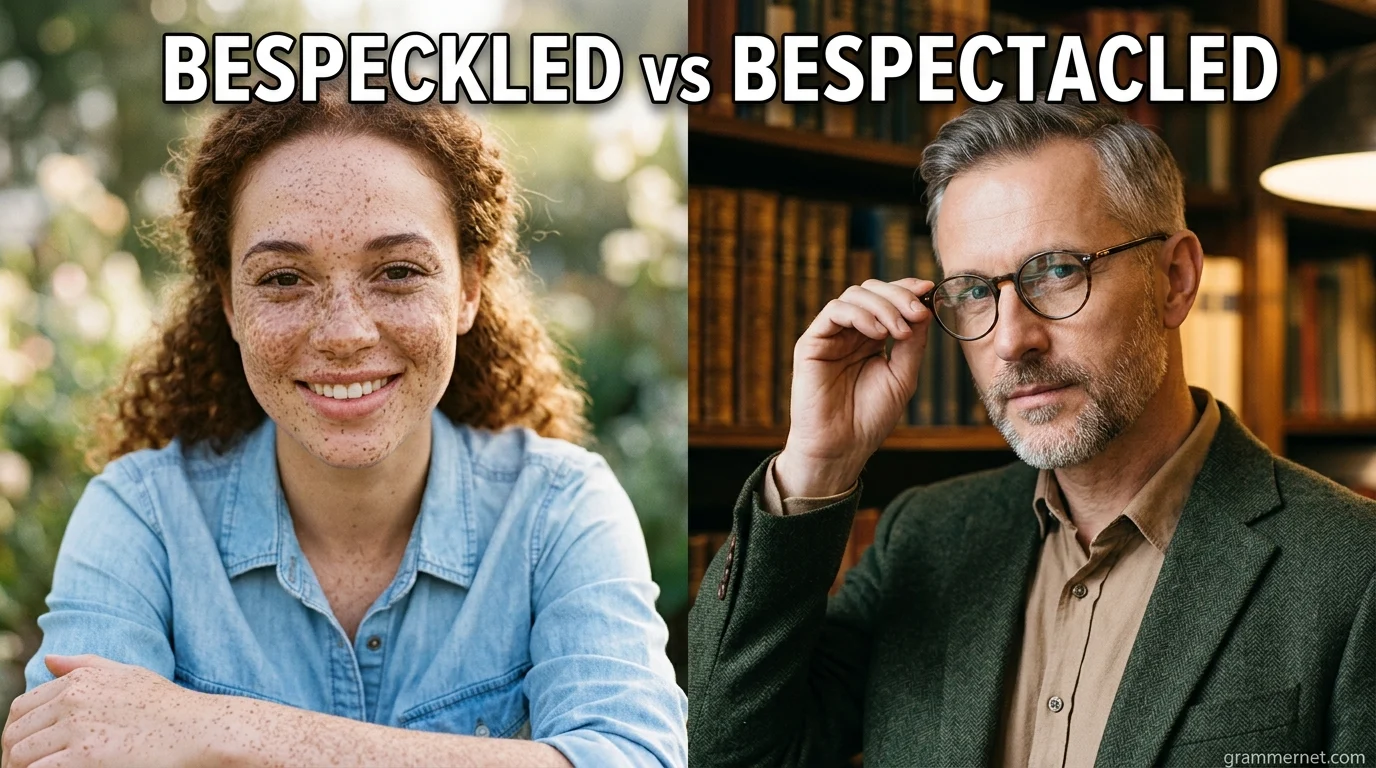
English has many word pairs that look and sound alike but have completely different meanings. Bespeckled and bespectacled are perfect examples. At first glance, these words seem interchangeable because they share the same beginning and have a similar rhythm. However, using the wrong one can change the meaning of your sentence entirely.
This confusion matters more than you might think. Whether you’re writing an academic essay, preparing for an exam, drafting a professional email, or simply trying to improve your vocabulary, choosing the correct word helps your communication sound polished and precise. Saying a “bespeckled professor” when you mean a professor wearing glasses can create an unintended image and distract readers from your message.
The good news is that once you understand the origins and meanings of these words, the distinction becomes easy to remember. In this guide, you’ll learn the definitions, spelling differences, grammar rules, pronunciation tips, examples, common mistakes, and practical memory tricks that will help you confidently choose between bespeckled and bespectacled every time.
Meaning: What Do Bespeckled and Bespectacled Mean?
Although they appear similar, these two words describe entirely different things.
What Does “Bespeckled” Mean?
Bespeckled means covered with specks, spots, or tiny marks.
It comes from the word speckle, which refers to small dots or spots scattered across a surface.
Examples:
- The old notebook was bespeckled with ink stains.
- Her dress was bespeckled with paint splashes.
- The bird had bespeckled feathers.
The focus is on appearance involving tiny spots.
What Does “Bespectacled” Mean?
Bespectacled means wearing spectacles or glasses.
It is a formal adjective used to describe people who wear eyeglasses.
Examples:
- The bespectacled professor greeted the class.
- A bespectacled librarian helped me find the book.
- The detective interviewed a bespectacled witness.
The focus is on eyewear.
Meaning Comparison Table
| Word | Meaning | Refers To |
| Bespeckled | Covered with specks or spots | Objects, surfaces, animals, people with marks |
| Bespectacled | Wearing spectacles or glasses | People |
Simple Memory Trick
- Speck = Spot
- Spectacle = Glasses
If you remember these root words, you’ll rarely confuse them.
Correct Usage: When Should You Use Each Word?
Choosing the correct word depends entirely on what you’re describing.
Use “Bespeckled” When Talking About Spots
Use this adjective when something has tiny marks, dots, or speckles.
Examples:
- The kitchen floor was bespeckled with flour.
- The leaves were bespeckled with raindrops.
- His shirt became bespeckled with mud.
Use “Bespectacled” When Talking About Glasses
Use this word when describing a person who wears spectacles.
Examples:
- The bespectacled scientist explained the experiment.
- Everyone recognized the bespectacled principal.
- A bespectacled customer approached the counter.
Side-by-Side Usage Table
| Situation | Correct Word | Example |
| Person wearing glasses | Bespectacled | The bespectacled lawyer entered the room. |
| Surface with tiny spots | Bespeckled | The wall was bespeckled with paint. |
| Child wearing spectacles | Bespectacled | The bespectacled boy smiled shyly. |
| Dress covered in dots | Bespeckled | She wore a bespeckled dress. |
Correct vs Incorrect Examples
| Correct | Incorrect |
| The bespectacled teacher graded papers. | The bespeckled teacher graded papers. |
| The tablecloth was bespeckled with stains. | The tablecloth was bespectacled with stains. |
| A bespectacled student raised his hand. | A bespeckled student raised his hand. |
Spelling Differences: Why Do People Confuse Them?
The confusion comes from their nearly identical structure.
Compare them closely:
- bespeckled
- bespectacled
Only a few letters differ, but those letters completely change the meaning.
Spelling Breakdown
Bespeckled
- Prefix: be-
- Root: speck
- Ending: -led
Bespectacled
- Prefix: be-
- Root: spectacle
- Ending: -d
Spelling Comparison Table
| Word | Root Word | Meaning of Root |
| Bespeckled | Speck | Small spot |
| Bespectacled | Spectacle | Glasses |
Why Learners Make This Error
People often:
- Read too quickly.
- Notice only the “bes…” beginning.
- Forget the root meaning.
- Assume the words are variations of each other.
Helpful Mnemonics
To remember the difference:
Bespeckled
- Think: Specks = Spots
Bespectacled
- Think: Spectacles = Glasses
These memory devices work surprisingly well.
Grammar Rules and Word Forms
Understanding how these words function grammatically makes them easier to use correctly.
Bespeckled
Usually functions as an adjective.
Examples:
- a bespeckled notebook
- a bespeckled mirror
- a bespeckled surface
It originates from the verb bespeckle, meaning to cover with specks.
Bespectacled
Functions as an adjective.
Examples:
- a bespectacled gentleman
- a bespectacled woman
- a bespectacled student
It directly describes someone wearing spectacles.
Grammar Forms Table
| Word | Part of Speech | Example |
| Bespeckle | Verb | Mud bespeckled the walls. |
| Bespeckled | Adjective | The bespeckled paper looked old. |
| Bespectacled | Adjective | The bespectacled doctor smiled. |
Sentence Patterns
Correct:
- The bespectacled manager greeted us.
- The bespeckled countertop needed cleaning.
Incorrect:
- The bespectacled countertop needed cleaning.
- The bespeckled manager adjusted his glasses.
Important Rule
Ask yourself:
Am I describing glasses or spots?
That answer determines which adjective to choose.
British vs American English Usage
Many English learners wonder whether one version is British and the other American.
The answer is simple:
Both English Varieties Use Both Words
Neither word changes spelling between British and American English.
Usage Table
| Variety | Bespeckled | Bespectacled |
| British English | Yes | Yes |
| American English | Yes | Yes |
| Australian English | Yes | Yes |
| Canadian English | Yes | Yes |
Style Differences
The only noticeable difference involves frequency.
Bespectacled tends to sound:
- slightly formal,
- literary,
- descriptive.
Writers often use it in novels and journalism.
For example:
- “The bespectacled historian addressed the audience.”
In everyday conversation, people often say:
- wearing glasses,
- wearing spectacles,
- wearing eyeglasses.
Bespeckled in Modern Usage
Bespeckled appears less frequently and often occurs in descriptive writing involving visual imagery.
Examples:
- nature writing,
- fiction,
- artistic descriptions.
Pronunciation Guide
Pronunciation is another reason these words get mixed up.
They sound very similar.
Bespeckled
Pronunciation:
bih-SPEK-uhld
Approximate breakdown:
- bih
- SPEK
- uhld
Bespectacled
Pronunciation:
bih-SPEK-tuh-kuhld
Approximate breakdown:
- bih
- SPEK
- tuh
- kuhld
Pronunciation Comparison Table
| Word | Syllables | Approximate Pronunciation |
| Bespeckled | 3 | bih-SPEK-uhld |
| Bespectacled | 4 | bih-SPEK-tuh-kuhld |
Pronunciation Tip
Listen for the extra syllable:
- Bespeckled → shorter
- Bespectacled → longer
That extra “tac” sound points to spectacles.
Practice Sentences
Say these aloud:
- The bespectacled professor gave a lecture.
- The bespeckled vase stood on the shelf.
- A bespectacled woman opened the door.
- The windows were bespeckled with rain.
Repeating them helps build confidence.
Sentence Examples in Everyday Contexts
Examples make vocabulary stick.
Bespeckled Examples
School:
- The art student’s apron was bespeckled with paint.
Home:
- The mirror became bespeckled with toothpaste droplets.
Nature:
- The butterfly had bespeckled wings.
Cooking:
- The countertop was bespeckled with flour.
Bespectacled Examples
Office:
- The bespectacled accountant reviewed the reports.
Education:
- A bespectacled student asked a thoughtful question.
Healthcare:
- The bespectacled pharmacist explained the medication.
Travel:
- The bespectacled tourist consulted a map.
Correct and Incorrect Examples
| Correct Usage | Incorrect Usage |
| The bespectacled judge entered. | The bespeckled judge entered. |
| Her coat was bespeckled with snow. | Her coat was bespectacled with snow. |
| The bespectacled doctor smiled warmly. | The bespeckled doctor smiled warmly. |
| The floor was bespeckled with glitter. | The floor was bespectacled with glitter. |
Mini Quiz
Which word fits?
- The ________ professor adjusted his glasses.
- The notebook was ________ with coffee stains.
- A ________ customer asked for assistance.
- The path was ________ with fallen leaves.
Answers:
- Bespectacled
- Bespeckled
- Bespectacled
- Bespeckled
Common Mistakes to Avoid
Many writers misuse these words because they rely on appearance rather than meaning.
Mistake 1: Using Bespeckled for Glasses
Incorrect:
- The bespeckled teacher wrote on the board.
Correct:
- The bespectacled teacher wrote on the board.
Mistake 2: Using Bespectacled for Spots
Incorrect:
- The rug was bespectacled with mud.
Correct:
- The rug was bespeckled with mud.
Mistake 3: Ignoring the Root Word
Remember:
- Speck → spots.
- Spectacle → glasses.
Mistake 4: Assuming They’re Interchangeable
They are not synonyms.
They describe entirely different things.
Common Errors Table
| Mistake | Correction |
| Bespeckled librarian | Bespectacled librarian |
| Bespectacled wallpaper | Bespeckled wallpaper |
| Bespeckled professor wearing glasses | Bespectacled professor |
| Bespectacled dress with dots | Bespeckled dress |
Editing Tip
During proofreading, ask:
Is this describing eyewear or tiny spots?
The answer reveals the correct choice instantly.
FAQs
Is “bespectacled” a real word?
Yes. It is a standard English adjective meaning “wearing glasses.”
Is “bespeckled” a real word?
Yes. It refers to something covered with tiny spots or speckles.
Can a person be bespeckled?
Yes, if the person has specks or spots on them.
Example:
- His face was bespeckled with freckles.
Is bespectacled old-fashioned?
It sounds somewhat formal and literary but is still correct and widely understood.
Which word is more common?
Bespectacled generally appears more often because describing people who wear glasses is a common need.
Are they interchangeable?
No.
- Bespeckled = spotted.
- Bespectacled = wearing glasses.
How can I remember the difference?
Use this rule:
- Speck = Spot
- Spectacle = Glasses
That simple connection solves the problem.
Conclusion
The difference between bespeckled and bespectacled is small in spelling but significant in meaning. Bespeckled refers to something covered with tiny spots, marks, or speckles, while bespectacled describes someone who wears spectacles or glasses.
To remember the distinction, focus on the root words:
- Speck → Spot
- Spectacle → Glasses
Whenever you’re unsure, ask yourself one question: Am I talking about spots or eyewear? If it’s spots, choose bespeckled. If it’s glasses, choose bespectacled.
Mastering these subtle vocabulary differences strengthens your writing, improves your accuracy in exams and professional settings, and helps you communicate with greater confidence. Once you connect the meanings to their roots, you’ll never have to guess between bespeckled and bespectacled again.
