
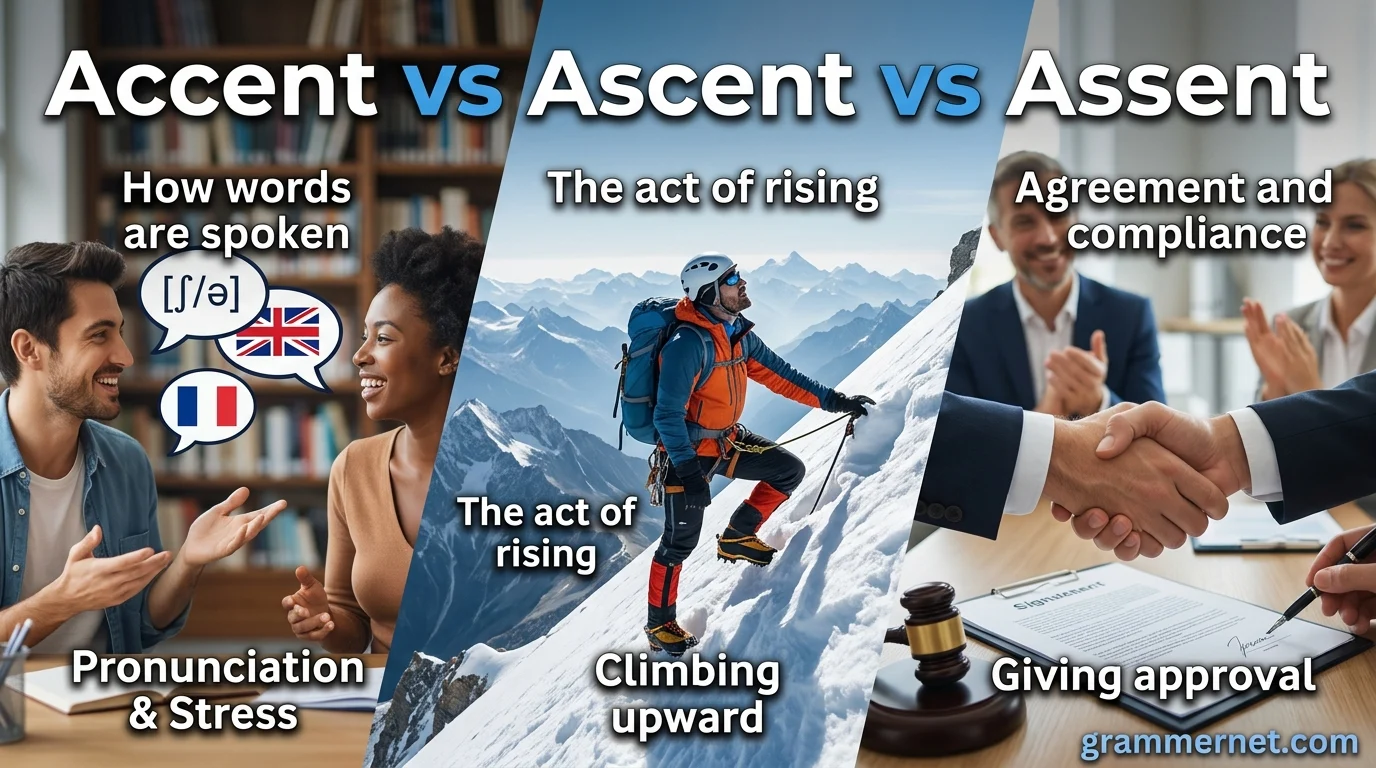
English is full of words that sound alike but have completely different meanings. Accent, ascent, and assent are perfect examples. Because they are pronounced similarly, many students, writers, and English learners confuse them in writing and speaking. Using the wrong word can change the meaning of your sentence and create unnecessary mistakes in exams, professional emails, academic writing, and everyday conversations.
Understanding the difference between accent vs ascent vs assent will help you communicate more accurately and confidently. In this guide, you’ll learn the meaning of each word, how to use them correctly, pronunciation tips, grammar rules, common mistakes, and plenty of real-life examples.
What Do Accent, Ascent, and Assent Mean?
Although these three words sound very similar, they belong to different parts of speech and express completely different ideas.
| Word | Part of Speech | Meaning | Example |
| Accent | Noun / Verb | A way of pronouncing words or special emphasis | She has a British accent. |
| Ascent | Noun | The act of climbing or rising upward | The ascent of the mountain took five hours. |
| Assent | Noun / Verb | Agreement or approval | The committee gave its assent to the proposal. |
The easiest way to remember them is:
- Accent → pronunciation or emphasis
- Ascent → climbing upward
- Assent → agreement or permission
Even though they sound alike, they should never replace one another.
Accent Meaning and Correct Usage
The word accent is the most common of the three. It refers to either the way someone pronounces words or the emphasis placed on a syllable, word, or idea.
Accent as a Noun
It can describe:
- A regional or national way of speaking
- Stress placed on a syllable
- A decorative feature that adds emphasis
Examples:
- She speaks English with an Australian accent.
- His French accent is easy to recognize.
- The teacher explained where the accent falls in the word.
- Blue cushions added an attractive accent to the room.
Accent as a Verb
As a verb, accent means to emphasize or highlight something.
Examples:
- Bright lighting accented the painting.
- The designer accented the walls with wooden panels.
Correct Examples
She has a strong Italian accent.
The speaker’s accent made the presentation interesting.
This wallpaper accents the living room beautifully.
Incorrect Examples
She has a strong Italian ascent.
The teacher liked my assent when I spoke.
Ascent Meaning and Correct Usage
Ascent is always related to going upward. It is used mainly as a noun and refers to climbing, rising, or moving toward a higher position.
It commonly appears in discussions about:
- Mountains
- Hills
- Airplanes
- Career growth
- Spiritual or personal progress
Examples:
- The ascent to the summit was difficult.
- The airplane began its ascent after takeoff.
- His rapid ascent in the company surprised everyone.
- They paused during the steep ascent.
Correct Examples
The hikers completed the ascent before sunset.
The helicopter started its ascent immediately.
Her ascent to leadership took years of hard work.
Incorrect Examples
The hikers completed the accent before sunset.
The airplane began its assent after takeoff.
Assent Meaning and Correct Usage
Assent refers to agreement, approval, or permission. It can be used as both a noun and a verb.
Assent as a Noun
Examples:
- The proposal received unanimous assent.
- The law required parliamentary assent.
Assent as a Verb
Examples:
- Everyone assented to the new policy.
- She silently assented to the request.
Correct Examples
The board gave its assent to the budget.
He nodded to show his assent.
They assented without hesitation.
Incorrect Examples
The board gave its accent to the proposal.
She gave her ascent to the new rules.
Accent vs Ascent vs Assent: Side-by-Side Comparison
The following table highlights the major differences.
| Feature | Accent | Ascent | Assent |
| Meaning | Pronunciation or emphasis | Climbing upward | Agreement or approval |
| Part of Speech | Noun, Verb | Noun | Noun, Verb |
| Related To | Speech, language, emphasis | Movement upward | Permission, acceptance |
| Common Context | Languages, pronunciation | Mountains, aircraft, careers | Meetings, decisions, laws |
| Easy Memory Trick | Speak | Climb | Agree |
Spelling and Pronunciation Differences
These words are examples of homophones or near-homophones because they sound almost identical in many English accents.
| Word | Pronunciation | Spelling Clue |
| Accent | AK-sent | Contains cent, often connected with speech emphasis |
| Ascent | uh-SENT | Begins with asc, similar to ascend |
| Assent | uh-SENT | Begins with ass, meaning agreement |
Helpful Memory Tricks
Accent
Think of accent and language.
If someone is speaking, use accent.
Ascent
Notice the letters asc, just like ascend.
If someone is climbing, use ascent.
Assent
Think of assent and agreement.
If someone approves or agrees, use assent.
Grammar Rules and Word Forms
Knowing the grammar forms makes these words much easier to use correctly.
| Word | Noun | Verb | Adjective |
| Accent | ✔ | ✔ | Accented |
| Ascent | ✔ | ✘ | Ascending (from ascend) |
| Assent | ✔ | ✔ | Assenting |
Notice that ascent itself has no verb form.
Instead, we use the verb ascend.
Examples:
- The balloon ascended quickly.
- Their ascent was slow.
Similarly:
- They assented immediately.
- Their assent surprised everyone.
Real-Life Sentence Examples
Seeing the words in context is the easiest way to remember them.
Accent Examples
- Her Scottish accent is easy to recognize.
- The actor learned a German accent for the movie.
- Teachers should respect every student’s accent.
- The blue curtains accent the room nicely.
- His accent reveals where he grew up.
Ascent Examples
- Their ascent became steeper after noon.
- The climbers celebrated their successful ascent.
- The rocket began its ascent into space.
- We stopped several times during the ascent.
- Her career ascent has been remarkable.
Assent Examples
- Everyone gave their assent.
- Parliament granted royal assent.
- The manager assented to the request.
- His silent nod indicated assent.
- The shareholders assented unanimously.
Common Mistakes and How to Avoid Them
Many learners confuse these words because they sound almost identical.
1: Using Accent Instead of Ascent
❌ Their accent up the mountain was difficult.
✔ Their ascent up the mountain was difficult.
2: Using Assent Instead of Accent
❌ His British assent sounds authentic.
✔ His British accent sounds authentic.
3: Using Ascent Instead of Assent
❌ The committee gave its ascent.
✔ The committee gave its assent.
4: Confusing Career Ascent with Agreement
❌ She earned everyone’s ascent.
✔ She earned everyone’s assent.
or
✔ Her ascent in the company was impressive.
The correct word depends on the meaning you want.
Accent vs Ascent vs Assent in Everyday Situations
These words appear in different contexts.
In School
- Learn pronunciation → accent
- Climb a hill → ascent
- Agree with a teacher → assent
At Work
- International employees may have different accents.
- Career growth is often described as an ascent.
- Managers give assent to proposals.
While Traveling
- You may hear different accents.
- Hiking involves an ascent.
- Travelers may need official assent for certain activities or permissions.
British vs American English
Unlike many English words, there is no spelling difference between British and American English for these three words.
Both varieties use:
- Accent
- Ascent
- Assent
The only noticeable difference may be pronunciation, especially the pronunciation of accent, but the spelling and meanings remain exactly the same.
Quick Memory Tricks
If you struggle to remember which word to use, these simple tricks can help.
Accent = Voice
Think:
People speak with an accent.
Ascent = Ascend
Think:
You ascend during an ascent.
Assent = Agree
Think:
You assent when you agree.
A simple phrase to remember all three is:
“Your accent stays on the ground, your ascent goes upward, and your assent says yes.”
FAQs
Is accent, ascent, and assent a homophone?
Yes. They are considered homophones or near-homophones because they are pronounced similarly but have different spellings and meanings.
Which word means agreement?
Assent means agreement, approval, or acceptance.
Example:
The committee gave its assent.
Which word refers to climbing?
Ascent refers to moving upward.
Example:
The mountain ascent was challenging.
Which word relates to pronunciation?
Accent refers to the way someone pronounces words or places stress on syllables.
Example:
She has a Canadian accent.
Can accent be used as a verb?
Yes.
Example:
The bright colors accent the design beautifully.
Is ascent a verb?
No.
The verb is ascend.
Correct:
The hikers ascended the mountain.
The ascent was difficult.
How can I remember the difference?
- Accent → speech
- Ascent → climb
- Assent → agree
Remembering these three keywords makes choosing the correct word much easier.
Conclusion About Accent vs Ascent vs Assent
Although accent, ascent, and assent sound almost identical, they have completely different meanings and uses. Accent relates to pronunciation or emphasis, ascent refers to climbing or rising upward, and assent means agreement or approval. Understanding these differences will help you avoid common writing mistakes and communicate more accurately in school, the workplace, and everyday conversations.
A simple way to remember them is to connect each word with its core idea: accent belongs to speech, ascent belongs to climbing, and assent belongs to agreement. Whenever you’re unsure, think about the context of your sentence rather than the pronunciation. With regular practice and the examples in this guide, you’ll be able to use all three words confidently and correctly.
