
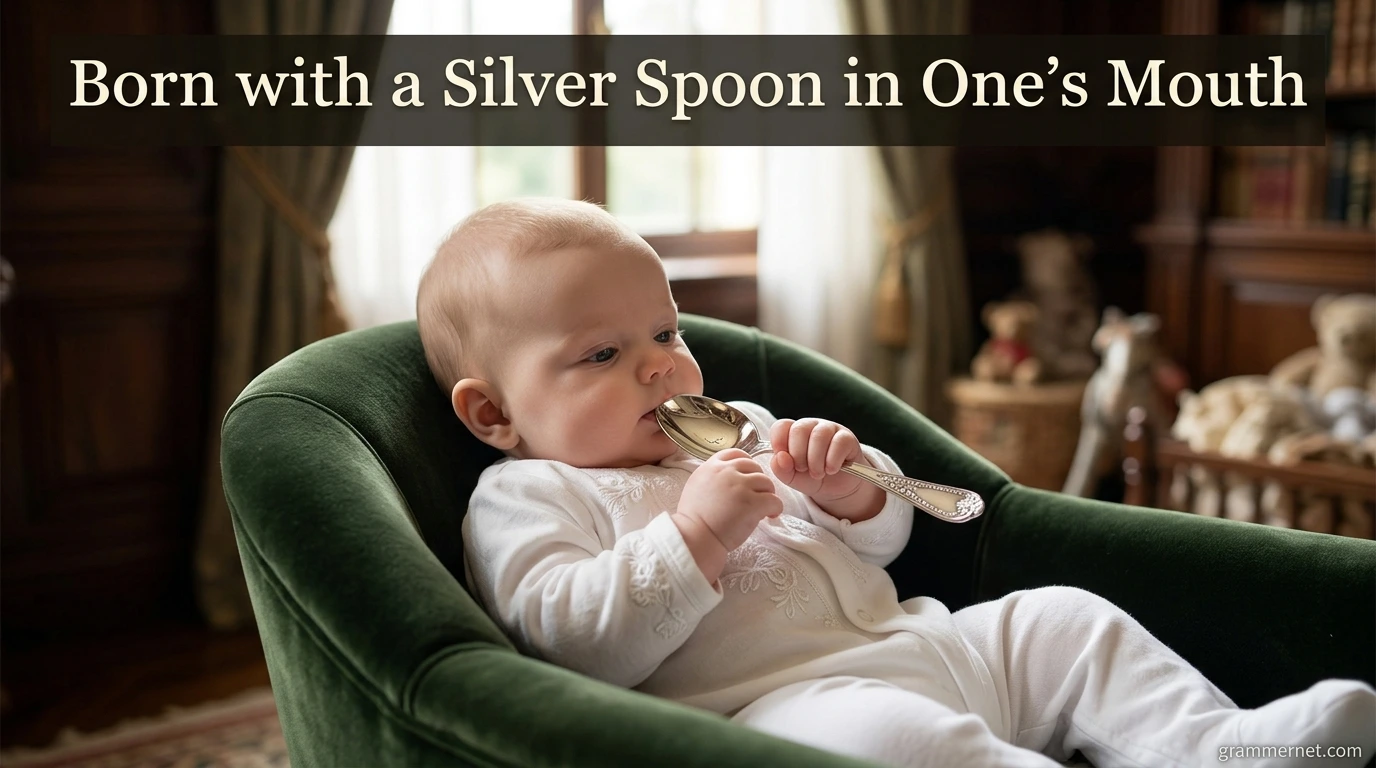
Many English learners encounter the phrase “born with a silver spoon in one’s mouth” and wonder what it actually means. The expression sounds unusual because it is an idiom rather than a literal statement. Since idioms often cannot be understood word for word, they can cause confusion in writing, speaking, exams, and professional communication.
Understanding this phrase is important because it appears frequently in books, newspapers, conversations, business discussions, and social commentary. Knowing when and how to use it correctly can improve your vocabulary, comprehension, and overall English fluency. This guide explains the meaning, origin, grammar, pronunciation, usage rules, examples, common mistakes, and frequently asked questions about born with a silver spoon in one’s mouth.
Meaning of “Born with a Silver Spoon in One’s Mouth”
The idiom born with a silver spoon in one’s mouth means that a person is born into a wealthy, privileged, or influential family. It suggests that someone has advantages from birth that make life easier compared to people who must struggle to achieve the same opportunities.
The phrase does not refer to an actual silver spoon. Instead, it symbolizes wealth, luxury, and social status.
Simple Definition
Born with a silver spoon in one’s mouth = born into wealth and privilege.
Examples
- She was born with a silver spoon in her mouth and attended the best schools.
- He never worried about money because he was born with a silver spoon in his mouth.
- Unlike his wealthy cousins, he was not born with a silver spoon in his mouth.
Meaning Comparison Table
| Expression | Meaning |
| Born with a silver spoon in one’s mouth | Born into wealth and privilege |
| Rich from birth | Financially comfortable from birth |
| Born into money | Born into a wealthy family |
| Privileged upbringing | Raised with significant advantages |
Although all these expressions are similar, born with a silver spoon in one’s mouth is the most colorful and idiomatic.
Origin of the Phrase
The expression has historical roots in Europe. In wealthy households, silver utensils were symbols of prosperity and social status. Families with money often gifted silver spoons to newborn children.
Over time, people began associating silver spoons with privilege and wealth. The phrase eventually evolved into an idiom used to describe anyone who was born into favorable financial circumstances.
Why a Silver Spoon?
Historically, silver was expensive and valuable. Owning silver tableware demonstrated wealth.
A child born into a family that could afford silver spoons likely enjoyed:
- Better education
- Better healthcare
- More opportunities
- Greater social influence
- Financial security
Thus, the silver spoon became a metaphor for inherited privilege.
Correct Usage of the Idiom
The phrase is generally used when discussing a person’s background, upbringing, or social advantages.
Common Usage Pattern
Subject + be verb + born with a silver spoon in his/her/their mouth
Examples:
- He was born with a silver spoon in his mouth.
- They were born with silver spoons in their mouths.
- She wasn’t born with a silver spoon in her mouth.
Appropriate Situations
Use the idiom when discussing:
- Wealthy families
- Privileged childhoods
- Social class differences
- Inherited advantages
- Economic opportunities
Not Appropriate For
Avoid using it when discussing:
- Actual silver utensils
- Temporary wealth
- Success earned entirely through hard work
- Technical or legal writing
Usage Comparison Table
| Situation | Correct Use? |
| Discussing wealthy upbringing | Yes |
| Describing inherited privilege | Yes |
| Referring to actual silverware | No |
| Formal legal documentation | Usually No |
| Casual conversation | Yes |
| Journalism and commentary | Yes |
Grammar Rules and Sentence Structure
Because the phrase is an idiom, its wording should remain mostly unchanged.
Standard Structure
Born with a silver spoon in one’s mouth
The possessive pronoun changes depending on the subject.
Grammar Forms Table
| Subject | Correct Form |
| He | Born with a silver spoon in his mouth |
| She | Born with a silver spoon in her mouth |
| I | Born with a silver spoon in my mouth |
| They | Born with silver spoons in their mouths |
| We | Born with silver spoons in our mouths |
Correct Examples
- She was born with a silver spoon in her mouth.
- They were born with silver spoons in their mouths.
- I wasn’t born with a silver spoon in my mouth.
Incorrect Examples
❌ He was born with a silver spoon in his hand.
✅ He was born with a silver spoon in his mouth.
❌ She was born with silver spoon in her mouth.
✅ She was born with a silver spoon in her mouth.
❌ They were born with silver spoon in their mouths.
✅ They were born with silver spoons in their mouths.
The key is to keep the core idiom intact.
Pronunciation Guide
Many learners understand the meaning but are unsure how to pronounce the phrase naturally.
Pronunciation
Born with a silver spoon in one’s mouth
Phonetic approximation:
/bɔːrn wɪð ə ˈsɪlvər spuːn ɪn wʌnz maʊθ/
Word Breakdown
| Word | Pronunciation |
| Born | bɔrn |
| Silver | SIL-ver |
| Spoon | spoon |
| One’s | wunz |
| Mouth | mouth |
Natural Stress Pattern
BORN with a SIL-ver SPOON in one’s MOUTH
The words silver, spoon, and mouth receive the strongest emphasis.
Speaking Example
“He was born with a silver spoon in his mouth, so financial struggles were unfamiliar to him.”
Practice saying the phrase as one smooth unit rather than pausing between words.
British vs American English Usage
One advantage of this idiom is that it works equally well in both British and American English.
Similarities
Both varieties use:
- The same spelling
- The same meaning
- The same grammar
- The same pronunciation pattern
Comparison Table
| Feature | British English | American English |
| Meaning | Same | Same |
| Spelling | Same | Same |
| Grammar | Same | Same |
| Common Usage | Yes | Yes |
Example in British English
- He was born with a silver spoon in his mouth and attended elite schools.
Example in American English
- She was born with a silver spoon in her mouth and inherited substantial wealth.
There is virtually no difference between the two varieties regarding this expression.
Real-Life Examples and Alternative Expressions
Understanding related expressions can help expand your vocabulary.
Everyday Examples
- Many people assume successful celebrities were born with a silver spoon in their mouths.
- Not everyone who appears wealthy was born with a silver spoon in their mouth.
- The politician was often criticized for being born with a silver spoon in his mouth.
Workplace Examples
- Some executives were born with a silver spoon in their mouths, while others worked their way up.
- Her privileged background gave her opportunities many people never receive.
Academic Examples
- The novel explores the contrast between characters born with silver spoons in their mouths and those raised in poverty.
Similar Expressions
| Expression | Meaning |
| Born into money | Born wealthy |
| Born into privilege | Born with advantages |
| Rich from birth | Wealthy since birth |
| Come from wealth | From a wealthy family |
| Have a privileged upbringing | Raised with advantages |
Opposite Expressions
| Expression | Meaning |
| Self-made | Achieved success independently |
| Started from nothing | Had few advantages |
| Worked one’s way up | Earned success gradually |
| Came from humble beginnings | Raised without wealth |
These alternatives help add variety to your writing.
Common Mistakes and How to Avoid Them
Learners often misuse this idiom because they focus on the literal words instead of the figurative meaning.
1: Taking It Literally
❌ The baby actually had a silver spoon in his mouth.
✅ He was born with a silver spoon in his mouth, meaning he came from a wealthy family.
2: Changing the Idiom
❌ Born with a gold spoon in his mouth.
✅ Born with a silver spoon in his mouth.
Although people may occasionally modify the phrase humorously, the standard form uses silver spoon.
3: Using the Wrong Body Part
❌ Born with a silver spoon in his hand.
✅ Born with a silver spoon in his mouth.
4: Using It for Temporary Wealth
❌ He won the lottery last year, so he was born with a silver spoon in his mouth.
✅ He won the lottery last year.
The idiom refers specifically to circumstances at birth.
Common Errors Table
| Incorrect | Correct |
| Born with a silver spoon in his hand | Born with a silver spoon in his mouth |
| Born with a gold spoon in his mouth | Born with a silver spoon in his mouth |
| Born with silver spoon | Born with a silver spoon |
| Used for lottery winners | Used for people wealthy from birth |
Remember: the phrase concerns inherited privilege, not wealth acquired later.
FAQs
Is the phrase positive or negative?
It can be either. Sometimes it simply describes wealth. Other times it implies criticism or suggests that someone had advantages others lacked.
Can the phrase be used professionally?
Yes, but carefully. It is acceptable in journalism, essays, biographies, and commentary. However, highly formal documents may require more neutral wording.
Is it offensive?
Not usually. However, some people may view it as slightly critical because it highlights privilege.
Can someone be successful and still be born with a silver spoon in their mouth?
Yes. Being born wealthy does not mean a person cannot also work hard or achieve success independently.
What is the opposite of being born with a silver spoon in one’s mouth?
Common opposites include:
- Self-made
- From humble beginnings
- Started with nothing
- Worked their way up
Is the phrase old-fashioned?
No. Although it is centuries old, it remains common in modern English and frequently appears in media and everyday conversation.
Conclusion
The idiom born with a silver spoon in one’s mouth is a well-known English expression that means being born into wealth, privilege, or a financially comfortable family. While the phrase sounds unusual at first, its meaning becomes easy to understand once you recognize it as an idiom rather than a literal statement.
The expression is widely used in both British and American English and appears in conversations, journalism, literature, social commentary, and academic writing. The key grammar point is to keep the idiom’s standard form intact: born with a silver spoon in his, her, my, your, or their mouth.
To remember it easily, think of a silver spoon as a symbol of luxury and inherited advantage. If someone is born with a silver spoon in their mouth, they start life with opportunities and privileges that many others do not have. Mastering this phrase will improve your vocabulary, strengthen your understanding of idioms, and help you communicate more naturally and confidently in English.
