
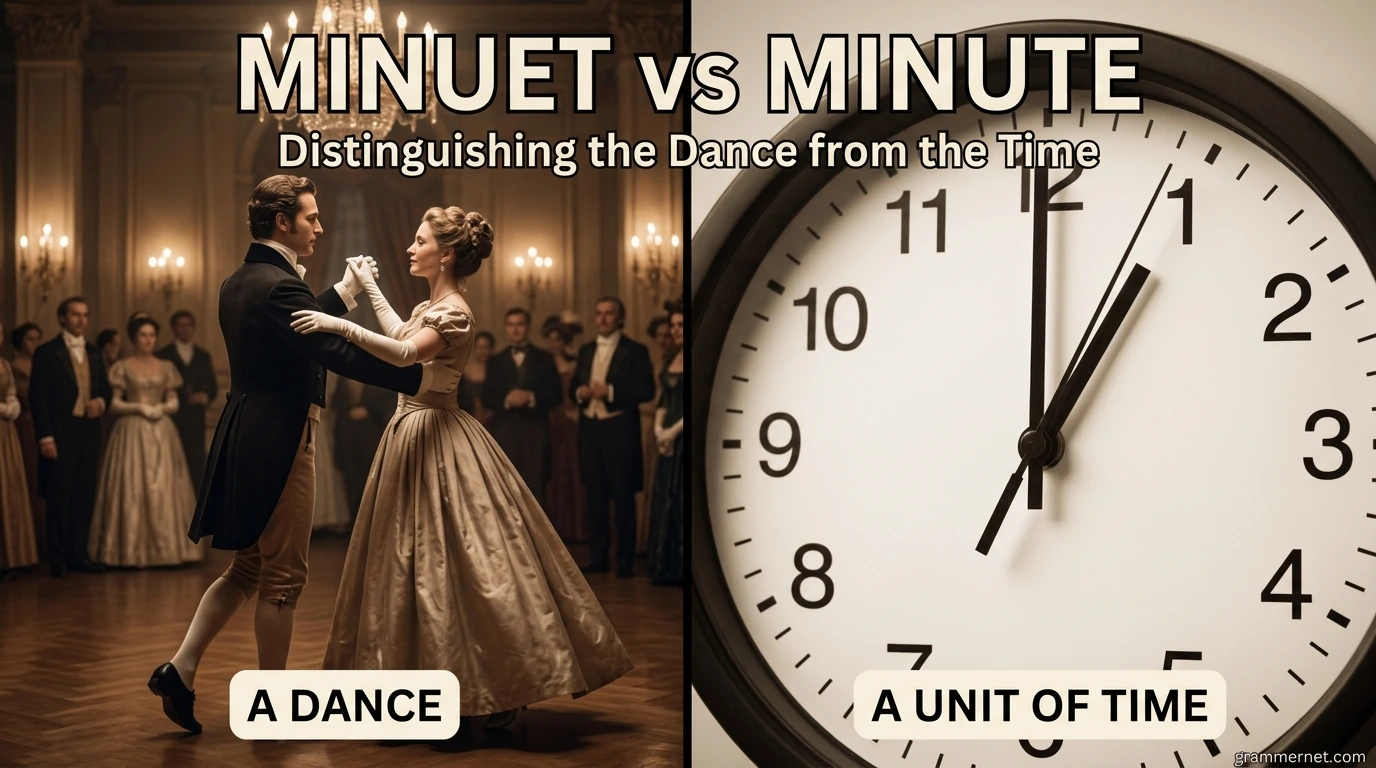
English is full of words that look almost the same but mean very different things. Minuet and minute are a perfect example. At a glance, they seem closely related because they share several letters and differ by only one vowel group. That makes them easy to mix up in writing, reading, spelling tests, and even speech. The confusion matters because using the wrong word can change your meaning completely. One word refers to a graceful dance or a piece of music; the other refers to time or something very small.
Understanding the difference between minuet vs minute helps you avoid spelling mistakes, improve vocabulary, and sound more confident in everyday English. It also matters in exams, professional communication, and any situation where accurate word choice is important. In this guide, you will learn the meaning, correct usage, spelling differences, grammar rules, pronunciation, sentence examples, British and American differences, common mistakes, FAQs, and simple memory tricks to help you remember the two words clearly.
Meaning: What Do “Minuet” and “Minute” Mean?
The first step is understanding the meaning of each word.
What does minuet mean?
A minuet is:
- a slow, graceful dance
- a piece of music written for that dance
- historically, a formal court dance in triple time
Examples:
- The orchestra played a beautiful minuet.
- She studied the minuet in her music class.
- The dancers performed a traditional minuet.
What does minute mean?
Minute has two very common meanings:
- A unit of time equal to 60 seconds.
- Very small or tiny.
Examples:
- Wait a minute.
- The meeting lasted ten minutes.
- There was a minute crack in the glass.
- He paid attention to every minute detail.
Meaning comparison table
| Word | Main meaning | Common use |
| minuet | a graceful dance or musical composition | music, history, dance |
| minute | 60 seconds or very small | time, size, description |
Simple way to remember
- Minuet = dance/music
- Minute = time or tiny
That small difference in meaning helps you choose the right word in context.
Correct Usage: When Should You Use Each Word?
Because the two words sound similar, context is very important.
Use minuet when talking about dance or music
Examples:
- The dancers performed a formal minuet.
- The composer wrote a minuet for the concert.
- We listened to a classical minuet in class.
This word is relatively uncommon in modern everyday conversation, but it still appears in:
- music
- literature
- history
- dance terminology
Use minute when talking about time
Examples:
- Give me a minute.
- I waited for five minutes.
- The lecture started exactly at the minute announced.
Use minute when talking about something tiny
Examples:
- There was a minute difference between the two results.
- She noticed a minute flaw in the design.
- The print was too minute to read easily.
Correct usage table
| Situation | Correct word | Example |
| Dance | minuet | They learned a minuet in history class. |
| Music | minuet | The pianist played a minuet. |
| Time | minute | Wait a minute, please. |
| Tiny detail | minute | There was a minute crack in the wall. |
Correct and incorrect examples
| Correct | Incorrect |
| The dancers performed a minuet. | The dancers performed a minute. |
| I’ll be there in a minute. | I’ll be there in a minuet. |
| The crack was minute. | The crack was minuet. |
The meanings are completely different, so the context should always guide your choice.
Spelling Differences: Why They Look So Similar
The main reason learners confuse these words is the spelling. The words differ by just a few letters:
- minuet
- minute
The difference is small visually, but huge in meaning.
Spelling comparison table
| Word | Letters | Visual clue |
| minuet | m-i-n-u-e-t | contains -uet |
| minute | m-i-n-u-t-e | ends with -ute |
Why the spellings are confusing
The words:
- begin with the same three letters: min
- are both short
- can be pronounced in a similar-looking way in writing
- appear in English tests as spelling traps
Helpful spelling trick
Think of:
- minuet → u-e = dance/music
- minute → time/tiny
The letter order helps, but the meaning helps even more.
Common spelling errors
| Wrong | Right |
| minuet (when you mean time) | minute |
| minute (when you mean dance) | minuet |
| minuetes | minutes |
| minuites | minutes |
Memory tip
Try connecting the spellings to meaning:
- Minuet has the extra u-e, like a formal old-style dance.
- Minute has the ending -ute, which you’ll see in time and size words.
Grammar Rules: How These Words Work in Sentences
Even though minuet and minute are different in meaning, they also function differently in grammar.
Minuet as a noun
Minuet is a noun.
Examples:
- The minuet was elegant.
- She learned a minuet at school.
- That minuet sounded beautiful.
It can be singular or plural:
- one minuet
- two minuets
Minute as a noun and adjective
Minute can be:
- A noun: a unit of time
- An adjective: meaning very small
As a noun
- The train arrives in ten minutes.
- Wait one minute.
As an adjective
- A minute crack
- A minute detail
- A minute change
Grammar comparison table
| Word | Part of speech | Example |
| minuet | noun | The minuet was beautiful. |
| minute | noun | Give me a minute. |
| minute | adjective | She noticed a minute error. |
Important grammar point
The adjective minute is pronounced differently from the noun minute when it means time. That is one reason the word is so confusing. We will explain pronunciation in the next section.
Correct and incorrect examples
| Correct | Incorrect |
| The minuet was part of the performance. | The minute was part of the performance. |
| The meeting lasted twenty minutes. | The meeting lasted twenty minuets. |
| He noticed a minute flaw. | He noticed a minuet flaw. |
Pronunciation: The Biggest Clue
Pronunciation is one of the easiest ways to tell these words apart.
Minuet pronunciation
Minuet is usually pronounced:
- min-yoo-ET
- /ˌmɪn.juˈet/
It has three syllables and ends with stress on the last syllable.
Minute pronunciation
Minute has two common pronunciations depending on meaning:
- Minute meaning 60 seconds:
- MIN-it
- /ˈmɪn.ɪt/
- Minute meaning tiny:
- my-NEWT or my-NOOT
- /maɪˈnjuːt/ in British English
- /maɪˈnuːt/ in American English
Pronunciation comparison table
| Word | Meaning | Pronunciation |
| minuet | dance/music | min-yoo-ET |
| minute | time | MIN-it |
| minute | tiny | my-NEWT / my-NOOT |
Why pronunciation matters
If you hear someone say:
- MIN-it, they usually mean time.
- my-NEWT or my-NOOT, they usually mean tiny.
- min-yoo-ET, they mean the dance or music term.
Speaking examples
- “Wait a minute.”
- “That is a minute detail.”
- “The dancers performed a minuet.”
Memory trick
- minuet = sounds elegant, like a dance
- minute = time or tiny, depending on pronunciation
Once you hear the stress pattern, the difference becomes much easier.
Sentence Examples in Real Life
Examples are the best way to lock in the difference.
1. Examples with minuet
- The ballroom performance ended with a graceful minuet.
- My music teacher explained the history of the minuet.
- The composer wrote a charming minuet for piano.
- The dancers practiced the minuet for the concert.
2. Examples with minute meaning time
- I’ll be ready in a minute.
- The speech lasted thirty minutes.
- She stepped out for a minute.
- The train leaves in ten minutes.
3. Examples with minute meaning tiny
- There was a minute mark on the table.
- He made a minute adjustment to the machine.
- The difference was so minute that no one noticed.
- She examined the minute details carefully.
Sentence comparison table
| Sentence | Correct word |
| The orchestra played a lovely ___ . | minuet |
| Give me a ___ to finish this. | minute |
| The crack was very ___. | minute |
| They rehearsed the classical ___. | minuet |
Correct and incorrect examples
| Correct | Incorrect |
| The minuet was performed beautifully. | The minute was performed beautifully. |
| Wait a minute while I check. | Wait a minuet while I check. |
| The mistake was minute. | The mistake was minuet. |
These examples show why context matters so much.
British vs American English: Is There a Difference?
There is no major difference in spelling between British and American English for these two words:
- minuet
- minute
However, there is a difference in how minute meaning “tiny” is pronounced.
British English
- minute (tiny) is usually pronounced my-NEWT
- minute (time) is MIN-it
American English
- minute (tiny) is usually pronounced my-NOOT
- minute (time) is MIN-it
Regional pronunciation table
| Word | British English | American English |
| minute = time | MIN-it | MIN-it |
| minute = tiny | my-NEWT | my-NOOT |
| minuet | min-yoo-ET | min-yoo-ET |
What does not change
- The spelling stays the same.
- The meanings stay the same.
- The difference between minuet and minute remains important in both varieties.
So, whether you are reading British or American English, the core distinction is exactly the same.
Common Mistakes, and How to Remember the Difference
Because these words look so close, learners make predictable mistakes.
Common mistakes
Mistake 1: Using the wrong word for time
Wrong:
- I’ll be there in a minuet.
Correct:
- I’ll be there in a minute.
Mistake 2: Using the wrong word for dance/music
Wrong:
- The orchestra played a minute.
Correct:
- The orchestra played a minuet.
Mistake 3: Forgetting that minute can mean “tiny”
Wrong assumption:
- minute only means sixty seconds.
Correct:
- minute can also mean very small.
Mistake 4: Pronouncing the words the same way
They do not always sound the same. Context and meaning affect pronunciation.
Common mistakes table
| Incorrect | Correct |
| Wait a minuet. | Wait a minute. |
| The dancer performed a minute. | The dancer performed a minuet. |
| The difference was minuet. | The difference was minute. |
| A minuet detail | A minute detail |
FAQs
Is “minute” only about time?
No. It can also mean very small or tiny.
What is a minuet?
A minuet is a formal dance or a piece of music written in that style.
Are minuet and minute related?
Only in appearance and spelling. Their meanings are very different.
How can I remember the difference easily?
Think:
- minuet = dance/music
- minute = time/tiny
Which one is more common?
Minute is much more common in everyday English. Minuet appears mostly in music, history, and literature.
Can “minute” be an adjective?
Yes. It can mean very small.
Examples:
- a minute difference
- a minute crack
- minute details
Why is “minute” pronounced differently?
Because English often gives the same spelling more than one pronunciation depending on meaning.
Memory trick
Here is a simple way to remember:
- Minuet has u-e → think of a graceful old dance
- Minute has -ute → think of time or tiny details
Another trick:
- Minuet is for the ballroom.
- Minute is for the clock.
Conclusion
The difference between minuet and minute is simple once you learn the meanings and pronunciation.
- Minuet = a graceful dance or a piece of music
- Minute = a unit of time or something very small
The words look alike, but they belong to very different contexts. Minuet appears most often in music, dance, and historical writing. Minute appears constantly in everyday English when talking about time, and it also works as an adjective meaning tiny or precise.
A quick memory rule:
- Minuet = dance/music
- Minute = time/tiny
If you are unsure, ask yourself:
- Am I talking about a dance or a song? → minuet
- Am I talking about time or something small? → minute
With this simple distinction, you can avoid one of English’s most common spelling and vocabulary confusions. The next time you see these words, you will know exactly which one belongs in the sentence—and why.
