
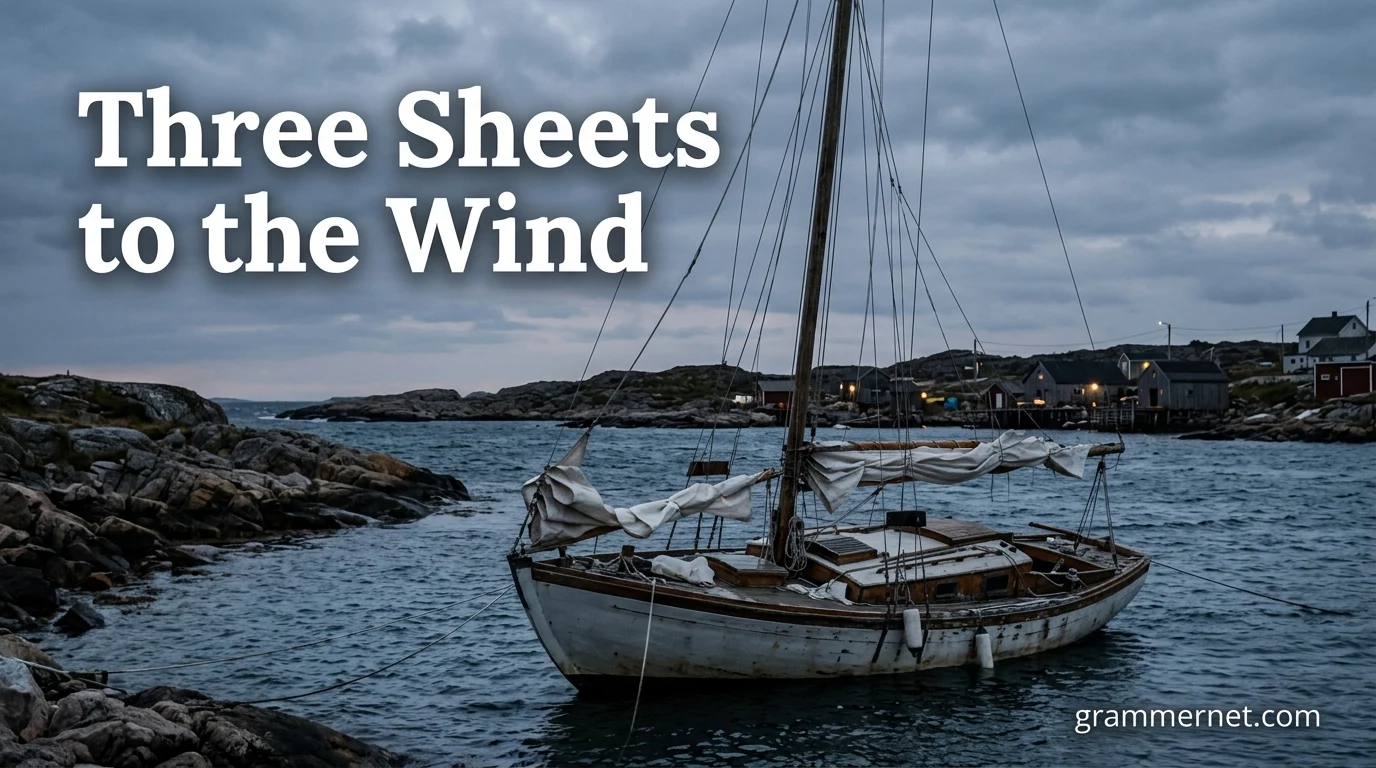
English is full of colorful idioms that can confuse learners, writers, and even native speakers. One expression that often raises questions is “three sheets to the wind.” At first glance, it sounds like something related to laundry or sailing, but its actual meaning is quite different. Because the phrase is figurative rather than literal, many people struggle to understand when and how to use it correctly.
Knowing the meaning of three sheets to the wind is useful for everyday conversations, literature, movies, business communication, and English exams. It also helps you recognize idiomatic language and avoid interpreting expressions word for word. In this guide, you’ll learn the definition, history, grammar, pronunciation, sentence examples, common mistakes, and practical tips for using this classic English idiom confidently.
What Does “Three Sheets to the Wind” Mean?
Three sheets to the wind is an idiom that means:
Very drunk or heavily intoxicated.
The phrase is often used humorously or informally to describe someone who has consumed a large amount of alcohol and is struggling to behave normally.
Simple Definition
- Three sheets to the wind = extremely drunk
- Not literal = does not refer to actual bed sheets or fabric
Examples
- By midnight, he was three sheets to the wind and singing loudly.
- They left the bar completely three sheets to the wind.
- The character in the movie spends most of the evening three sheets to the wind.
Quick Meaning Table
| Expression | Meaning |
| Three sheets to the wind | Very drunk |
| Tipsy | Slightly drunk |
| Intoxicated | Under the influence of alcohol |
| Sober | Not drunk |
The phrase is typically used in casual conversation rather than formal writing.
The Origin of “Three Sheets to the Wind”
One reason people find this idiom confusing is that the words themselves seem unrelated to alcohol.
The expression comes from sailing terminology.
In nautical language, a sheet is not a piece of cloth used on a bed. Instead, it is a rope that controls a sail. When a ship’s sheets become loose, the sails flap uncontrollably in the wind, causing the vessel to sway and move unpredictably.
Sailors noticed that a ship with loose sheets staggered through the water much like a drunk person staggers while walking.
How the Metaphor Developed
| Sailing Situation | Human Comparison |
| Loose sheets cause instability | Alcohol causes unsteady movement |
| Ship sways from side to side | Person staggers while walking |
| Difficult to control direction | Difficult to control behavior |
Over time, the phrase evolved into a popular idiom meaning extremely drunk.
Historical Note
Originally, sailors used different levels:
- One sheet to the wind
- Two sheets to the wind
- Three sheets to the wind
The more sheets that were loose, the more unstable the ship became. Eventually, three sheets to the wind became the standard expression and survived in modern English.
Correct Usage of “Three Sheets to the Wind”
This idiom functions primarily as an adjective phrase describing a person’s condition.
Basic Pattern
Subject + be verb + three sheets to the wind
Examples:
- He was three sheets to the wind.
- They were three sheets to the wind after the celebration.
- She looked three sheets to the wind.
Common Contexts
You can use it when discussing:
- Parties
- Celebrations
- Social gatherings
- Stories
- Movies
- Literature
- Humorous situations
Examples in Context
- After the wedding reception, several guests were three sheets to the wind.
- The detective found the witness three sheets to the wind and unable to answer questions clearly.
- By closing time, the man at the bar was completely three sheets to the wind.
Correct vs Incorrect Usage
| Correct | Incorrect |
| He was three sheets to the wind. | He was three sheets in the wind. |
| They were three sheets to the wind after drinking. | They were three sheet to the wind. |
| She looked three sheets to the wind. | She looked three sheets of the wind. |
The wording should remain fixed because idioms generally do not change form.
Grammar Rules and Sentence Structure
Since three sheets to the wind is an idiom, it follows specific grammatical patterns.
As a Predicate Expression
Most often, it appears after a linking verb.
Examples:
- He is three sheets to the wind.
- They were three sheets to the wind.
- She seemed three sheets to the wind.
As Part of a Description
- The three-sheets-to-the-wind customer caused a scene.
When used before a noun as a compound modifier, hyphens are sometimes added.
Structure Table
| Structure | Example |
| Be verb + idiom | He was three sheets to the wind. |
| Seem + idiom | She seemed three sheets to the wind. |
| Look + idiom | They looked three sheets to the wind. |
| Hyphenated modifier | A three-sheets-to-the-wind sailor stumbled home. |
Tense Examples
| Tense | Example |
| Present | He is three sheets to the wind. |
| Past | He was three sheets to the wind. |
| Future | He’ll be three sheets to the wind by midnight. |
| Present Perfect | He has been three sheets to the wind all evening. |
British vs American English Usage
The idiom is recognized in both British and American English.
Similarities
In both varieties:
- The meaning is the same.
- The spelling is the same.
- The pronunciation is nearly identical.
- The phrase refers to drunkenness.
Differences
The main difference lies in frequency and style.
| Feature | British English | American English |
| Recognition | Very common | Common |
| Meaning | Very drunk | Very drunk |
| Formality | Informal | Informal |
| Modern Usage | Still familiar | Still familiar |
Many speakers today may choose modern alternatives such as:
- drunk
- wasted
- hammered
- intoxicated
However, three sheets to the wind remains popular because it is vivid and colorful.
Pronunciation and Speaking Tips
Many learners encounter this idiom in books before hearing it spoken.
Pronunciation
Three sheets to the wind
/θriː ʃiːts tə ðə wɪnd/
Word Breakdown
| Word | Pronunciation |
| Three | /θriː/ |
| Sheets | /ʃiːts/ |
| To | /tə/ |
| The | /ðə/ |
| Wind | /wɪnd/ |
Speaking Tip
In natural speech, native speakers often say it quickly:
“He’s three sheets t’the wind.”
The phrase should flow smoothly as a single idiomatic unit.
Stress Pattern
The strongest stress usually falls on:
THREE SHEETS to the wind
This helps listeners recognize the idiom.
Examples of “Three Sheets to the Wind” in Real-Life Situations
Understanding examples is the fastest way to master an idiom.
Social Gatherings
- He arrived sober but left three sheets to the wind.
- By the end of the party, half the guests were three sheets to the wind.
Movies and Literature
- The pirate captain was three sheets to the wind during the celebration.
- The novel describes a traveler who becomes three sheets to the wind in a tavern.
Workplace Conversations
While possible, it is usually informal.
- The client showed up three sheets to the wind, which made the meeting difficult.
Storytelling
- We knew something was wrong when he came home three sheets to the wind.
Example Comparison Table
| Situation | Example Sentence |
| Party | He was three sheets to the wind by midnight. |
| Wedding | Several guests were three sheets to the wind. |
| Story | The sailor returned three sheets to the wind. |
| Movie | The character spends the evening three sheets to the wind. |
Common Mistakes and How to Avoid Them
Because the expression is old and unusual, learners frequently make errors.
1: Taking It Literally
Incorrect interpretation:
The phrase is about actual bed sheets.
Correct interpretation:
It is a nautical idiom meaning “very drunk.”
2: Changing the Words
Incorrect:
- Three sheets in the wind
- Three sheets on the wind
- Three sheets of the wind
Correct:
- Three sheets to the wind
3: Using It in Formal Documents
Formal writing generally prefers:
- intoxicated
- impaired
- under the influence
Instead of:
- three sheets to the wind
4: Using It for Mild Drunkenness
The phrase usually suggests a high level of intoxication.
Correct vs Incorrect Examples
| Correct | Incorrect |
| He was three sheets to the wind. | He was three sheets in the wind. |
| They were three sheets to the wind after drinking heavily. | They were three sheets to the wind after one sip. |
| The sailor came back three sheets to the wind. | The sailor came back three sheet to the wind. |
Memory Trick
Think of:
Loose sails → unstable ship → staggering person → very drunk
That sequence makes the meaning easier to remember.
FAQs
Is “three sheets to the wind” still used today?
Yes. Although it is an older idiom, native speakers still recognize and use it, especially in stories, conversation, and humorous contexts.
Does it always mean drunk?
Almost always. In modern English, the phrase is strongly associated with alcohol intoxication.
Is it formal or informal?
It is considered informal.
Can I use it in academic writing?
Generally no. Formal alternatives such as intoxicated or under the influence are more appropriate.
Why are there three sheets?
The number comes from old sailing terminology where multiple loose sheets created increasing instability.
Is it British or American?
It is used in both British and American English.
Can it be used metaphorically?
Sometimes writers use it creatively to describe someone acting wildly or lacking control, but the primary meaning remains “very drunk.”
Is it offensive?
No. It is usually considered humorous, informal, and non-offensive.
Conclusion
The idiom three sheets to the wind is one of English’s most colorful expressions. Although the phrase sounds mysterious at first, its meaning is straightforward: someone who is very drunk or heavily intoxicated. The expression comes from sailing, where loose sheets caused a ship to sway unpredictably, much like a drunk person stumbling while walking.
To use the phrase correctly, remember these key points:
- It means very drunk.
- It is an idiom, not a literal expression.
- The correct form is three sheets to the wind.
- It is best suited to informal conversation, storytelling, and literature.
- Avoid changing the wording because idioms work as fixed expressions.
A simple memory trick is:
Loose sails → unstable ship → staggering person → three sheets to the wind.
Once you understand its nautical roots and figurative meaning, you’ll be able to recognize and use three sheets to the wind confidently in conversation, writing, and everyday English.
