
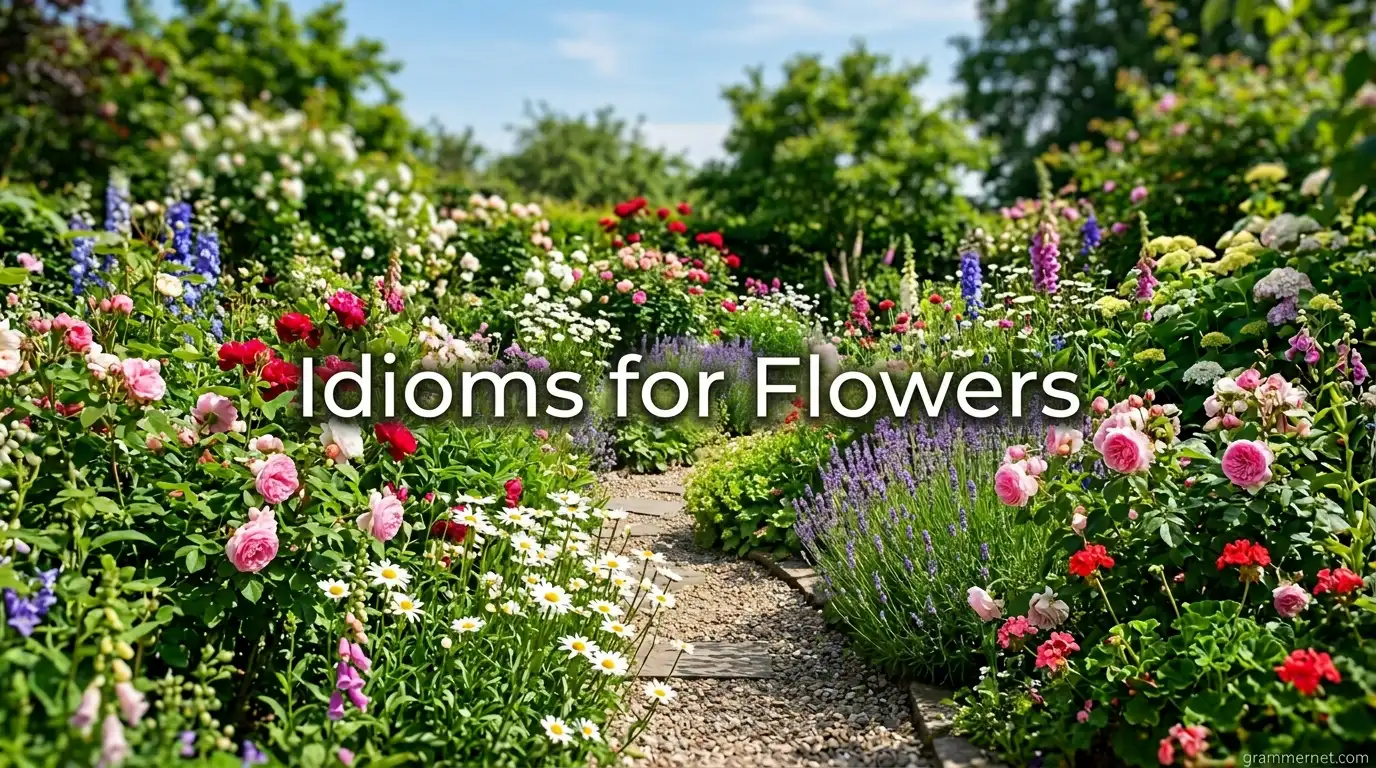
Flowers are more than beautiful decorations. In English, they also appear in many colorful idioms and expressions that describe growth, beauty, hope, kindness, difficulty, and even death. Learning idioms for flowers can help English learners understand native speakers better, speak more naturally, and add emotion to everyday conversations.
These expressions are especially useful in storytelling, casual speech, writing, and even professional communication when you want your English to sound vivid and memorable.
In real life, flower idioms can help you talk about personal growth, support a friend, describe a hard situation, or share a positive message. This guide explains the most useful flower idioms, their meanings, examples, origins, and how to use them correctly.
What Are Idioms for Flowers?
Idioms for flowers are expressions that use flowers, blooming, buds, roses, daisies, and similar natural images to describe ideas beyond literal flowers. Sometimes they are traditional idioms, and sometimes they are common figurative phrases that English speakers use often.
For example, “bloom where you are planted” does not mean becoming a literal flower. It means making the best of the situation you are in and growing successfully.
These expressions are common in:
- daily conversation
- motivational writing
- workplace language
- literature and poetry
- social media captions
- self-improvement talks
Why Learn Flower Idioms?
Learning flower idioms can help you:
- sound more natural and expressive
- understand English books, songs, and movies better
- describe emotions and life situations creatively
- improve speaking and writing fluency
- recognize cultural references and poetic language
Flower idioms are especially useful when talking about:
- growth and development
- beauty and freshness
- difficult situations
- optimism and perspective
- personality and shyness
Common Idioms for Flowers
1. Bloom Where You Are Planted
Meaning: To do well and grow successfully in the situation or environment you are in.
Example: “Even after moving to a new country, she learned to bloom where she was planted.”
Alternative expressions:
- make the best of things
- grow in any situation
- adapt and succeed
Typical use cases:
- personal growth
- career advice
- moving to a new place
- self-development
Fun fact / origin: This phrase comes from gardening imagery, where a flower grows best if it adapts to the soil it is planted in. It is often used as motivational advice.
2. Nip It in the Bud
Meaning: To stop a problem early before it gets worse.
Example: “The teacher noticed the behavior and nipped it in the bud.”
Alternative expressions:
- deal with it early
- stop it before it grows
- prevent it from becoming serious
Typical use cases:
- school discipline
- workplace problems
- relationships
- health or financial concerns
Fun fact / origin: A bud is the early stage of a flower before it blooms. If you remove it early, the flower never develops fully. That image makes this idiom easy to remember.
3. Come Up Roses
Meaning: To turn out well; to end successfully.
Example: “Despite the stress, everything came up roses in the end.”
Alternative expressions:
- turn out well
- work out perfectly
- end happily
Typical use cases:
- success stories
- project results
- personal plans
- lucky outcomes
Fun fact / origin: The phrase became popular because roses symbolize beauty, success, and a positive outcome. Saying something “came up roses” means it ended very well.
4. Fresh as a Daisy
Meaning: Feeling energetic, clean, lively, and refreshed.
Example: “She looked fresh as a daisy after a good night’s sleep.”
Alternative expressions:
- full of energy
- refreshed
- lively and bright
Typical use cases:
- morning conversations
- health and wellness
- compliments
- casual writing
Fun fact / origin: Daisies are bright, open, and cheerful flowers, so the phrase suggests a fresh and lively appearance.
5. Stop and Smell the Roses
Meaning: To slow down and enjoy life instead of always rushing.
Example: “You work too much—sometimes you need to stop and smell the roses.”
Alternative expressions:
- enjoy the moment
- slow down
- appreciate life
Typical use cases:
- life advice
- stress management
- motivational talks
- travel and leisure
Fun fact / origin: The phrase uses the simple image of pausing to enjoy the scent of roses, which reflects mindfulness and relaxation.
6. No Bed of Roses
Meaning: Something that is not easy or pleasant.
Example: “Starting a business is no bed of roses.”
Alternative expressions:
- not easy
- full of challenges
- difficult situation
Typical use cases:
- work problems
- life challenges
- studies
- relationships
Fun fact / origin: A bed of roses sounds comfortable and beautiful, so saying something is “no bed of roses” means the opposite—it is hard or uncomfortable.
7. Push Up Daisies
Meaning: A humorous or informal way to say someone has died.
Example: “In old movies, they sometimes joke that people who die are pushing up daisies.”
Alternative expressions:
- pass away
- die
- be no longer alive
Typical use cases:
- informal or humorous speech
- fiction
- dark comedy
Caution: This expression is slangy and disrespectful in serious situations. Use carefully, or avoid it altogether in formal or sensitive contexts.
Fun fact / origin: The phrase paints a visual image of a buried person under the ground, with daisies growing above them.
8. In Full Bloom
Meaning: At the height of beauty, development, or success.
Example: “Her career was in full bloom by the time she turned thirty.”
Alternative expressions:
- at its peak
- thriving
- fully developed
Typical use cases:
- personal success
- physical beauty
- artistic development
- nature descriptions
Fun fact / origin: In gardening, a flower in full bloom has opened completely. This image naturally translates into growth or success in life.
9. Rose-Colored Glasses
Meaning: An overly positive or unrealistic view of something.
Example: “He sees the past through rose-colored glasses and forgets the bad parts.”
Alternative expressions:
- overly optimistic
- unrealistic view
- biased positive thinking
Typical use cases:
- relationships
- nostalgia
- criticism of unrealistic thinking
Fun fact / origin: The phrase suggests that if you wear glasses with rose-colored lenses, everything looks softer, prettier, and less real.
10. Wallflower
Meaning: A shy person who avoids attention, especially at social events.
Example: “At the party, he was a wallflower and didn’t dance much.”
Alternative expressions:
- shy person
- quiet person
- reserved individual
Typical use cases:
- social situations
- personality descriptions
- school dances or parties
Fun fact / origin: A wallflower is a flower that grows against a wall or in the shade. The image was later used for someone standing alone at a dance.
11. Shrinking Violet
Meaning: A very shy or timid person.
Example: “She may seem like a shrinking violet, but she speaks confidently once she gets to know people.”
Alternative expressions:
- shy person
- timid individual
- quiet personality
Typical use cases:
- personality descriptions
- social confidence
- storytelling
Fun fact / origin: The violet is a small, delicate flower. The idiom suggests someone who appears delicate or hesitant.
12. Budding Talent
Meaning: A person with growing potential or early signs of skill.
Example: “He is a budding artist with a lot of promise.”
Alternative expressions:
- rising talent
- emerging skill
- developing potential
Typical use cases:
- education
- sports
- art
- career development
Fun fact / origin: The word budding comes from the early stage of a flower before it opens.
13. Flower of Youth
Meaning: The best or most energetic time of someone’s youth.
Example: “She was in the flower of her youth when she began traveling the world.”
Alternative expressions:
- prime of youth
- youthful peak
- best years
Typical use cases:
- literature
- personal reflection
- poetic writing
Fun fact / origin: This phrase comes from the idea that youth is like a flower at its most beautiful stage.
14. Come Into Full Flower
Meaning: To develop fully and reach maturity or success.
Example: “His talent came into full flower during college.”
Alternative expressions:
- fully develop
- mature beautifully
- reach full potential
Typical use cases:
- education
- career growth
- art and creativity
15. A Late Bloomer
Meaning: Someone who develops skill, success, or maturity later than others.
Example: “She was a late bloomer and found her confidence in her thirties.”
Alternative expressions:
- developed later
- slow starter
- found success later in life
Typical use cases:
- education
- career paths
- personal growth
Fun fact / origin: The phrase comes from flowers that bloom later than expected, symbolizing delayed but eventual success.
Idioms for Flowers by Context
Growth and Development
- bloom where you are planted
- budding talent
- come into full flower
- late bloomer
Beauty and Energy
- fresh as a daisy
- in full bloom
- flower of youth
Problems and Warnings
- nip it in the bud
- no bed of roses
- rose-colored glasses
Personality and Social Behavior
- wallflower
- shrinking violet
Humorous or Informal Use
- push up daisies
Grouping idioms by context helps learners remember them more easily and use them naturally.
How to Use Flower Idioms Naturally
Match the tone
Some flower idioms sound poetic or positive, while others are casual or even humorous.
- Positive: bloom where you are planted, fresh as a daisy
- Critical: rose-colored glasses
- Informal: push up daisies
Learn them in context
Try not to memorize only the meaning. Learn the idiom in a full sentence and a real-life situation.
Use them in the right setting
Some idioms work well in motivational speech, while others are better for casual conversation or writing.
Practice with your own experiences
Think about your own growth, challenges, or social experiences and describe them using these idioms.
Common Mistakes to Avoid
Taking idioms literally
“Bloom where you are planted” does not mean you are a real flower.
Using the wrong tone
“Push up daisies” is too informal or insensitive for serious conversations.
Confusing similar idioms
- fresh as a daisy = energetic and refreshed
- late bloomer = someone who develops later
Overusing idioms
Too many idioms in one conversation can sound unnatural.
Using poetic idioms in formal reports
Some phrases are better for essays, stories, or speeches than for technical writing.
Fun Origins Behind Flower Idioms
Bloom where you are planted
This phrase likely comes from agricultural and motivational imagery, encouraging people to thrive in any environment.
Nip it in the bud
A bud is the earliest stage of a flower, so stopping something at that stage means preventing full development.
Rose-colored glasses
This idiom suggests seeing the world through a beautiful but unrealistic filter.
Wallflower
The flower image originally described someone standing on the edge of a dance floor, like a flower on the wall.
Knowing origins can make idioms more memorable and easier to understand.
Interactive Practice Section
Exercise 1: Fill in the Blanks (Easy)
- She is a ______ talent in music.
- The plan failed because no one nipped the issue in the ______.
- After the vacation, I felt fresh as a ______.
Answers
- budding
- bud
- daisy
Exercise 2: Match the Idiom to the Meaning (Medium)
IdiomMeaningRose-colored glassesA. Too optimisticNo bed of rosesB. Not easyWallflowerC. Shy person at a social event
Answers
- Rose-colored glasses → A
- No bed of roses → B
- Wallflower → C
Exercise 3: Choose the Best Idiom (Advanced)
- “She seems shy and stays away from attention at parties.”
- “He learned to succeed in the situation he was given.”
- “They waited too long, and the small problem became serious.”
Answers
- Wallflower / shrinking violet
- Bloom where you are planted
- Nip it in the bud
Quick Quiz
Question 1
Which idiom means “to stop a problem early”?
A. In full bloom B. Nip it in the bud C. Fresh as a daisy
Answer: B
Question 2
Which idiom means “an overly positive view”?
A. Rose-colored glasses B. A late bloomer C. Come up roses
Answer: A
Question 3
Which idiom means “to thrive in your situation”?
A. Bloom where you are planted B. Push up daisies C. No bed of roses
Answer: A
Tips for Remembering Flower Idioms
Use visual imagination
Picture a bud, a blooming rose, a daisy, or a wallflower at a dance.
Create flashcards
Write the idiom on one side and the meaning and example on the other.
Practice with real-life situations
Use idioms when talking about:
- growth
- confidence
- problems
- relationships
- success
Read stories and poems
Flower idioms are common in creative writing, so literature is a great source for practice.
Suggested Visuals and Infographics
To make this article more engaging, you can add:
- a flower idiom chart by theme
- a blooming flower timeline for growth idioms
- a comparison table of positive vs negative flower idioms
- flashcards with literal and figurative meanings
- a “flower personality” infographic for wallflower, shrinking violet, and budding talent
Visual learning makes idioms easier to remember and more enjoyable to study.
Why Flower Idioms Matter
Flower idioms are useful because they appear in literature, conversations, motivational writing, and everyday English. They help learners express ideas about growth, beauty, hope, difficulty, and personality in a more natural and vivid way. They also make your English feel more expressive and memorable.
These expressions are especially helpful when talking about:
- personal development
- social behavior
- optimism
- problems and solutions
- success and maturity
FAQs
What are idioms for flowers?
They are figurative expressions in English that use flowers, blooms, buds, roses, and similar images to describe life, growth, beauty, or personality.
Why should English learners study flower idioms?
They help learners understand native English and speak or write more naturally.
What does “bloom where you are planted” mean?
It means to do well and grow successfully in the situation or environment you are in.
What does “nip it in the bud” mean?
It means to stop a problem early before it grows bigger.
Is “push up daisies” polite?
No, it is informal and often considered insensitive or humorous, so use it carefully.
What does “wallflower” mean?
It means a shy person who avoids attention at social events.
Can flower idioms be used in writing?
Yes, especially in creative writing, storytelling, motivational speeches, and essays.
Conclusion
Learning idioms for flowers is a beautiful way to expand your English vocabulary and communicate more vividly. These expressions help you talk about growth, beauty, optimism, difficulty, and personality in a natural and memorable way. From bloom where you are planted to nip it in the bud, fresh as a daisy, and rose-colored glasses, flower idioms appear often in real English and can make your language more expressive.
The best way to master them is through regular practice, context-based learning, and using them in your own sentences. Over time, these idioms will become a natural part of your vocabulary and help you speak and write English with more confidence and creativity.
