
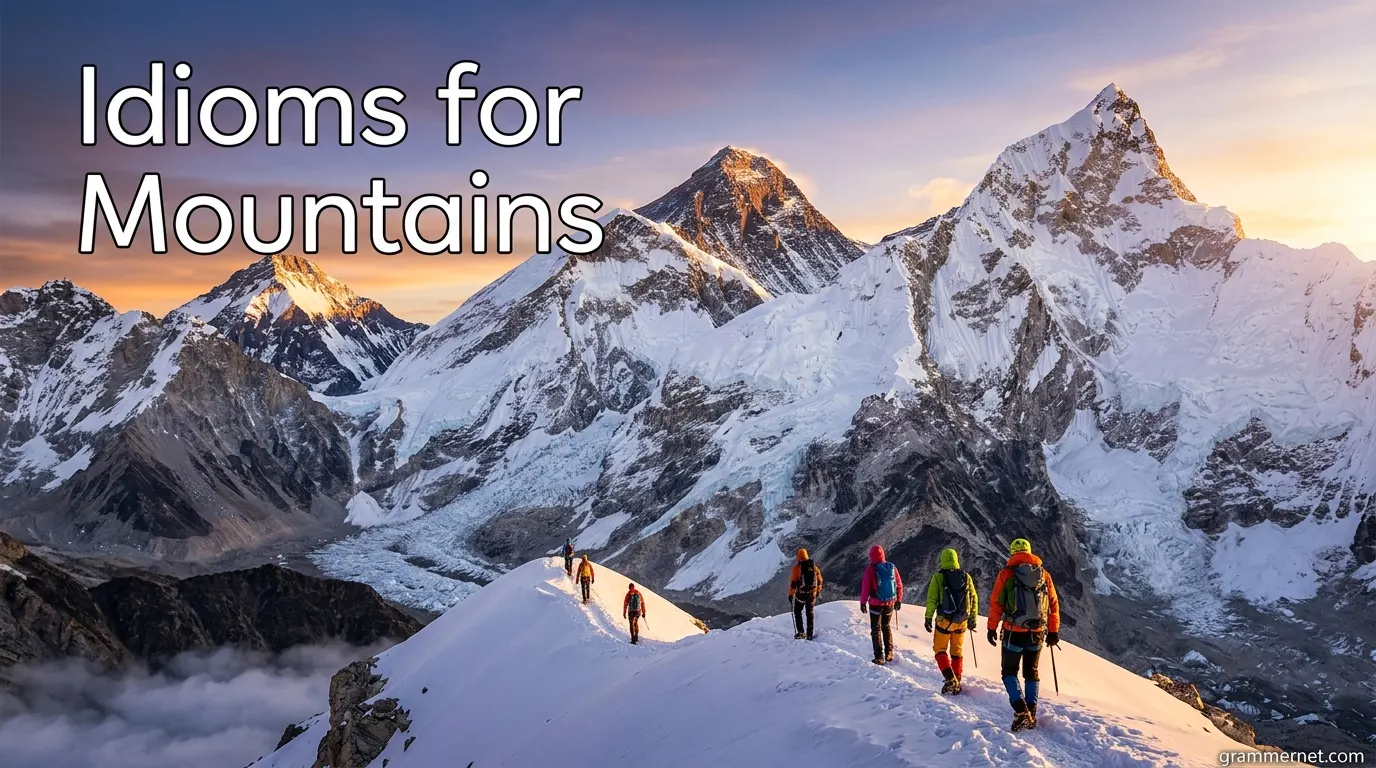
Idioms for mountains are powerful expressions that help English learners describe challenges, success, determination, emotions, and life experiences in a vivid and memorable way. Mountains symbolize strength, obstacles, adventure, and achievement, making these idioms especially useful in everyday communication.
Whether you are a student improving vocabulary, a professional enhancing communication skills, or a language enthusiast exploring figurative English, mountain idioms can make your speaking and writing more expressive. Learning these phrases also improves cultural understanding and helps you sound more fluent and natural in conversations, storytelling, and professional settings.
What Are Mountain Idioms?
Mountain idioms are figurative expressions inspired by mountains, climbing, valleys, peaks, and rocky landscapes. These phrases rarely mean exactly what the words suggest. Instead, they symbolize emotions, challenges, goals, or personal growth.
For example:
- “Move mountains” does not literally mean pushing mountains.
- It means achieving something extremely difficult.
These idioms are commonly used in:
- daily conversations
- motivational speeches
- workplace communication
- books and movies
- travel and adventure stories
Why Learn Idioms for Mountains?
Learning mountain-related idioms helps English learners:
- understand native speakers more easily
- express ideas creatively
- improve speaking and writing skills
- sound more fluent and confident
- remember vocabulary through vivid imagery
Mountain idioms are especially useful when discussing:
- challenges
- success
- determination
- emotions
- difficult journeys
- ambition
Common Idioms for Mountains
Move Mountains
Meaning: To do something extremely difficult or achieve the impossible.
Example: “She would move mountains to help her family.”
Alternative Expressions:
- Do the impossible
- Go above and beyond
- Make great efforts
Typical Use Cases:
- Motivation
- Hard work
- Personal sacrifice
Fun Fact / Origin: This expression has been used for centuries in religious and motivational contexts to symbolize incredible determination.
Make a Mountain Out of a Molehill
Meaning: To exaggerate a small problem.
Example: “He made a mountain out of a molehill when the internet stopped working.”
Alternative Expressions:
- Overreact
- Blow things out of proportion
- Exaggerate a problem
Typical Use Cases:
- Family arguments
- Workplace stress
- Everyday misunderstandings
Fun Fact: A molehill is tiny compared to a mountain, making this idiom easy to visualize.
Reach the Summit
Meaning: To achieve a major goal or success.
Example: “After years of hard work, she finally reached the summit of her career.”
Alternative Expressions:
- Achieve success
- Reach the top
- Accomplish a goal
Typical Use Cases:
- Career achievements
- Education
- Personal development
Uphill Battle
Meaning: A very difficult struggle.
Example: “Starting a business without funding is an uphill battle.”
Alternative Expressions:
- Tough challenge
- Difficult struggle
- Hard journey
Typical Use Cases:
- Work challenges
- Financial difficulties
- Health struggles
Downhill From Here
Meaning: Things will become easier after a difficult stage.
Example: “Now that the exams are over, it’s downhill from here.”
Alternative Expressions:
- Easier from now on
- Smooth journey ahead
- Less difficult
Typical Use Cases:
- Long projects
- Recovery periods
- Difficult tasks
Climb Every Mountain
Meaning: To try every possible way to achieve something.
Example: “She climbed every mountain to find the right university.”
Alternative Expressions:
- Try everything
- Leave no stone unturned
- Explore every option
Typical Use Cases:
- Personal goals
- Career planning
- Relationships
Fun Fact / Origin: This phrase became widely known through music and inspirational literature.
Over the Hill
Meaning: Past one’s best years, especially because of age.
Example: “He jokes that he’s over the hill after turning fifty.”
Alternative Expressions:
- Aging
- Past your prime
- No longer young
Typical Use Cases:
- Humor about age
- Informal conversations
Note: This idiom can sound rude if used carelessly.
Rocky Road
Meaning: A difficult or challenging period.
Example: “Their relationship has had a rocky road recently.”
Alternative Expressions:
- Rough patch
- Difficult path
- Hard times
Typical Use Cases:
- Relationships
- Careers
- Personal struggles
Peak of Success
Meaning: The highest point of achievement.
Example: “The athlete reached the peak of success after winning the championship.”
Alternative Expressions:
- Greatest achievement
- Highest level
- Ultimate success
Typical Use Cases:
- Sports
- Careers
- Personal accomplishments
Valley of Despair
Meaning: A period of sadness, difficulty, or hopelessness.
Example: “After losing his job, he went through a valley of despair.”
Alternative Expressions:
- Difficult emotional period
- Depression
- Hard times
Typical Use Cases:
- Emotional struggles
- Motivation
- Personal stories
Mountain Idioms Grouped by Context
Idioms for Challenges
IdiomMeaningUphill battleDifficult struggleRocky roadChallenging periodValley of despairEmotional difficulty
Idioms for Success
IdiomMeaningReach the summitAchieve successPeak of successHighest achievementMove mountainsAccomplish difficult things
Idioms for Emotions and Reactions
IdiomMeaningMake a mountain out of a molehillOverreactOver the hillFeeling oldDownhill from hereEasier ahead
How to Use Mountain Idioms Naturally
Mountain idioms sound best when they match the emotional tone of a conversation.
Good Examples
- “Building a new company was an uphill battle.”
- “The hardest part is over—it’s downhill from here.”
- “She moved mountains to help her children.”
Tips for Natural Usage
- Use motivational idioms positively.
- Avoid overusing idioms in formal writing.
- Learn the emotional meaning behind each phrase.
- Practice using idioms in real-life examples.
Common Mistakes to Avoid
Using Idioms Literally
Incorrect: “He actually moved a mountain yesterday.”
Correct: “He worked extremely hard to solve the problem.”
Confusing Similar Idioms
“Uphill battle” means difficulty. “Downhill from here” means things become easier.
Overusing Idioms
Too many idioms in one sentence can sound unnatural.
Incorrect: “My uphill battle became downhill from here after moving mountains.”
Correct: “After months of hard work, things became easier.”
Fun Origins Behind Mountain Idioms
Many mountain idioms come from real experiences of travelers, climbers, and explorers.
Uphill Battle
Walking uphill is physically difficult, so the phrase became associated with hard struggles.
Reach the Summit
Mountain climbers celebrate reaching the summit because it represents achievement and perseverance.
Make a Mountain Out of a Molehill
This phrase dates back hundreds of years and humorously compares tiny molehills to giant mountains.
These origins make the idioms easier to remember.
Idioms for Mountains in Professional Communication
Mountain idioms are common in workplaces and motivational speaking.
Examples
- “Launching the project was an uphill battle.”
- “We finally reached the summit after months of effort.”
- “The company moved mountains to meet the deadline.”
Workplace Benefits
These idioms:
- inspire teamwork
- create vivid communication
- express challenges effectively
Interactive Practice Activities
Fill in the Blanks (Easy)
- Starting the business was an uphill ______.
- She made a mountain out of a ______.
- We finally reached the ______ after years of work.
Answers
- battle
- molehill
- summit
Match the Idiom to Its Meaning (Medium)
IdiomMeaningMove mountainsA. Exaggerate a problemReach the summitB. Achieve something difficultMake a mountain out of a molehillC. Reach success
Answers
- Move mountains → B
- Reach the summit → C
- Make a mountain out of a molehill → A
Advanced Writing Challenge
Write a short paragraph using:
- uphill battle
- move mountains
- peak of success
Try to describe a personal challenge or goal.
Quick Quiz
1. Which idiom means “to exaggerate a small issue”?
A. Reach the summit B. Make a mountain out of a molehill C. Rocky road
Answer: B
2. Which idiom means “a difficult struggle”?
A. Uphill battle B. Peak of success C. Downhill from here
Answer: A
3. Which idiom describes reaching your highest achievement?
A. Valley of despair B. Peak of success C. Rocky road
Answer: B
Tips for Remembering Mountain Idioms
Visualize the Scene
Imagine climbing steep mountains or standing at a summit.
Group Idioms by Meaning
Study challenge idioms separately from success idioms.
Practice in Conversations
Use one new idiom daily.
Create Flashcards
Write the idiom on one side and the meaning on the other.
Suggestions for Visuals and Infographics
To make learning more engaging, include:
- mountain climbing illustrations
- summit achievement graphics
- challenge vs success charts
- idiom flashcards
- progress mountain diagrams
Visual learning improves memory and understanding.
Why Mountain Idioms Matter in English
Mountain idioms are powerful because mountains symbolize:
- struggle
- growth
- determination
- adventure
- achievement
Using these idioms helps speakers communicate emotions and experiences more vividly.
FAQs
What are mountain idioms?
Mountain idioms are figurative expressions inspired by mountains and climbing that describe challenges, success, emotions, and determination.
Why are mountain idioms important?
They make English more expressive, natural, and emotionally powerful.
What does “move mountains” mean?
It means making huge efforts or achieving something extremely difficult.
Is “make a mountain out of a molehill” negative?
Usually yes, because it suggests someone is exaggerating a small problem.
What does “uphill battle” mean?
It describes a difficult challenge or struggle.
Can mountain idioms be used professionally?
Yes, many are common in motivational speaking and workplace communication.
What is the easiest mountain idiom for beginners?
“Downhill from here” is easy because the image clearly suggests something becoming easier.
Conclusion
Learning idioms for mountains is an excellent way to make your English more vivid, fluent, and emotionally expressive. These idioms help describe struggles, determination, success, and personal growth using powerful natural imagery. Expressions like “move mountains,” “reach the summit,” and “uphill battle” are widely used in conversations, professional communication, and storytelling.
Practice these idioms regularly, use them naturally in speaking and writing, and pay attention to how native speakers use them in context. Over time, mountain idioms will become a valuable part of your English vocabulary, helping you communicate with more confidence, creativity, and impact.
