
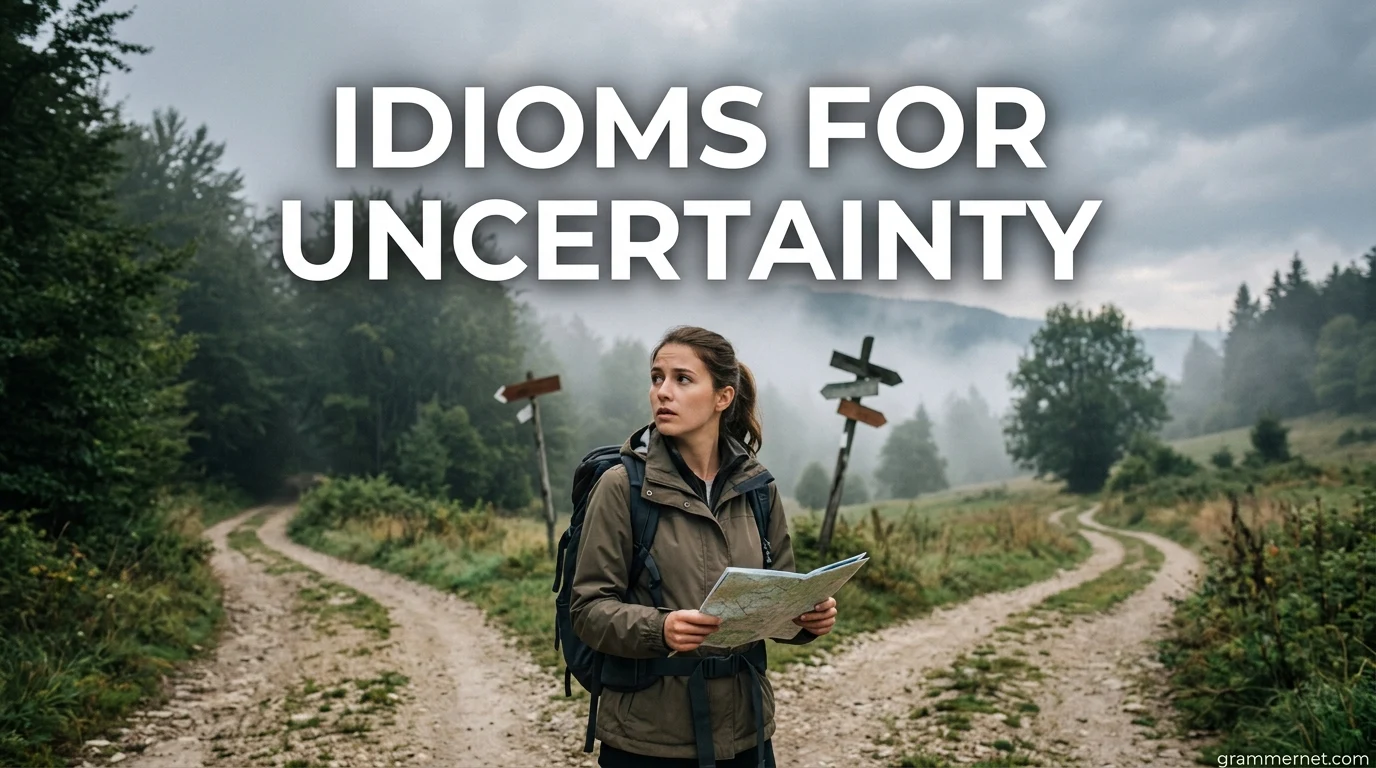
Uncertainty is part of everyday life. We feel it when plans change, when results are delayed, or when the future is unclear. Learning idioms for uncertainty helps English learners, students, and professionals express doubt, hesitation, and unpredictability in a more natural and fluent way.
These expressions are useful in conversations, essays, presentations, and real-world decision-making. They also help you understand native speakers better and respond with more confidence when things are not yet clear.
What Does “Uncertainty” Mean in Idiomatic English?
In simple English, uncertainty means not knowing what will happen, what something means, or what decision to make. Idioms make this idea more vivid and expressive.
For example:
- “I am not sure about the plan.”
- “I am in two minds about the plan.”
Both express hesitation, but the idiom sounds more natural and emotionally rich.
Idioms for uncertainty are especially useful because uncertainty appears in many forms:
- doubt
- hesitation
- confusion
- unpredictability
- lack of clarity
Why Learning Idioms for Uncertainty Matters
Learning idioms for uncertainty gives you several advantages.
First, it improves comprehension. Native speakers often use these expressions in daily speech, news, business, and storytelling.
Second, it improves expression. Instead of repeating “I am not sure,” you can choose a phrase that fits the exact situation.
Third, it helps with emotional accuracy. Uncertainty is not always the same as fear or confusion. Sometimes it means hesitation. Sometimes it means risk, Sometimes it means not having enough information.
That is why idioms for uncertainty are valuable for both spoken and written English.
Common Idioms for Uncertainty With Meanings and Examples
1. Up in the Air
Meaning: Not decided yet; uncertain.
Example: “Our travel plans are still up in the air.”
Alternative expressions:
- Not finalized
- Still undecided
- Unresolved
Typical use cases: Plans, projects, schedules, future events
Fun fact/origin: The phrase likely comes from something being tossed upward and not yet landing in a final place.
2. In Two Minds
Meaning: Unsure about what choice to make.
Example: “I am in two minds about accepting the new job.”
Alternative expressions:
- Torn between two choices
- Unsure
- Hesitant
Typical use cases: Career decisions, personal choices, buying decisions
Fun fact/origin: This idiom reflects the image of a person mentally split between two options.
3. At a Crossroads
Meaning: Facing an important decision or uncertain direction in life.
Example: “She is at a crossroads in her career.”
Alternative expressions:
- At a turning point
- Facing a major decision
- Unsure about the next step
Typical use cases: Life changes, education, career, relationships
Fun fact/origin: A crossroads is literally a place where roads meet, symbolizing a choice between directions.
4. Sit on the Fence
Meaning: To avoid choosing one side or decision.
Example: “He sat on the fence during the debate.”
Alternative expressions:
- Stay neutral
- Avoid commitment
- Delay a decision
Typical use cases: Politics, arguments, group decisions, debates
Fun fact/origin: The image is of someone sitting on a fence between two sides, not choosing either one.
5. Leave Things Open
Meaning: Not decide something yet so there is room for change.
Example: “We left the date open because the weather is uncertain.”
Alternative expressions:
- Keep options open
- Delay a final decision
- Remain flexible
Typical use cases: Scheduling, business planning, negotiations
6. A Gray Area
Meaning: A situation that is unclear or not easy to classify.
Example: “Whether this counts as plagiarism is a gray area.”
Alternative expressions:
- Unclear situation
- Ambiguous issue
- Not fully defined
Typical use cases: Rules, ethics, legal discussions, difficult judgments
Fun fact/origin: The word “gray” suggests a lack of black-and-white clarity.
7. Not Set in Stone
Meaning: Not final; still changeable.
Example: “The deadline is not set in stone.”
Alternative expressions:
- Flexible
- Subject to change
- Not fixed
Typical use cases: Plans, deadlines, rules, schedules
Fun fact/origin: The phrase suggests something carved in stone, which would be permanent.
8. Take It as It Comes
Meaning: To deal with uncertainty calmly, without worrying too much.
Example: “I do not know what will happen, so I will take it as it comes.”
Alternative expressions:
- Go with the flow
- Stay flexible
- Handle things as they happen
Typical use cases: Life changes, travel, stressful situations
9. Your Guess Is as Good as Mine
Meaning: You do not know the answer any more than the other person does.
Example: “Where did he go? Your guess is as good as mine.”
Alternative expressions:
- I have no idea
- I am just as unsure
- I cannot say
Typical use cases: Casual conversation, uncertain facts, missing information
Fun fact/origin: This phrase emphasizes equal uncertainty between two people.
10. Wait and See
Meaning: To remain uncertain until more information becomes available.
Example: “We will have to wait and see what the company decides.”
Alternative expressions:
- Be patient
- Hold off on judgment
- See what happens
Typical use cases: News, predictions, results, decisions
11. A Leap of Faith
Meaning: A decision made without complete certainty.
Example: “Starting her own business was a leap of faith.”
Alternative expressions:
- Risky decision
- Trust without proof
- Bold step
Typical use cases: Career moves, relationships, investments, personal growth
Fun fact/origin: The phrase suggests trusting something before having all the facts.
12. In Limbo
Meaning: In a state of uncertainty or waiting.
Example: “The application is still in limbo.”
Alternative expressions:
- On hold
- Undecided
- Suspended
Typical use cases: Applications, legal matters, job offers, delayed plans
Fun fact/origin: The word originally comes from religious and philosophical ideas about an in-between state.
Idioms for Uncertainty Grouped by Context
Grouping idioms by context helps you learn them faster and use them more naturally.
For Personal Decisions
- In two minds
- At a crossroads
- A leap of faith
These are useful when talking about careers, relationships, moving, studying, or major life changes.
For Plans and Schedules
- Up in the air
- Not set in stone
- Leave things open
- In limbo
These work well when plans are delayed, flexible, or unfinished.
For Opinions and Debate
- Sit on the fence
- A gray area
- Your guess is as good as mine
These are common in discussions, arguments, and unclear situations.
For Coping With Uncertainty
- Take it as it comes
- Wait and see
- Leave things open
These are especially helpful when you want to sound calm and adaptable.
Formal vs Informal Idioms for Uncertainty
Some idioms are better for casual conversation, while others fit formal writing or professional communication.
More formal or neutral
- Up in the air
- Not set in stone
- A gray area
- In limbo
- At a crossroads
More informal
- Your guess is as good as mine
- Sit on the fence
- Take it as it comes
- In two minds
For essays, reports, and presentations, the more neutral idioms are often the safest choice.
Tips for Using Idioms for Uncertainty Effectively
1. Match the idiom to the situation
Use “up in the air” for plans, “in two minds” for choices, and “gray area” for unclear rules or meanings.
2. Do not overuse idioms
A few well-placed idioms are better than many in one paragraph.
3. Learn the whole expression
Idioms have fixed wording. Changing them too much can make them sound unnatural.
4. Practice with real examples
Write sentences about your own life, school, work, or future plans.
5. Notice the tone
Some idioms sound calm and thoughtful, while others sound casual or conversational. Choose carefully.
Common Mistakes to Avoid
Mistake 1: Using idioms literally
“Up in the air” does not mean flying. It means undecided or uncertain.
Mistake 2: Choosing the wrong context
“Sit on the fence” works for opinions and decisions, not for a delayed project.
Mistake 3: Mixing formal and informal language
A business report may sound awkward if it includes too many casual idioms.
Mistake 4: Using an idiom without understanding its emotional tone
Some idioms suggest hesitation. Others suggest avoidance, confusion, or flexibility.
Mistake 5: Over-translating from your native language
Idioms rarely translate word for word. Learn the full English phrase instead.
Practice Section: Exercises
Easy Level: Fill in the blanks
- Our plans are still up in the ________.
- She is in two ________ about the offer.
- The deadline is not set in ________.
Answers:
- air
- minds
- stone
Medium Level: Match the idiom to the meaning
- A gray area
- Wait and see
- At a crossroads
A. Facing an important decision B. A situation that is unclear C. Be patient until more is known
Answers:
- B
- C
- A
Advanced Level: Rewrite the sentence using an idiom
- We have not decided the date yet.
- I do not know the answer either.
- She is uncertain about her future.
Sample answers:
- The date is still up in the air.
- Your guess is as good as mine.
- She is at a crossroads in her life.
Mini Quiz
1. Which idiom means “not final yet”?
a) Not set in stone b) In limbo c) Both a and b
2. Which idiom means “unsure between two choices”?
a) In two minds b) Up in the air c) A gray area
3. Which idiom means “something unclear or difficult to define”?
a) Sit on the fence b) A gray area c) Take it as it comes
Answers:
- c
- a
- b
Extra Value: Better Alternatives to “Uncertain”
Sometimes you need a more formal or precise word instead of an idiom.
- unclear
- undecided
- ambiguous
- flexible
- unresolved
- unpredictable
- tentative
These are useful in academic writing, workplace communication, and formal reports.
Visual and Infographic Ideas
This topic works especially well with visuals.
1. Decision tree infographic
Show how uncertainty leads to different idioms based on context.
2. Context map
Group idioms into personal, professional, and conversational categories.
3. Tone scale
Display idioms from neutral to casual to formal.
4. Before-and-after examples
Show a plain sentence and then the same sentence using an idiom.
Example:
- Plain: “We have not made a final decision.”
- Idiomatic: “The decision is still up in the air.”
These visuals are ideal for blogs, classroom materials, and social media posts.
FAQs
1. What are idioms for uncertainty?
They are expressions used to describe doubt, hesitation, unclear situations, or undecided outcomes.
2. Why should English learners study idioms for uncertainty?
They help you understand native English better and express hesitation or unpredictability more naturally.
3. Which idiom is most common for plans that are not finished?
“Up in the air” is one of the most common idioms for unfinished or uncertain plans.
4. Can I use these idioms in professional writing?
Yes, but choose neutral ones like “not set in stone,” “in limbo,” or “at a crossroads.”
5. What is the difference between “in two minds” and “sit on the fence”?
“In two minds” means you personally cannot decide. “Sit on the fence” means avoiding taking a side, often in an argument or debate.
6. How can I remember these idioms more easily?
Group them by context, write your own examples, and practice them in conversations or short journal entries.
Conclusion
Learning idioms for uncertainty gives you a stronger way to talk about doubt, hesitation, and unclear situations in English. These expressions help you sound more natural, understand native speakers better, and communicate more clearly when decisions are not yet final.
From up in the air to at a crossroads, each idiom captures a different kind of uncertainty. Some describe unfinished plans, some show personal hesitation, and others express unclear rules or outcomes. The more you practice, the easier it becomes to choose the right phrase for the right moment.
Keep reviewing the examples, complete the exercises, and try using these idioms in your own speaking and writing. Over time, you will feel more confident handling uncertainty in English and expressing it with precision and style.
