
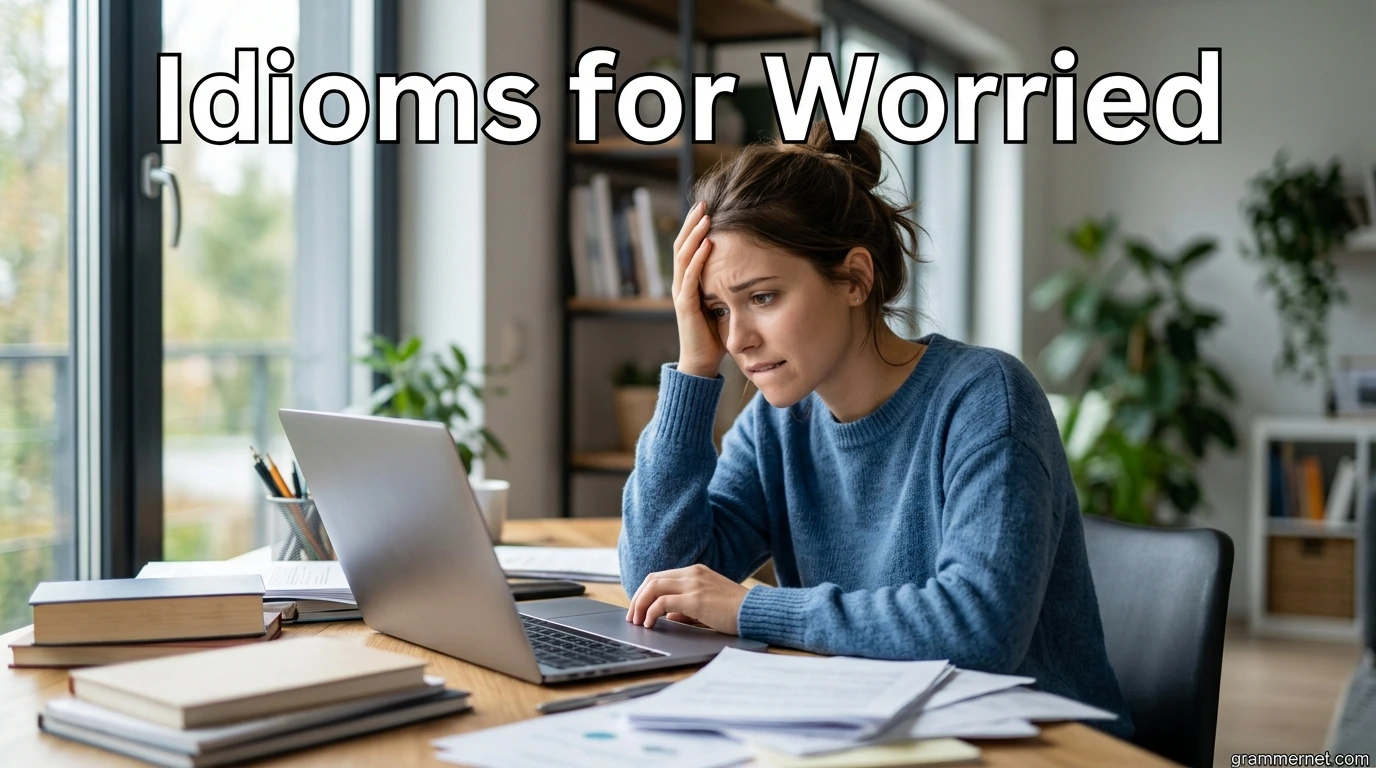
Feeling worried is part of being human. In school, at work, and in daily life, people often need language that expresses concern in a natural and meaningful way. That is why learning idioms for worried is so valuable for English learners, students, and professionals alike. These expressions help you describe emotions more clearly, sound more fluent, and understand native speakers in real conversations. They also give your writing and speaking more depth, especially when you want to talk about stress, fear, doubt, or uncertainty in a realistic way.
In this guide, you will learn the most useful worried idioms, their meanings, examples, alternative expressions, and common situations where they are used. You will also get practice exercises, a quiz, common mistakes to avoid, and ideas for using visuals or infographics to remember everything better.
What Does “Worried” Mean in Idiomatic English?
The word worried usually means feeling anxious, uneasy, or concerned about something that may happen. In idiomatic English, people often use creative phrases to describe this feeling instead of saying “I am worried” again and again.
For example:
- “I am worried about the exam.”
- “I have been losing sleep over the exam.”
- “I am on edge because of the exam.”
These idioms help you express different levels of concern. Some sound mild, while others show strong anxiety or stress. This is useful in essays, conversations, emails, interviews, and storytelling.
Why Learning Idioms for Worried Matters
Understanding idioms for worry is useful for three big reasons.
First, it improves comprehension. Native speakers often use idioms in everyday speech, and knowing them helps you understand the real meaning quickly.
Second, it improves expression. Instead of repeating “worried” all the time, you can use varied and natural language.
Third, it helps with emotional accuracy. Worry is not always the same as fear, panic, or stress. Idioms let you choose the right tone.
Common Idioms for Worried With Meanings and Examples
1. Lose Sleep Over Something
Meaning: To worry so much that it affects your sleep.
Example: “I lost sleep over the job interview for days.”
Alternative expressions:
- Stress about something
- Keep thinking about something
Typical use case: Used when worry feels strong and ongoing, especially about exams, money, health, or family issues.
Fun fact/origin: This phrase comes from the idea that anxiety keeps a person awake at night.
2. Be On Edge
Meaning: To feel nervous, tense, or easily irritated because of worry.
Example: “She has been on edge since the test results were announced.”
Alternative expressions:
- Feel tense
- Be nervous
Typical use case: Common in stressful situations such as deadlines, conflict, or waiting for important news.
3. Worry Sick
Meaning: To worry so much that it makes you feel emotionally or physically unwell.
Example: “He worried himself sick waiting for his daughter to come home.”
Alternative expressions:
- Be extremely anxious
- Be deeply concerned
Typical use case: Used in emotional, personal, or family-related situations.
4. A Nervous Wreck
Meaning: A person who is extremely worried, stressed, or emotionally unstable.
Example: “Before the presentation, I was a nervous wreck.”
Alternative expressions:
- Completely stressed out
- Extremely anxious
Typical use case: Used informally to describe someone under heavy pressure.
5. Beside Yourself With Worry
Meaning: To be extremely worried or emotionally overwhelmed.
Example: “Her parents were beside themselves with worry when she missed the last train.”
Alternative expressions:
- Extremely upset
- Deeply concerned
Typical use case: Common in serious or emotional situations.
Fun fact/origin: The phrase “beside yourself” suggests feeling so emotional that you are almost not in control of yourself.
6. Have a Heavy Heart
Meaning: To feel emotional pain, sadness, or worry.
Example: “She left for the hospital with a heavy heart.”
Alternative expressions:
- Feel sad and worried
- Be emotionally burdened
Typical use case: Often used in serious personal, emotional, or reflective writing.
7. Bite Your Nails
Meaning: To show worry or nervousness.
Example: “Fans were biting their nails during the final minutes of the match.”
Alternative expressions:
- Feel anxious
- Be tense
Typical use case: Used for anticipation, suspense, or stressful waiting.
Fun fact/origin: The image comes from a person literally biting their nails when nervous.
8. A Lump in Your Throat
Meaning: A tight feeling in your throat caused by emotion, worry, or sadness.
Example: “I had a lump in my throat when I heard the bad news.”
Alternative expressions:
- Feel emotionally overwhelmed
- Be close to tears
Typical use case: Used in emotional writing, especially when worry mixes with sadness.
9. Run Around Like a Chicken With Its Head Cut Off
Meaning: To behave in a confused, worried, and frantic way.
Example: “When the power went out, everyone ran around like a chicken with its head cut off.”
Alternative expressions:
- Panic
- Act frantically
Typical use case: Used informally when someone is stressed and disorganized.
Note: This idiom is very informal and may not suit academic writing.
10. Carry the Weight of the World on Your Shoulders
Meaning: To feel overwhelmed by responsibility, stress, or worry.
Example: “After his father became ill, he felt like he was carrying the weight of the world on his shoulders.”
Alternative expressions:
- Feel overwhelmed
- Bear too much responsibility
Typical use case: Used when describing serious life pressure.
Idioms for Worried Grouped by Context
Grouping idioms by situation makes them easier to remember.
Everyday Conversation
- On edge
- Lose sleep over something
- Bite your nails
These work well in casual speech when talking about exams, delays, money, or daily stress.
Emotional or Serious Situations
- Beside yourself with worry
- Worry sick
- Have a heavy heart
These are stronger and more suitable for family concerns, health problems, or emotional stories.
Work and Study Pressure
- Nervous wreck
- Carry the weight of the world on your shoulders
- Lose sleep over something
These are useful when discussing deadlines, career pressure, or academic stress.
Panic or Confusion
- Run around like a chicken with its head cut off
- Be on edge
These are common when people react badly to sudden problems.
Formal vs Informal Idioms for Worried
Not every idiom fits every situation. This is especially important for students and professionals.
More formal or semi-formal
- Be on edge
- Lose sleep over something
- Carry the weight of the world on your shoulders
- Have a heavy heart
More informal
- Nervous wreck
- Bite your nails
- Run around like a chicken with its head cut off
Best rule to remember
Use formal or neutral idioms in essays, workplace communication, and presentations. Save the more playful idioms for casual conversation.
Tips for Using Idioms for Worried Correctly
1. Match the tone
If you are writing an academic essay, do not use very casual idioms that sound too playful.
2. Do not overuse idioms
One or two idioms in a paragraph are enough. Too many can make writing sound unnatural.
3. Learn the full phrase
Idioms are fixed expressions. Changing them too much can make them incorrect.
Incorrect: “Lose sleep on it” Correct: “Lose sleep over it”
4. Understand the emotion behind the idiom
Some idioms show mild concern. Others show panic, sadness, or deep emotional stress. Choose carefully.
5. Practice in context
It is easier to remember idioms when you use them in your own sentences.
Common Mistakes to Avoid
Mistake 1: Using idioms literally
Idioms are not meant to be understood word-for-word.
Wrong idea: “I bit my nails, so I was worried.” Better: “I was biting my nails while waiting for the results.”
Mistake 2: Using the wrong level of formality
Some idioms are too informal for essays or job emails.
Mistake 3: Mixing idioms
Do not combine two idioms in a way that sounds unnatural.
Awkward: “I lost sleep and ran like a chicken with my head cut off.” This may be grammatically fine, but it sounds overdone.
Mistake 4: Using the idiom without context
An idiom works best when the situation clearly supports it.
Fun Facts and Origins of Worry Idioms
Some worry idioms come from physical reactions to stress. For example, “bite your nails” reflects a common nervous habit. “Lose sleep over something” connects worry with insomnia. “Be on edge” comes from the feeling of being emotionally sharp and tense, almost like standing on a dangerous edge.
These origins matter because they help learners remember meaning naturally. When you visualize the image behind an idiom, it becomes easier to recall during speaking or writing.
Examples in Real-Life Situations
School
- “I was on edge before the final exam.”
- “She lost sleep over her math test.”
Family life
- “Their parents were beside themselves with worry.”
- “He worried himself sick about his brother.”
The workplace
- “The manager looked like a nervous wreck before the launch.”
- “We all felt on edge before the presentation.”
Daily conversation
- “I have been biting my nails waiting for your reply.”
- “She is carrying the weight of the world on her shoulders.”
Practice Section: Idioms for Worried Exercises
Easy Level: Fill in the blanks
Complete the sentences using the correct idiom.
- I was __________ before the interview because I really wanted the job.
- She lost sleep __________ the exam results.
- His mother was __________ with worry when he did not call.
Answers:
- on edge
- over
- beside herself
Medium Level: Match the idiom to the meaning
- Lose sleep over something
- A nervous wreck
- Carry the weight of the world on your shoulders
A. Feel extremely stressed or worried B. Feel overwhelmed by responsibility C. Worry so much that it affects sleep
Answers:
- C
- A
- B
Advanced Level: Rewrite the sentence using an idiom
- She felt very anxious before the competition.
- He was extremely worried about his family’s health.
- Everyone was panicking and acting confused.
Sample answers:
- She was on edge before the competition.
- He was worrying himself sick about his family’s health.
- Everyone was running around like a chicken with its head cut off.
Mini Quiz: Test Your Understanding
Choose the best answer.
1. Which idiom means “to feel extremely nervous or stressed”?
a) Have a heavy heart b) Be on edge c) In the long run
2. Which idiom describes someone who is very worried and emotionally overwhelmed?
a) Beside yourself with worry b) Hit the nail on the head c) Break the ice
3. Which idiom is best for informal panic?
a) Carry the weight of the world on your shoulders b) Run around like a chicken with its head cut off c) Have a heavy heart
Answers:
- b
- a
- b
Extra Value: How to Remember These Idioms Faster
A simple memory strategy is to group idioms by feeling.
- Nervousness: on edge, bite your nails, nervous wreck
- Deep worry: worry sick, beside yourself with worry, lose sleep over something
- Overwhelm: carry the weight of the world on your shoulders, heavy heart
You can also make flashcards with:
- the idiom
- the meaning
- one example sentence
- one real-life situation
This makes review faster and more effective.
Visual and Infographic Ideas
To make this topic easier for learners, consider these visual formats:
1. Emotion wheel
Show “worried” in the center and connect related idioms around it.
2. Situation-based chart
Group idioms into school, work, family, and daily life.
3. Formal vs informal table
A visual comparison helps students choose the right idiom for the right setting.
4. Before-and-after examples
Show a plain sentence and then the same idea with an idiom.
Example:
- Plain: “I was very nervous before the test.”
- Idiomatic: “I was on edge before the test.”
These visuals are especially useful for social media posts, classroom handouts, blog images, and study guides.
When to Use Idioms for Worried in Writing and Speaking
Idioms work best when they fit the audience.
Use them in:
- storytelling
- everyday conversations
- presentations with a conversational tone
- essays that allow expressive language
- emails or messages where a natural tone is welcome
Use them carefully in:
- research papers
- legal writing
- technical documents
- highly formal business reports
The goal is not to sound decorative. The goal is to sound clear, natural, and appropriate.
Conclusion: Mastering Idioms for Worried
Learning idioms for worried gives you more than just vocabulary. It helps you express stress, anxiety, concern, and emotional pressure in a way that sounds natural and meaningful. It also improves your reading comprehension, speaking confidence, and writing quality.
From be on edge to lose sleep over something, these expressions let you describe worry with accuracy and variety. The more you practice, the easier it becomes to use them naturally in essays, conversations, and professional communication.
Start with a few idioms, write your own examples, and review them in real-life contexts. With regular practice, you will not only understand worry-related idioms better—you will also sound more fluent and confident every time you use them.
FAQs
1. What are idioms for worried?
Idioms for worried are expressions used to describe feelings of anxiety, stress, or concern in a more natural and creative way than simply saying “worried.”
2. Why should I learn idioms for worried?
Learning these idioms helps you:
- Speak more like a native English speaker
- Add variety to your writing and speaking
- Express emotions more accurately
- Improve your performance in exams and communication
3. Are idioms for worried suitable for academic essays?
Yes, but you should choose neutral or semi-formal idioms like “be on edge” or “lose sleep over something.” Avoid very informal idioms in formal writing.
4. What is the difference between “be on edge” and “a nervous wreck”?
- Be on edge: Mild to moderate nervousness
- A nervous wreck: Extreme anxiety or stress
5. Can I use idioms in professional communication?
Yes, but carefully. Use clear and widely understood idioms in emails, presentations, or meetings. Avoid slang or overly informal expressions.
6. Is it okay to use many idioms in one paragraph?
No. Overusing idioms can make your writing confusing or unnatural. It’s best to use 1–2 idioms per paragraph.
7. Do idioms have literal meanings?
No. Idioms usually have figurative meanings that are different from the actual words.
