
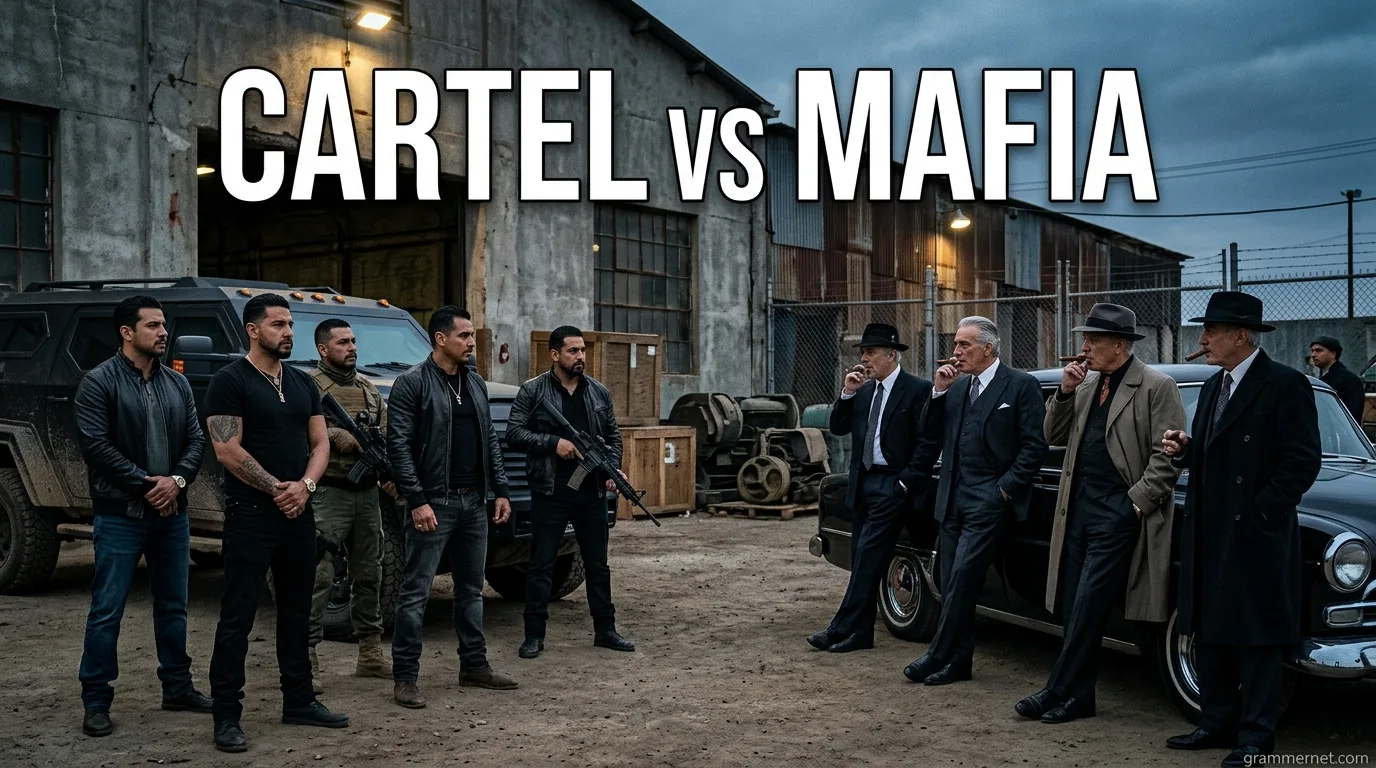
Many English learners assume that cartel and mafia mean exactly the same thing. After all, both words often appear in news reports, movies, books, and everyday conversations involving organized crime. However, while the two terms are related in some contexts, they are not interchangeable. Using the wrong word can change the meaning of a sentence and create confusion in academic writing, examinations, professional communication, or general discussions.
Part of the confusion comes from popular culture. Films and television frequently use these terms loosely, leading people to believe they refer to any criminal organization. In reality, each word has its own history, definition, and usage patterns. Additionally, cartel has a legitimate business meaning that many learners overlook.
Understanding the distinction between cartel vs mafia helps improve vocabulary accuracy, strengthens writing skills, and enables you to communicate more precisely. This guide explains the meanings, grammar rules, pronunciation, sentence examples, common mistakes, and practical tips you need to confidently choose the correct term.
What Do “Cartel” and “Mafia” Mean?
The first step is understanding the definitions of both words.
What Is a Cartel?
A cartel is an alliance or association of independent organizations that cooperate to control prices, production, or markets. In economics, the term is often used legally to describe businesses working together, although such arrangements may violate competition laws in some countries.
The word is also commonly used in media reports to describe powerful criminal groups involved in illegal trade, particularly drug trafficking.
Examples:
- Several companies formed a cartel to influence market prices.
- Authorities arrested members of a drug cartel.
- The documentary examined the history of international cartels.
What Is a Mafia?
A mafia refers to a highly organized criminal group, traditionally associated with secret societies originating in Italy, especially Sicily. Over time, the word expanded to describe similar organized crime groups elsewhere.
Examples:
- The novel explored the rise of the Sicilian mafia.
- The mafia controlled illegal gambling operations.
- Investigators uncovered mafia connections.
Basic Comparison Table
| Term | Primary Meaning | Typical Context |
| Cartel | Alliance controlling markets or trade | Economics, business, organized crime |
| Mafia | Organized criminal society | Crime, history, popular culture |
Although both words may relate to criminal activity, their meanings are not identical.
Cartel vs Mafia: The Main Differences
People often use these terms interchangeably, but important distinctions exist.
Structure
A cartel is generally an alliance of separate entities working together toward shared goals.
A mafia is usually a single organized group with a hierarchical structure.
Purpose
Cartels often focus on controlling markets, prices, or distribution.
Mafia organizations engage in a broader range of criminal activities, including extortion, illegal gambling, racketeering, and influence over communities.
Origins
The term cartel originated from agreements between independent groups.
The word mafia has historical roots in Sicily and Italian organized crime.
Side-by-Side Comparison Table
| Feature | Cartel | Mafia |
| Basic Definition | Cooperative alliance | Organized criminal group |
| Structure | Multiple organizations working together | Single hierarchical organization |
| Origin | Economic agreements | Sicilian organized crime |
| Common Activities | Market control, trafficking | Extortion, racketeering, illegal operations |
| Legitimate Use | Yes | Rarely |
| Criminal Association | Often | Almost always |
Understanding these differences prevents inaccurate usage.
Correct Usage in English
Choosing the right word depends on context.
When to Use “Cartel”
Use cartel when discussing:
- Economic alliances
- Price-fixing agreements
- Production control
- Certain organized trafficking networks
Examples:
- Economists studied the effects of the oil cartel.
- The investigation targeted a drug cartel.
- The companies were accused of forming a cartel.
When to Use “Mafia”
Use mafia when referring to:
- Traditional organized crime groups
- Criminal syndicates
- Groups modeled after Sicilian organizations
Examples:
- The mafia influenced local politics.
- The film portrayed mafia families.
- Authorities dismantled a mafia operation.
Correct Usage Table
| Situation | Correct Term |
| Companies controlling prices | Cartel |
| Sicilian organized crime | Mafia |
| Drug trafficking organization | Usually cartel |
| Criminal family syndicate | Mafia |
| Market agreements | Cartel |
Context determines accuracy.
Grammar Rules and Word Forms
Although these are nouns, learners sometimes struggle with their grammatical forms.
Cartel
Singular:
- cartel
Plural:
- cartels
Examples:
- One cartel dominated the market.
- Several cartels competed for influence.
Mafia
Singular:
- mafia
Plural:
- mafias
Examples:
- The mafia expanded its operations.
- Different mafias emerged across regions.
Grammar Forms Table
| Word | Singular | Plural |
| Cartel | cartel | cartels |
| Mafia | mafia | mafias |
Sentence Functions
Both words commonly function as nouns.
Examples:
Subject:
- The cartel controlled distribution.
- The mafia influenced businesses.
Object:
- Investigators exposed the cartel.
- The government targeted the mafia.
Understanding these forms supports grammatical accuracy.
Pronunciation and Spelling
Correct pronunciation improves confidence in speaking.
Cartel Pronunciation
Common pronunciation:
/kɑːrˈtel/
Sounds like:
kar-TEL
Examples:
- cartel leader
- economic cartel
Mafia Pronunciation
Common pronunciation:
/ˈmɑː.fi.ə/
Sounds like:
MAH-fee-uh
Examples:
- mafia boss
- mafia organization
Pronunciation Comparison Table
| Word | Pronunciation | Sound Guide |
| Cartel | /kɑːrˈtel/ | kar-TEL |
| Mafia | /ˈmɑː.fi.ə/ | MAH-fee-uh |
Spelling Notes
Both spellings remain consistent across major English varieties.
There are no common British versus American spelling differences.
British vs American English Usage
Unlike many vocabulary questions, British and American English generally agree on these terms.
Shared Meanings
Both varieties use:
- cartel
- mafia
with essentially the same meanings.
Slight Differences in Frequency
American media frequently uses cartel when discussing drug trafficking organizations.
British publications may emphasize the geographical origin or structure of criminal groups.
However, the definitions remain consistent.
Regional Usage Table
| Variety | Cartel Usage | Mafia Usage |
| American English | Common in crime reporting | Common |
| British English | Common | Common |
| Academic Writing | Standard | Standard |
Learners can safely apply the same definitions in both varieties.
Sentence Examples: Correct and Incorrect Usage
Examples help reinforce understanding.
Correct Examples
- The companies formed a cartel to influence prices.
- Police investigated the drug cartel.
- Historians studied the Sicilian mafia.
- The mafia controlled illegal operations.
Incorrect Examples
Incorrect:
- The mafia agreed to regulate oil production.
Better:
- The cartel agreed to regulate oil production.
Incorrect:
- The drug mafia fixed airline ticket prices.
Better:
- The cartel fixed airline ticket prices.
Correct vs Incorrect Table
| Incorrect | Correct |
| The mafia controlled global oil prices. | The cartel controlled global oil prices. |
| The cartel operated as a Sicilian crime family. | The mafia operated as a Sicilian crime family. |
| Several mafia groups fixed production quotas. | Several cartels fixed production quotas. |
| Investigators exposed the mafia’s extortion network. | Correct |
Choosing the more precise word improves clarity.
Common Mistakes and How to Avoid Them
Certain errors occur repeatedly.
Mistake 1: Treating Them as Synonyms
Incorrect assumption:
- Cartel and mafia always mean the same thing.
Reality:
They overlap in some criminal contexts but have different meanings.
Mistake 2: Ignoring Legitimate Uses of Cartel
Many learners believe cartel always refers to crime.
However, economic discussions frequently use the term.
Example:
- Analysts studied the effects of the cartel on prices.
Mistake 3: Using Mafia for Every Organized Group
Not every organized criminal group is a mafia.
The term carries historical and structural associations.
Mistake 4: Forgetting Plural Forms
Incorrect:
- Two mafia was investigated.
Correct:
- Two mafias were investigated.
Common Errors Table
| Mistake | Incorrect | Correct |
| Treating terms as identical | The mafia fixed market quotas. | The cartel fixed market quotas. |
| Ignoring economic meaning | Cartel always means criminals. | Cartel can refer to market alliances. |
| Plural error | Two mafia were arrested. | Two mafias were investigated. |
| Overgeneralization | Every gang is a mafia. | Use the most accurate term. |
Precision strengthens communication.
FAQs
Are cartel and mafia the same thing?
No.
Although both can relate to organized crime, their meanings differ.
What is the main difference?
A cartel is generally an alliance controlling markets or trade.
A mafia is an organized criminal society.
Can cartel have a legal meaning?
Yes.
The word often appears in economics to describe coordinated market behavior.
Is mafia always criminal?
Almost always in English usage.
It usually refers to organized crime.
Which term is more common in drug trafficking discussions?
Cartel is frequently used.
Are there spelling differences in British and American English?
No.
Both varieties use the same spellings.
Which word should I use in academic writing?
Choose the term that most accurately matches the context.
Precision is more important than familiarity.
Conclusion
Understanding the distinction between cartel vs mafia helps you communicate more accurately and confidently. While popular culture sometimes blurs the line between these terms, they are not true synonyms.
A cartel typically refers to an alliance of independent groups that cooperate to control markets, production, or distribution. Although the term often appears in discussions of drug trafficking organizations, it also has legitimate economic uses.
A mafia, on the other hand, usually refers to a structured organized crime group with historical roots in Sicily and strong associations with criminal syndicates.
The easiest way to remember the difference is this:
- Cartel = cooperation and control
- Mafia = organized criminal society
By understanding their meanings, grammar forms, pronunciation, and usage patterns, you’ll avoid common mistakes and choose the correct term in exams, professional writing, academic work, and everyday communication. Accurate vocabulary not only improves your English but also helps you express complex ideas with clarity and confidence.
