
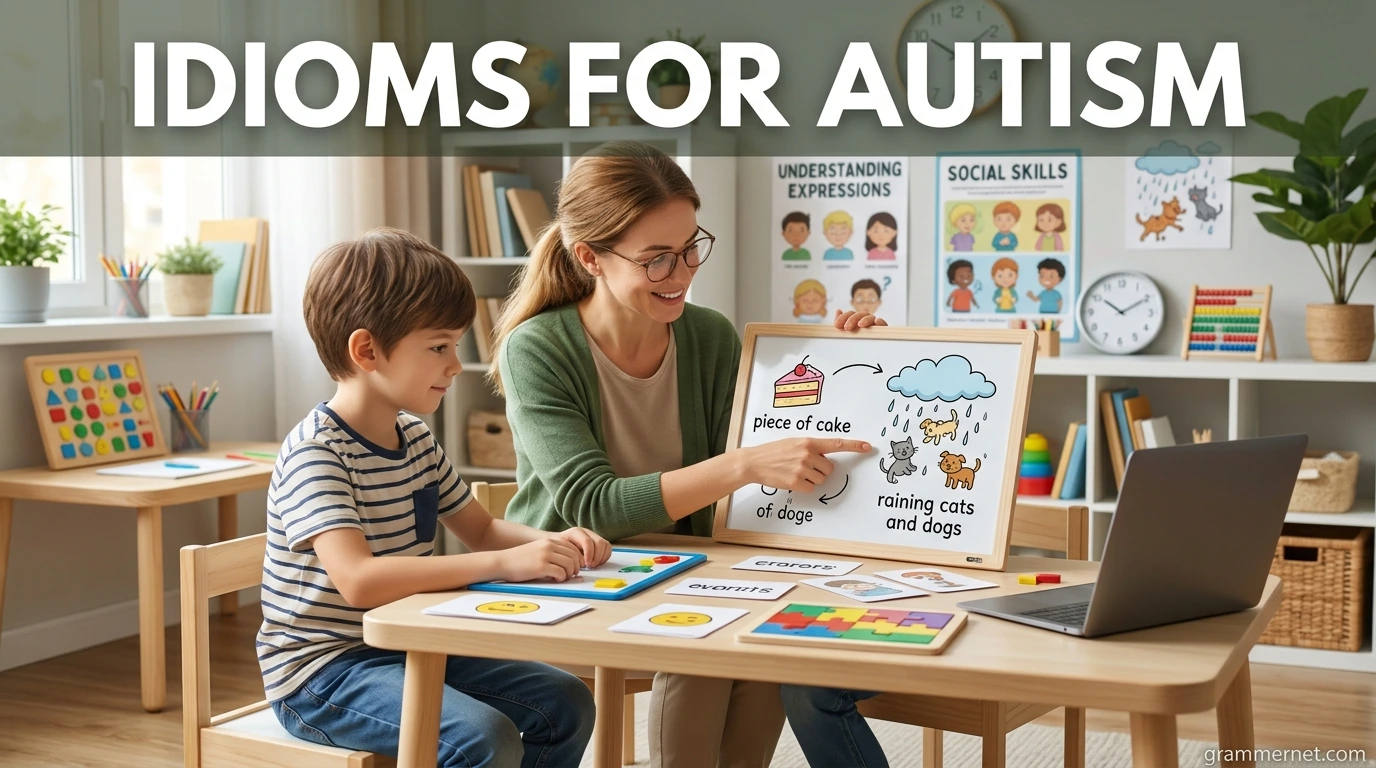
Understanding communication differences is essential for building inclusive, respectful, and supportive environments. When we talk about “idioms for autism,” we are not describing idioms that define autism, but rather English expressions that often cause confusion for autistic individuals—and strategies to communicate more clearly and compassionately. This topic is important for educators, students, professionals, caregivers, and English learners who want to use language in a more inclusive way.
Learning how idioms work—and when they may be confusing—helps improve real-life communication, reduces misunderstandings, and builds emotional comfort in conversations. It also supports neurodiversity awareness, encouraging people to use clearer language when needed. In this guide, you’ll explore common idioms, their meanings, why they can be confusing, and how to adapt communication for clarity.
Why this topic matters
Autism is not a “one-size-fits-all” experience. People on the autism spectrum communicate, think, and process information in different ways. That is why idioms can be helpful in one situation and frustrating in another.
For English learners, idioms are important because native speakers use them constantly. For autistic readers, family members, educators, and professionals, idioms are important because they can shape how clearly and respectfully you communicate.
This topic matters because it helps you:
- understand figurative English in real conversations
- communicate more clearly with autistic people
- avoid language that sounds rude, vague, or stereotyping
- choose simpler alternatives when clarity is more important than style
- build more inclusive and supportive communication habits
What “idioms for autism” usually means
The phrase “idioms for autism” is not a fixed grammar category. People usually mean one of two things:
- idioms that often come up in conversations about autism, learning, or communication
- expressions that can be confusing for autistic people or should be used carefully around autistic audiences
That is why this guide focuses on both understanding and respectful use.
Important note on respectful language
Some idioms may describe behavior in a way that sounds harmless to one person but dismissive to another. For example, saying someone is “in their own world” may be meant casually, but it can sound like you are ignoring their perspective or making assumptions about them.
A good rule is simple: use idioms to explain ideas, not to label people.
What Are Idioms and Why They Can Be Challenging
Idioms are phrases whose meanings are not literal. For example, “break the ice” does not mean breaking actual ice—it means starting a conversation.
Why idioms can be difficult for some people:
- The meaning is not direct or logical
- Words don’t match the actual message
- They require social context or cultural knowledge
- They can be interpreted literally
For some autistic individuals—especially those who prefer direct communication—idioms may create confusion in fast conversations.
Common idioms and expressions relevant to autism discussions
1. March to the beat of a different drum
Meaning: To think or behave in a unique, independent, or unconventional way.
Example: He marches to the beat of a different drum, and that is part of what makes his ideas interesting.
Alternative expressions: think differently, be independent, have a unique style
Typical use case: Used when describing someone who does not follow social norms in the usual way.
Fun fact / origin: This idiom comes from the idea of a drumbeat guiding movement. If someone follows a different beat, they move differently from the crowd.
Careful use note: This can be positive, but avoid using it as a label for someone’s diagnosis.
2. Think outside the box
Meaning: To solve problems in a creative or unusual way.
Example: The team had to think outside the box to make the lesson more accessible.
Alternative expressions: be creative, find a new approach, solve differently
Typical use case: Used in education, business, and problem-solving.
Why it matters here: Many autistic people are known for creative, original thinking, but this idiom should be used to describe ideas, not people in a stereotypical way.
3. In their own world
Meaning: Focused on their own thoughts or interests, sometimes appearing unaware of others.
Example: He can seem to be in his own world when he is reading about trains.
Alternative expressions: deeply focused, absorbed, highly concentrated
Typical use case: Often used in casual speech.
Important caution: This phrase can sound dismissive or inaccurate if used carelessly. It is better to say “very focused” or “deep in concentration.”
4. A creature of habit
Meaning: Someone who likes routine and repeated patterns.
Example: She is a creature of habit and feels calmer when her schedule stays the same.
Alternative expressions: likes routine, prefers consistency, enjoys predictability
Typical use case: Useful in discussions about daily routines, work habits, or comfort zones.
Why it matters here: Routine and predictability can be especially important in autism-friendly communication.
5. Need things spelled out
Meaning: To need clear, direct explanation.
Example: Please spell out the steps for me so I do not miss anything.
Alternative expressions: be direct, explain clearly, give detailed instructions
Typical use case: Common in classrooms, workplaces, and support settings.
Why it matters here: Clear language is often more helpful than hints, sarcasm, or vague instructions.
6. Read between the lines
Meaning: Understand hidden meaning or implied messages.
Example: It can be hard to read between the lines when people are not direct.
Alternative expressions: infer meaning, understand indirectly, interpret hints
Typical use case: Used in conversation, literature, and social situations.
Important note: Not everyone finds indirect communication easy. In autism-friendly communication, it is often better to say things directly.
7. A lot on their plate
Meaning: Having many responsibilities or too much to handle.
Example: She has a lot on her plate right now, so keep instructions simple.
Alternative expressions: very busy, overwhelmed, under pressure
Typical use case: Used for work, school, or family responsibilities.
Why it matters here: Autistic people can also feel overwhelmed by sensory or social demands, so this idiom may be useful in support conversations.
8. Walk on eggshells
Meaning: Be extremely careful not to upset someone or cause a problem.
Example: The team felt like they had to walk on eggshells during the meeting.
Alternative expressions: be very careful, act cautiously, avoid tension
Typical use case: Used when communication feels tense or sensitive.
Important caution: This idiom can sound negative if used to describe autistic people. It is better to talk about unclear expectations, sensory stress, or communication barriers.
9. The elephant in the room
Meaning: An obvious issue that everyone avoids discussing.
Example: The elephant in the room was the lack of clear support.
Alternative expressions: obvious problem, unspoken issue, clear concern
Typical use case: Used in meetings, family talks, or group discussions.
Why it matters here: Sometimes the biggest issue is not the person, but the lack of clarity or accommodation.
10. Keep it simple
Meaning: Use clear, direct, easy-to-follow language.
Example: When giving instructions, keep it simple and step by step.
Alternative expressions: be clear, use plain language, explain directly
Typical use case: Useful in education, workplace training, healthcare, and everyday communication.
Why it matters here: This is one of the most useful communication habits for autism-friendly language.
Idioms and expressions by context
In classrooms
Useful expressions include:
- think outside the box
- keep it simple
- need things spelled out
- a lot on their plate
These help teachers and students talk about learning styles, assignments, and support needs.
In workplaces
Useful expressions include:
- a lot on their plate
- read between the lines
- think outside the box
- keep it simple
These are common in teamwork, training, and feedback.
In family conversations
Useful expressions include:
- creature of habit
- in their own world
- walk on eggshells
- need things spelled out
These can describe routine, focus, and communication style, but they should be used carefully and kindly.
In healthcare or support settings
Useful expressions include:
- keep it simple
- a lot on their plate
- need things spelled out
- elephant in the room
Direct language is usually the most helpful here.
Why Clear Communication Matters in Autism-Inclusive Spaces
Clear communication helps reduce misunderstanding and anxiety. In classrooms, workplaces, and social environments, using direct language can improve inclusion.
Benefits of clear language:
- Reduces confusion
- Improves learning speed
- Builds trust in communication
- Supports emotional safety
- Helps non-native English learners too
Idioms vs Clear Language: A Helpful Comparison
| Idiomatic Expression | Clear Alternative |
|---|---|
| Break the ice | Start talking |
| Hit the books | Study |
| Hold your horses | Wait |
| Piece of cake | Easy task |
| Spill the beans | Reveal secret |
Clear language is especially helpful in instructions, education, and professional settings.
Better alternatives to vague or confusing idioms
If your goal is clarity, these alternatives often work better:
- instead of “in their own world” → “very focused” or “deep in concentration”
- instead of “read between the lines” → “Here is the direct meaning”
- instead of “walk on eggshells” → “We need clearer communication”
- instead of “a creature of habit” → “prefers routine”
These alternatives are more autism-friendly because they are direct and specific.
Tips for effective use
Use idioms to explain ideas, not to judge people
This keeps your language respectful and accurate.
Match the setting
Casual idioms may work with friends, but direct language is often better in school, work, or healthcare.
Prefer clarity over cleverness
If a sentence can be misunderstood, say it more simply.
Watch tone carefully
The same idiom can sound kind, neutral, or rude depending on how you say it.
Learn the listener’s needs
Some people enjoy idioms. Others prefer plain language. When in doubt, choose clarity.
Common mistakes to avoid
Assuming everyone understands idioms
Not every English speaker interprets figurative language the same way.
Using stereotypes
Avoid phrases that reduce autistic people to one trait or behavior.
Confusing diagnosis with personality
A person’s communication style is not the same as their identity.
Using idioms as labels
Say “needs direct instructions,” not “is impossible to read.”
Ignoring context
An idiom that is fine in a casual chat may be too vague in a classroom or workplace.
Fun facts and origins
Many idioms in English come from everyday life, such as music, animals, boxing, sailing, or farming.
- “march to the beat of a different drum” comes from music imagery
- “think outside the box” became popular in business and creativity discussions
- “walk on eggshells” uses a fragile image to describe caution
- “a lot on their plate” comes from the idea of having too much food, and by extension too many responsibilities
These images are memorable, which is why idioms stay popular.
Interactive exercise 1: Match the idiom to the meaning
Easy
- think outside the box
- a creature of habit
- need things spelled out
- a lot on their plate
A. prefers routine B. requires clear explanation C. very busy D. creative thinking
Answers: 1-D, 2-A, 3-B, 4-C
Interactive exercise 2: Fill in the blanks
Medium
- The teacher decided to ________ and give step-by-step instructions.
- She has ________ right now, so be patient.
- He likes schedules and is a real ________.
- The team had to ________ to solve the problem.
Answers:
- keep it simple
- a lot on her plate
- creature of habit
- think outside the box
Interactive exercise 3: Choose the best wording
Advanced
Which sentence is most respectful and clear?
A. He is in his own world again. B. He needs things spelled out. C. He is weird and confusing. D. He cannot function without hints.
Answer: B. He needs things spelled out.
Mini quiz
Easy
Which idiom means “be creative”?
A. think outside the box B. a lot on your plate C. walk on eggshells
Answer: A
Medium
Which phrase is best for autism-friendly communication?
A. read between the lines B. keep it simple C. in their own world
Answer: B
Advanced
Why should some idioms be used carefully in autism-related conversations?
Suggested answer: Because they can sound vague, misleading, or disrespectful, and direct language is often clearer and kinder.
Tips for Teaching or Explaining Idioms Clearly
- Use simple definitions first
- Give real-life examples
- Avoid multiple idioms in one sentence
- Use repetition for learning
- Pair idioms with visuals or gestures
Visual Ideas for Better Understanding
To make learning more accessible, consider:
- Side-by-side “idiom vs meaning” charts
- Emoji-based explanation cards
- Story illustrations showing literal vs real meaning
- Flashcards with examples
- Simple infographic posters for classrooms
Why This Topic Matters Beyond Language Learning
Understanding idioms and communication differences supports:
- Inclusive education
- Better workplace communication
- Stronger social relationships
- Reduced misunderstandings in daily life
It also benefits English learners globally, not only autistic individuals, because idioms are culturally loaded expressions.
Suggested visuals and infographics
A helpful article on this topic could include:
- a “clear vs figurative language” comparison chart
- a routine-and-support visual for autism-friendly communication
- a tone map showing respectful, neutral, and risky expressions
- example cards with an idiom on one side and a plain-language alternative on the other
- icons for each context, such as school, work, home, or healthcare
These visuals make the language easier to remember and easier to use correctly.
FAQs
Q1: What does “idioms for autism” mean?
It usually refers to idioms used in conversations about autism or expressions that may be confusing or useful in autism-related communication.
Q2: Are idioms hard for autistic people?
Some idioms can be confusing because their meanings are not literal. Clear, direct language is often easier to understand.
Q3: Should I avoid idioms around autistic people?
Not always. The best choice depends on the person and the situation. If clarity is important, plain language is safer.
Q4: Which idioms are most useful in autism-friendly communication?
“Keep it simple,” “need things spelled out,” and “a lot on their plate” are often useful because they encourage clarity.
Q5: Which idioms should I be careful with?
Phrases like “in their own world” or “walk on eggshells” can sound dismissive or negative if used carelessly.
Q6: How can I communicate more respectfully?
Use direct, specific language, avoid stereotypes, and focus on clarity instead of hidden meanings.
Conclusion
Idioms are a rich part of the English language, but they can also create barriers when communication is not clear. In autism-inclusive communication, the goal is not to eliminate idioms completely but to balance them with clarity, context, and understanding.
By learning both idioms and their plain-language meanings, educators, professionals, and learners can build stronger communication skills. This approach supports inclusion, reduces misunderstanding, and makes English more accessible to everyone.
Clear communication is not about simplifying ideas—it’s about making sure every person has equal access to understanding them.
